


Enphase Energy has released a new technical white paper detailing its latest custom silicon platform, the “Enphase Kestrel ASIC,” a purpose-built chip designed to advance intelligent power conversion across its product ecosystem.
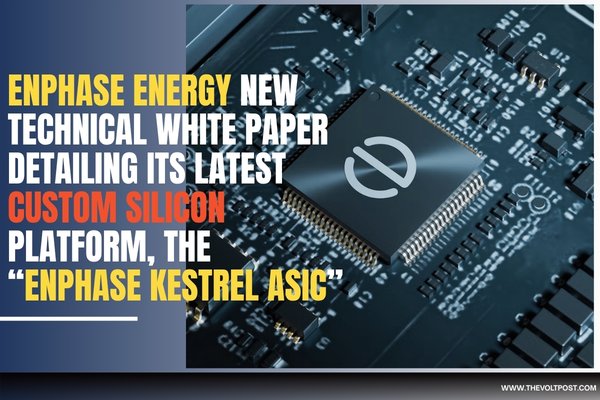
Kestrel marks the company’s fifth generation of internally developed ASICs and extends Enphase’s silicon strategy across its microinverters, next-generation IQ® Battery systems, IQ® Bidirectional EV Charger, and the IQ® Solid-State Transformer (IQ SST).
Built on a 22 nm CMOS process, the chip consolidates key power conversion functions, including control, sensing, communication, protection, and security into a single silicon platform, reducing system complexity while maintaining performance and reliability for grid-connected applications.
At its core, Kestrel integrates high-speed deterministic control hardware, four 100 Msps ADCs, and custom communication interfaces such as power line communication and LVDS controllers. It also incorporates hardware-enforced isolation, secure boot, and advanced cryptographic features, enabling a tightly integrated and secure architecture.
A key focus of the design is enabling high-frequency operation with gallium nitride (GaN) bi-directional switches. Enphase’s single-stage, dual-active-bridge, series-resonant cycloconverter topology requires extremely fast and precise control-down to nanosecond-scale timing.
Kestrel addresses this by moving control loops from firmware into dedicated hardware, allowing closed-loop bandwidths exceeding 100 kHz while maintaining soft switching and minimizing losses.
The chip also plays a central role in Enphase’s IQ SST power module, where a tandem control architecture is used across a medium-voltage isolation boundary. Two Kestrel ASICs, one on the low-voltage side and another on the medium-voltage side, communicate via fiber-optic links using custom LVDS controllers.
This setup enables real-time exchange of measurements, control signals, and protection commands, while eliminating the need for external processors or flash memory on the medium-voltage side.
Enphase links this architecture to emerging power challenges in AI data centers, where GPU workloads can fluctuate rapidly. Kestrel’s hardware-driven control and SST-based design enable sub-millisecond transient response and native three-phase operation, supporting fast and efficient conversion between medium-voltage AC and low-voltage DC. The company says this responsiveness could remove the need for localized energy buffering, such as supercapacitors or batteries, near compute racks.
The white paper also outlines Kestrel’s built-in security and functional safety features. These include processor islands, hardware acceleration for AES and SHA, secure boot rooted in ROM, true random number generation, and certificate-based public key infrastructure. Additional safeguards such as error correction, memory scrubbing, watchdog timers, and centralized fault handling are designed to enhance system reliability and lifecycle management.
 Leadership Comments
“Kestrel is an important milestone because it turns the company’s custom silicon into a reusable platform for multiple product families,” said Raghu Belur, co-founder and chief product officer of Enphase Energy. “The white paper shows how one ASIC can help us carry proven power conversion intelligence across microinverters, batteries, bidirectional EV charging, and solid-state transformer modules while supporting the reliability, security, and cost structure required for products deployed at grid scale.”
“Kestrel was designed because the control problem cannot be solved well enough with a commodity microcontroller,” said Hans van Antwerpen, chief technology officer of Enphase Energy. “The ASIC integrates the high-speed ADCs, deterministic power-control hardware, protection units, security engines, and tandem fiber-link functions needed to control GaN-based resonant converters safely, securely, and at very high frequency. That is what allows the same silicon foundation to support microinverters and also scale into solid-state transformer applications for dynamic data center loads.”
To Read The Whitepaper, CLICK HERE