



Automotive electronics have come a long way in the last decade, but anyone who has actually built or debugged in-vehicle hardware knows it can still be a grind. Fragile dev boards, spaghetti wiring, endless CAN bus gremlins – it often feels like you’re doing emergency hardware triage instead of real engineering. ARDEP exists precisely to take that pain out of the process.
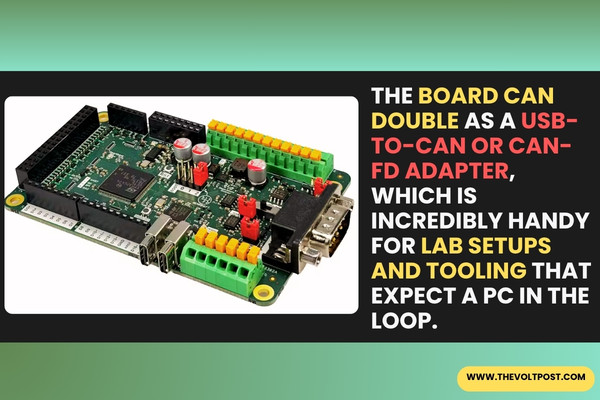
ARDEP, short for Automotive Rapid Development Platform, gives developers a proper, robust playground for in-car electronics instead of forcing general-purpose boards into environments they were never designed for.
The idea came from a very real problem. Mercedes-Benz engineers were leaning on Arduino-class hardware for early vehicle R&D and kept frying boards because they simply weren’t built for noisy automotive power rails or long-term deployment inside a car.
Rather than keep hacking around those limitations, Mercedes-Benz teamed up with Frickly Systems to create something that feels as approachable as a maker board but behaves like true automotive-grade hardware. You still get fast iteration and open tooling, but wrapped in a stack that’s built from the ground up for vehicles.
Under the hood, ARDEP runs Zephyr RTOS, which immediately tells you it’s aimed at serious embedded work, not quick scripts that fall apart under load. Zephyr brings modularity, clean abstractions, CI integration and a clear path from prototype firmware to something you’d actually trust in the field.
On top of that, ARDEP bakes in the interfaces automotive developers need every day. CAN and LIN support come out of the box, including CAN-FD for higher bandwidth use cases. No more stacking fragile shields just to get on the vehicle network.
There’s also a comprehensive UDS framework over CAN, with layered abstractions and support for most UDS services, firmware updates included. That means you can bury a board deep in the car and still flash, debug and manage it remotely over the bus.
On the hardware side, ARDEP is built to live in a vehicle, not just on a lab bench. It’s designed to tolerate “dirty” voltages and the kind of electrical noise that’s standard in real cars.
Connectors, protection circuitry and power handling are all tuned for in-vehicle use, so you can mount the board in a chassis or behind interior panels without treating it like a delicate prototype that might die if someone slams a door.
Abriding R&D and Production Hardware
Philosophically, ARDEP is about narrowing the gap between R&D setups and something that looks and feels closer to production hardware. In a typical workflow, teams prototype on consumer dev kits, then throw away a lot of that work when they migrate to more serious platforms.
With ARDEP, you start on a board that’s already aligned with automotive expectations, so more of your software, interfaces and integration logic can carry forward as the project matures.
Mercedes-Benz is already using ARDEP on projects like FlexCar, an open development platform where contributors can bolt on new modules and features.
Because ARDEP is open source and open hardware, other teams can inspect the KiCad design files, reuse production-ready layouts and adapt the platform to their own needs instead of starting from pixelated PDF schematics.
For developers, that openness is a big deal. You’re not stuck with a closed, proprietary dev kit where you have to guess what’s happening on the board. You can trace signal paths, understand protection strategies, and line up your firmware design with how the hardware actually behaves.
For hobbyists and small teams building custom EVs, aftermarket controllers or experimental platforms, ARDEP offers a starting point that’s much closer to industry practice than the average maker board.
 A New Developer Experience
Crucially, ARDEP treats developer experience as more than an afterthought. There’s an on-board debugger, so you don’t need an external probe for basic flashing and debugging. The board can double as a USB-to-CAN or CAN-FD adapter, which is incredibly handy for lab setups and tooling that expect a PC in the loop.
Combined with the Zephyr-based stack and CI-friendly architecture, it’s much easier to plug automotive projects into modern software workflows, write modular drivers, validate logic against simulations, then deploy onto hardware that speaks the same buses and diagnostics protocols you’ll see in the vehicle.
If you’re used to juggling one board for bench tests and another for in-car trials, consolidating onto a single platform built for both worlds can save a lot of time and frustration.
A Robust Open Board
For engineers in automotive R&D, ARDEP is a way to standardize rapid development on a platform that natively understands CAN, LIN and UDS, without giving up the flexibility of open tools and open hardware.
It helps accelerate proof-of-concept work, cuts down on the number of boards that get scrapped at each stage, and gives teams more confidence that early prototypes can evolve into something deployment-ready.
For advanced hobbyists and independent developers, it’s an invitation to tackle automotive-grade projects without reinventing the hardware stack from scratch.
Whether you’re building custom ECUs, adding smarter features to a track car or experimenting with EV control modules, having a robust open board that speaks the same language as modern vehicles is a huge advantage.
Easing Out The Complexity of Automotive Electronics
As vehicles continue to turn into rolling networks of sensors, controllers and software-defined features, the complexity of automotive electronics is only going to ramp up. Platforms like ARDEP point to a more sustainable way forward. Instead of fighting consumer dev kits in harsh environments, engineers can lean on hardware designed for the road, backed by open source tooling and documentation that welcomes both industry teams and serious makers into the same ecosystem.