




For decades, automakers have tried to solve the acoustic challenges of a car cabin by cramming in more speakers and wattage. But in a recent interview with Niloy Banerjee, Group Editor of The Volt Post; Dirac, CEO – Anders Storm argued that this hardware-heavy approach has hit a wall of diminishing returns.
The future of automotive audio, Storm explains, that we need to rely on system-level intelligence rather than speaker inflation. During the candid chat, he unpacked the mechanics behind Dirac Spaces, a new platform using real-time signal processing and MIMO technology to digitally transform a compact car cabin into distinctly different acoustic environments, like a grand concert hall or an intimate studio.
Pointing to Dirac’s recent integration in the NIO ES9, Storm also detailed how China’s hyper-competitive, “experience-first” market is currently setting the global pace for software-defined, immersive cabin technology.
Read the full Edited Volt-Age Conversation Below.
What is the fundamental acoustic problem inside a car that more speakers and greater processing power still cannot solve?
A car is an inherently difficult place to reproduce sound. You’re working within a compact and asymmetrical cabin where glass, seats, interior materials and the position of each speaker all affect what ultimately reaches the listener.
With audio systems growing more sophisticated, the number of interactions that need to be managed grows with them. Every speaker contributes to the overall sound field, and its behavior is shaped by the other speakers around it and by the cabin itself. So simply adding more components doesn’t automatically translate into a better listening experience.
What we’re after is greater control over that complete acoustic system.
Once you can govern how sound behaves throughout the cabin, you can begin to overcome the perceptual limitations imposed by the vehicle’s physical dimensions, and create a listening experience that feels far more expansive than the space you’re actually sitting in.
What is the core technology behind Dirac Spaces, and how does it recreate the acoustic character of a real-world venue inside a moving vehicle?
Dirac Spaces is our newest automotive audio solution designed to bring the acoustic character of real-world listening environments into the vehicle cabin. To do that, there are really two environments we have to understand: the space we want to recreate and the vehicle where the listener will experience it.
We characterize the acoustic behavior of both, and then Dirac Spaces uses acoustic modeling, real-time signal processing and our proprietary MIMO sound field control technology to translate the defining characteristics of the target environment into the vehicle.
That includes elements such as how reflections arrive, how sound decays, and the directionality and spatial response that give a venue its particular character.
A concert hall and a car behave very differently acoustically, so the technology has to determine how those cues can be reproduced coherently through the vehicle’s existing speaker system. That translation is what allows someone sitting inside a car to experience the acoustic character of a much larger purpose-built listening environment.
How does Dirac Spaces differ from conventional surround-sound, spatial-audio or “concert mode” systems already offered by automakers?
The key difference is what we’re trying to create for the listener. Surround sound and spatial audio are primarily about positioning sound, creating a sense that voices, instruments or effects are coming from specific locations around you. Dirac Spaces shapes your perception of the acoustic environment itself.
Think about the difference between hearing music in an intimate studio and experiencing it in a large performance hall. Where the sound comes from is only one part of what makes those experiences distinct.
The way the room responds to that sound – its sense of scale, ambience and acoustic character – has an enormous influence on what you hear and feel.
That environment becomes part of the experience we can shape. Our Designed Spaces, for example, include environments such as Warm Stage and Grand Hall, giving listeners the ability to experience distinctly different acoustic settings within the same vehicle.
That’s a really important step forward for automotive audio. We’ve moved from placing sound around the listener to giving them a sense of being somewhere acoustically different, which opens up an entirely new creative dimension for the in-car listening experience.
What role do signal processing, machine learning and real-time cabin adaptation play in creating a convincing sense of acoustic space?
Real-time signal processing is critical because we’re asking a complex collection of speakers to behave as a coordinated acoustic system within an equally complex physical environment.
MIMO sound field control technology allows us to consider the interactions across that system and manage the resulting sound field throughout the cabin.
That level of coordination is important when you’re trying to preserve the acoustic cues of another environment across different listening positions inside a vehicle.
The processing has to bring together our understanding of the target environment, the characteristics of the cabin and the vehicle’s speaker architecture. When those elements are controlled together, we can create a much more convincing perception of the intended acoustic environment.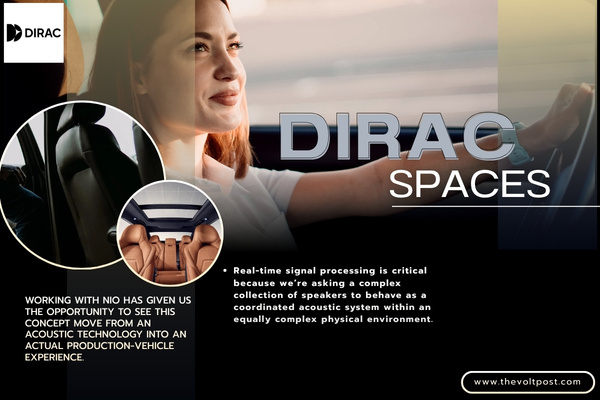
What have you learned from the initial deployment of Dirac Spaces with NIO in China?
Working with NIO has given us the opportunity to see this concept move from an acoustic technology into an actual production-vehicle experience. Spaces debuted in the NIO ES9 alongside the Lyra sound system, so the technology became part of an overall approach to how that vehicle’s cabin should sound and feel.
What that experience reinforces is just how much room there still is to rethink automotive audio. When the acoustic environment becomes something that can be shaped through software, automakers gain an entirely renewed creative tool.
They can start thinking about sound the same way they think about other elements that define the character of the cabin.
Our work with NIO also illustrates the pace of experimentation happening in China right now. There’s a real appetite for bringing these kinds of experiences into production vehicles and exploring what they can add to the overall product.
Why are Chinese automakers moving more quickly than many Western manufacturers on immersive in-cabin experiences?
China uses an experience-first approach to vehicle development. There’s a willingness to look beyond traditional specifications and consider the cabin as a complete environment, with greater emphasis on what people actually experience when they spend time inside the vehicle.
That mindset creates more room to experiment with technologies that can shape the character of the cabin. Audio is a natural part of that, given how powerful an influence it has on the way an environment feels.
Our work with NIO, and the introduction of Dirac Spaces in the NIO ES9, are examples of that thinking already making its way into production vehicles.
I also think the severe competition of the China market pushes automakers to explore new use cases for differentiation quickly.
When the in-cabin experience becomes a key factor in how consumers evaluate a vehicle, technologies that make that experience more distinctive take on greater strategic importance. Besides, the hardware supplier chain is so mature here which is the solid foundation of “China Speed”.
China offers a compelling view of where automotive audio can go when it’s considered part of the vehicle experience from the outset. And we’re seeing that same opportunity resonate with automakers globally, even as individual markets move at different speeds.
Is the future of automotive audio about adding more hardware, or making existing hardware significantly more intelligent?
Both will continue to matter, but I think there is enormous untapped potential in using existing hardware more effectively.
As speaker counts and processing capabilities increase, the audio system becomes a more complex network of interactions. The opportunity lies in coordinating those resources so the system behaves as a whole, rather than evaluating performance primarily at the component level.
MIMO sound field control is particularly relevant here because it gives us much greater control over the relationships between speakers, the cabin and different listening positions. That allows  engineers to extract capabilities from the complete system that individual components could never deliver on their own.
To me, that’s the frontier that makes this field worth paying attention to. The sophistication of the hardware provides the foundation, and intelligent system-level control determines what we can ultimately build on top of it.
Disclaimer: The views, thoughts, and opinions expressed in this interview are solely those of Anders Storm and do not necessarily reflect the editorial stance, official policy, or position of The Volt Post. The Volt Post assumes no responsibility or liability for the accuracy, completeness, or validity of any statements or claims made herein.