


Choosing between traditional fuses, resettable PPTCs and eFuses helps engineers create consumer products that are reliable, space-efficient and aligned with safety and compliance requirements.
By Paulius Juskevicius, Strategic Marketing Manager, Littelfuse, Inc.
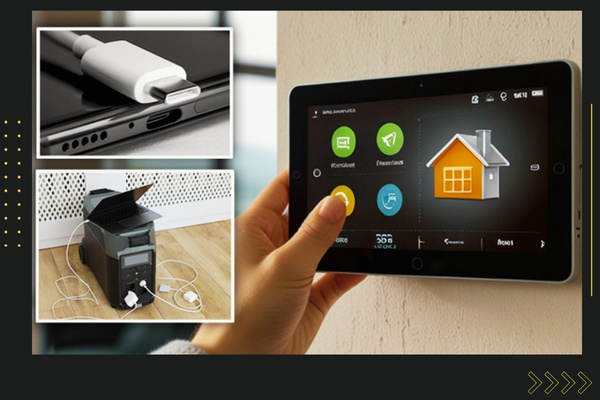
Smaller footprints, higher power density and greater functional integration are now common requirements across consumer electronics design. From USB-C powered peripherals and battery-operated tools to smart home hubs and connected appliances, engineers must protect against fault conditions without compromising usability, compliance or cost targets.
Selecting the right overcurrent protection technology is therefore an important system-level decision. Traditional fuses, resettable polymer PTCs (PPTCs) and electronic fuses (eFuses) each offer different advantages and trade-offs, depending on the circuit’s operating voltage, current profile, environmental conditions and system architecture.
The following sections compare these three technologies from an application perspective. By looking at how each device behaves under practical fault conditions, designers can identify the most appropriate approach for improving safety, reliability and serviceability across consumer electronic products.
Overview of Overcurrent Protection Devices
Traditional Fuses
A traditional fuse provides single-use protection by permanently opening the circuit when current rises above its rated threshold. The device works by melting a conductive element once heat generated by the overcurrent condition exceeds a critical level.
Key benefits:
• Simple, low-cost and reliable
• Available in a wide range of voltage and current ratings
• Well-characterized trip curves
Design considerations:
• Non-resettable: must be manually replaced
• Not ideal for hard-to-service or portable devices
• Larger fuses may consume valuable PCB space
For compact consumer products, surface-mount fuses support automated assembly and can be used in small devices such as Bluetooth speakers, handheld remote controls and personal grooming products.
PPTC Resettable Fuses
Polymer Positive Temperature Coefficient (PPTC) devices provide self-resetting overcurrent protection. Their conductive polymer material increases sharply in resistance when the device is heated by excessive current.
Key benefits:
• Automatic reset after the fault clears and cool-down occurs
• Compact surface-mount formats
• Cost-effective for low-voltage applications
Design considerations:
• Slower response time than fuses or eFuses
• Performance varies with ambient temperature and lacks repeatability after resets
• Limited to low-voltage, low-current circuits
Common applications for PPTC devices include rechargeable battery packs, USB peripheral circuits and products with small DC motors, such as grooming tools and robotic vacuums.
eFuses (Electronic Fuses)
An eFuse is an integrated circuit that combines a power MOSFET with control and protection logic. Designed for fast and precise overcurrent protection, many eFuse models also include overvoltage protection, thermal shutdown, reverse current blocking, soft start and fault reporting.
Key benefits:
• Very fast response time
• Programmable current limits and fault thresholds
• Integrates multiple protection features in one device
• Remote reset and diagnostics
Design considerations:
• More expensive than fuses or PPTCs
• Requires bias power and sometimes MCU integration
• Not suitable for high-voltage AC line applications
Applications such as USB-C power delivery ports, embedded control modules, SSDs and IoT hubs benefit from eFuses where compact, intelligent protection is necessary.
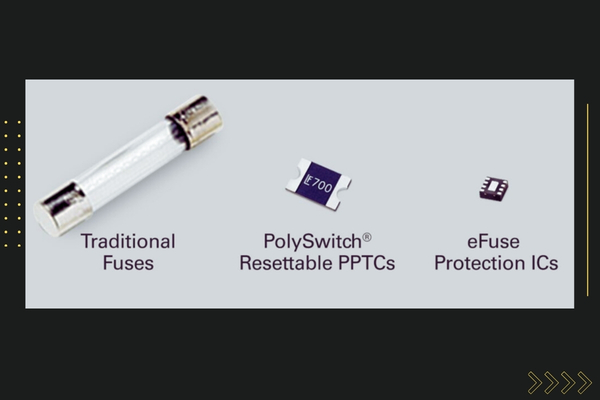
Figure 1. Relative size comparison of traditional fuse, PPTC and eFuse overcurrent protection technologies.
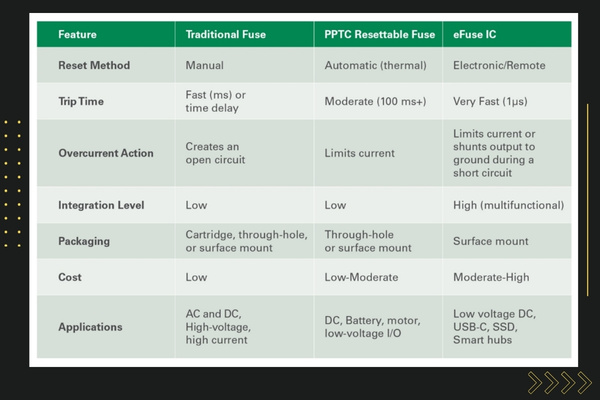
Technical Comparison Table
Application-Specific Design Examples
- Line-Powered Appliances
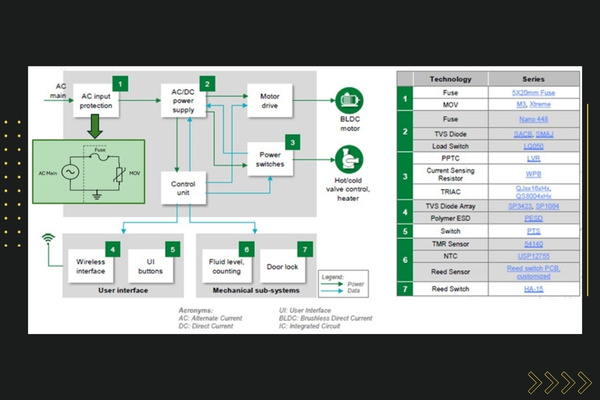
Traditional fuses are required for line-powered devices that operate from AC line voltage. These products include small and large appliances such as blenders, air fryers, washing machines and dryers.
Figure 2 shows a washing machine block diagram that includes several protection, control and sensing components. The inset highlights the AC input block, where the fuse provides overcurrent protection with a voltage rating suitable for single-phase AC line operation. The MOV protects against AC line voltage transients, while a time-delay fuse can help avoid nuisance openings caused by startup inrush current.
Design note: Select a fuse with a room-temperature current rating equal to 133% of the maximum load current and certified to UL 248-1.
- Portable Battery-Powered Devices
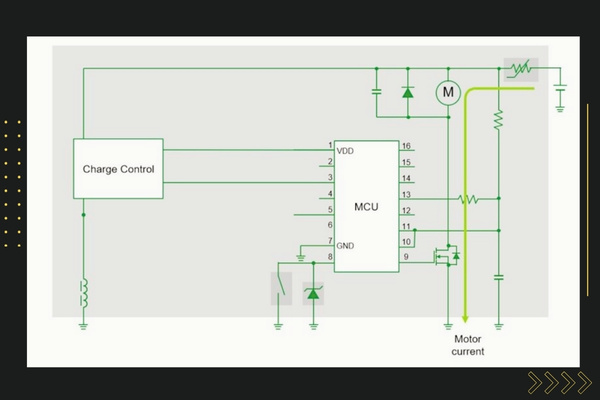
Rechargeable lithium-ion batteries, small motors and constrained board space are common design features in products such as consumer electric drills, portable fans and grooming tools.
For these low-voltage applications, PPTC resettable fuses are well suited because they combine resettable operation with low cost.
Placed between the battery input and the motor controller, as shown in Figure 3, a PPTC can limit fault current if a motor stalls or a wiring short occurs. In this configuration, the PPTC provides resettable overcurrent protection, while the MCU controls switching and monitors motor current.
Design note: When selecting a PPTC device, derate hold current based on ambient temperature and account for inrush current during charging or startup.
- USB-C Powered Electronics
USB-C powered products, including smart speakers, portable projectors and high-end grooming tools, must comply with USB Type-C power delivery (PD) negotiation standards and operate across wide input voltages from 5 V to 20 V.
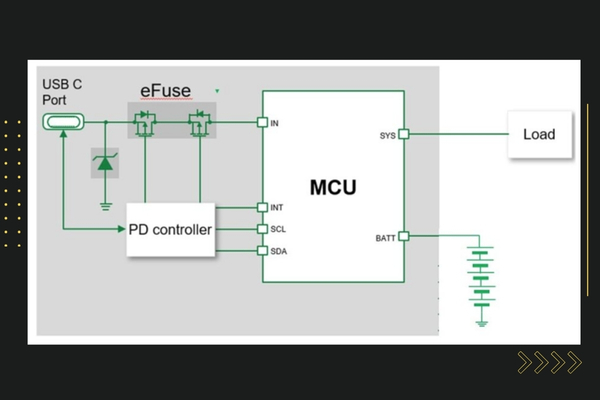
For these devices, an eFuse is typically the most suitable protection option. It integrates multiple protection functions in a single IC, including reverse current blocking to help prevent reverse current from damaging the circuit.
Depending on the model, eFuses can also provide programmable current limits, short-circuit protection, overtemperature protection, undervoltage lockout and seamless integration with power delivery (PD) controllers.
Figure 4 shows an eFuse used to protect a USB-C port. In this configuration, the eFuse provides overcurrent and reverse current protection, while the PD controller negotiates power delivery with the host.
Design note: Select an eFuse with adjustable slew-rate control to manage inrush current caused by capacitive loads.
- Smart Home Hubs and Consumer IoT
Smart home hubs and consumer IoT products often include microcontrollers, Wi-Fi/Bluetooth modules and external flash memory. Faults in these systems can result from cable shorts, component failures or ESD events.
In low-voltage digital circuits operating at 3.3 V or 5 V, traditional fuses may not react quickly enough, while PPTCs may not trip reliably at currents only slightly above their hold current ratings.
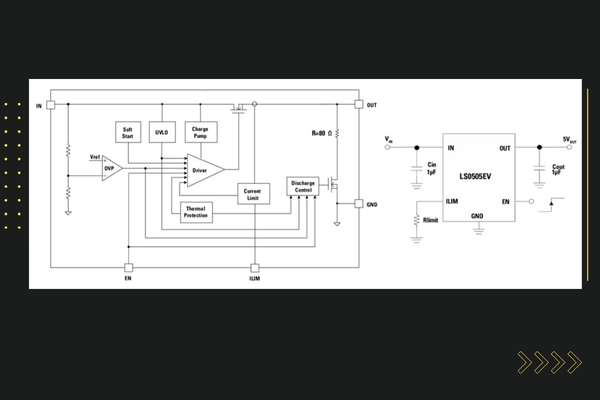
An eFuse with a 0.5 A to 3 A current rating combines fast overcurrent protection for sensitive ICs with overvoltage protection, overtemperature protection, inrush control and undervoltage lockout control in a single component.
By integrating these functions, an eFuse helps protect against electrical hazards while reducing component count and saving PCB space.
Figure 5 shows a basic eFuse diagram and its use in monitoring a voltage rail.
- Display Panels and Touchscreen Electronics
Backlight circuits, capacitive touch controllers and I/O ports require overcurrent protection that responds effectively without disrupting normal operation. PPTCs are often used in LED driver outputs, I2C/SPI data lines and circuits that power peripheral boards.
For these applications, PPTCs provide automatic reset capability without requiring user intervention. In circuits with user-accessible ports, including USB and HDMI data ports, combining PPTCs with TVS diodes provides both overcurrent and transient protection.
Discrete vs. Integrated Protection Strategies
Complete circuit protection can be implemented using discrete components, an integrated approach or a combination of both within the same product. The most appropriate strategy depends on the protection requirements of each subsystem and the trade-offs the designer needs to manage.
Discrete Solutions
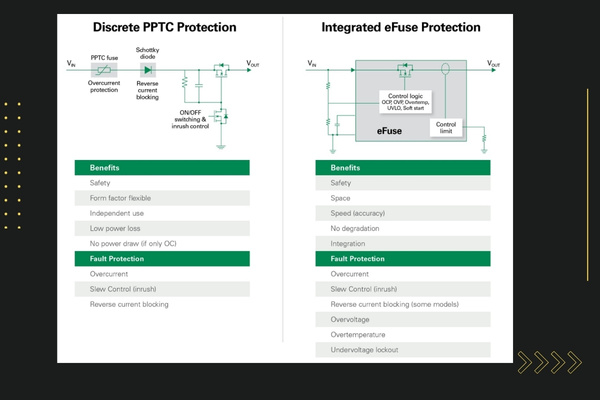
A discrete approach combines a traditional fuse or PPTC with MOSFETs, diodes and logic. This provides modular flexibility, but also increases component count and circuit complexity. It is useful when separate subsystems within a product require individual protection.
Integrated eFuse Solutions
With an integrated eFuse, multiple protection functions are consolidated into one device. This can reduce layout complexity and improve MTBF (mean time between failure) by minimizing the number of components used in the protection circuit.
Figure 6 compares the two approaches. The PPTC-based discrete circuit provides configuration flexibility but uses more PCB space, while the integrated eFuse circuit delivers more fault protection features in a compact design.
A smart appliance with multiple voltage rails illustrates how different protection technologies can be used within one product architecture. Depending on the circuit function, designers may include:
- A traditional fuse on the primary AC or DC input
- PPTCs for low-power voltage rails
- An eFuse for the USB-C port or external I/O path
Thermal and Environmental Considerations
Environmental conditions should be reviewed early in the protection selection process. Temperature, moisture and vibration can all influence device performance and may determine which overcurrent protection technology is best suited to the application.
Because the electrical characteristics of components change with temperature, thermal behaviour is an important design factor.
An eFuse’s protection settings are less affected by wide temperature swings than PPTCs or traditional fuses. Products intended for bathrooms, kitchens or outdoor use must also be designed to withstand moisture and vibration, which can influence package selection, including options such as conformal coating or sealed fuses.
Regulatory and Compliance Requirements
Compliance requirements also play an important role in device selection. Designers must account for relevant standards, regulations and communication protocol interoperability requirements. Consumer electronics must meet:
- UL/IEC standards for safety and flammability
- EMC/EMI regulations for emissions and immunity
- USB-IF specifications for power negotiation
Where a mandated fail-safe open condition is required, UL-certified traditional fuses are needed. PPTCs, which are frequently UL-recognized, are appropriate for IEC 60950/62368-compliant designs. An eFuse can support safety requirements through fault detection with programmable protection logic.
Selecting the Right Device: Process Framework
A structured evaluation process helps designers select the most appropriate overcurrent protection technology for a specific design:
1. Define the voltage and current envelope
- What is the normal operating voltage?
- What is the max load current? Inrush?2. Identify the fault conditions that need protection
- Short circuits
- Overload
- Reverse current
- Transients3. Determine the required reset behavior
- Manual (fuse)
- Auto (PPTC)
- Software (eFuse)4. Evaluate space, cost and integration tradeoffs
- BOM cost
- PCB real estate
Diagnostic capability
5. Review compliance and testing standards
- UL
- IEC
- USB-IF
- ISO
Conclusion
Choosing the right overcurrent protection device is a system-level decision based on application requirements, not simply a preference for one component type. Operating voltage, fault response time, reset behavior, environmental exposure and regulatory compliance all affect which solution offers the most practical balance of protection and performance.
Traditional fuses continue to be essential for primary power inputs and applications that require a certified fail-safe open condition. For low-voltage circuits where convenience and cost are important, PPTC devices provide a simple resettable option. eFuses meet the growing requirement for fast, programmable and space-efficient protection in digitally controlled, power-dense designs.
By matching protection technology to system architecture and real-world operating conditions, engineers can develop consumer electronics that are compliant, reliable and more resilient in increasingly complex electrical environments.
References
- Circuit Protection Product Selection Guide
- eFuse Protection ICs Technology Brief
- eFuse Overcurrent, Overvoltage, Inrush Current Protection
- Resettable Bladed Sold State & Battery Strap PPTC Fuses
- Cartridge Fuses: Types & Sizes
Product Intro Videos
- Littelfuse eFuse LS05006VPQ33 Protection ICs
- Littelfuse Load Switch ICs
- Littelfuse 606 Series Fuse
- Littelfuse 607 Series High-Current & Voltage Cartridge Fuse
- Protect Your Circuits with the Nano2® 415 SMD Fuse
- 871 Fuse Series: Industry-First Ultra-High Amperage SMD Fuse Series
- Littelfuse AEC-Q200 Rev E Qualified Fuses