


Japan has taken another major step toward 6G with a wireless transmission test that reached 112 Gbps in the 560 GHz band.
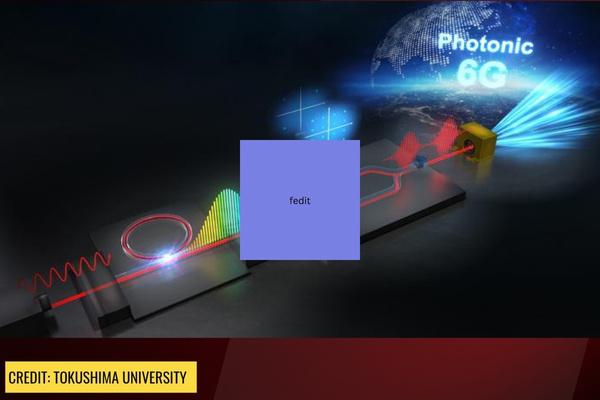
The demonstration, led by Tokushima University and research partners, used a microcomb-driven terahertz communication system that is designed to overcome the power and noise limits that have held back conventional electronics at extreme frequencies.
The result is notable because it pushes wireless communication into a band above 420 GHz, where practical high-speed links have remained rare.
In the experiment, the team achieved 84 Gbps using QPSK modulation and 112 Gbps using 16QAM, marking a major milestone for ultra-high-speed short-range wireless and future mobile backhaul applications.
This is more than a lab curiosity. The broader 6G vision depends on networks that can support massive bandwidth, lower latency, and high-capacity data transport between infrastructure layers, especially where fiber is costly or impractical.
By combining photonics and terahertz wireless, the Japanese team has shown a promising route toward those goals.
For the telecom industry, the significance lies in what this unlocks next. If such systems can be refined for stability, range, and scalability, they could support photonic-wireless integrated networks, dense urban backhaul, and future edge-connected services that need enormous data throughput.
The work is an important reminder that the race to 6G is not just about faster phones, but about building a completely new communications foundation.
“In addition, the integration of a temperature control function for the microresonator improves the reproducibility of optical resonance characteristics and enhances robustness against environmental temperature fluctuations,” the researchers noted.
“This result represents a major step toward practical 6G wireless systems and ultra-high-speed mobile backhaul,” said Prof. Takeshi Yasui of Tokushima University.
Future work will focus on further reducing phase noise, enabling higher-order modulation formats, and extending transmission distance through improved terahertz output power and antenna design, said its official release.
Reference notes
Useful references for attribution includes Tokushima’s announcement, EurekAlert’s research summary, and TelecomPaper’s coverage of the 112 Gbps demonstration.