Researchers led by Professor Hyun Il Kang from the Department of Electrical Engineering at Hanbat National University, Republic of Korea, has proposed a robust, stretchable wearable NH3 sensor that combines quantitative chemiresistive detection with instant visual colorimetric readout in a highly gas-permeable polymer nanofiber platform, delivering ppm-level sensitivity and stable performance under humidity and mechanical deformation.
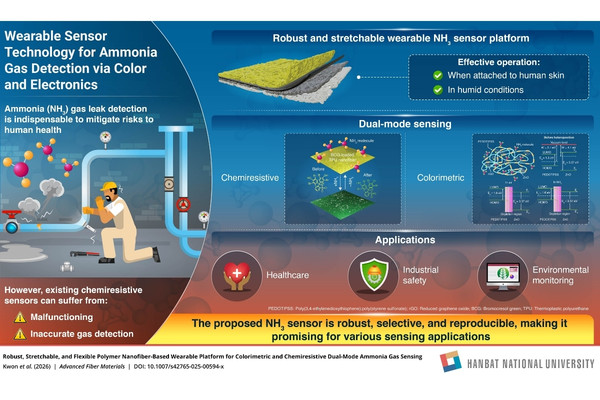
Image credit: Hyun Il Kang from Hanbat National University
Ammonia gas, a popular industrial chemical, is dangerous to human health. A new study by Hanbat National University researchers presents a wearable ammonia gas sensor that detects harmful ammonia levels visually and electronically.
The sensor is flexible, stretchable, and works reliably when attached to human skin and exposed to high humidity. By combining two sensing methods in one device, the platform remains accurate even if one sensing mode fails, making it suitable for real-world use.
Ammonia (NH3)—the second-most-produced chemical globally—has proven to be highly important in furthering human civilization over the centuries, both in terms of technological capabilities and innovation potential.
It is widely utilized in fertilizers, refrigerants, biomarkers, and next-generation fuel. Unfortunately, NH3 is highly toxic, resulting in complications such as respiratory irritation, chest pain, pulmonary edema, and even death.
This makes effective and rapid NH3 sensing and detection capabilities indispensable in industries or environments prone to NH3 leaks.
Over the decades, scientists have developed innovative portable and wearable NH3 sensors, including chemiresistive sensors based on conductive polymers or metal oxide semiconductors and colorimetric sensors based on state-of-the-art gas sensing technology.
While chemiresistive gas sensors have short response times, they demonstrate subpar stability and selectivity. On the other hand, colorimetric gas sensors are highly resistant to humidity and other environmental factors, but show long recovery times. This trend suggests that a dual-mode detection system that integrates the above two technologies can be highly promising for NH3 sensing.
In a new study, making significant advances in this direction, a team of researchers led by Professor Hyun Il Kang from the Department of Electrical Engineering at Hanbat National University, Republic of Korea, has proposed a robust, stretchable wearable NH3 sensor that combines quantitative chemiresistive detection with instant visual colorimetric readout in a highly gas-permeable polymer nanofiber platform, delivering ppm-level sensitivity and stable performance under humidity and mechanical deformation.
Their novel findings were made available online on 18 August 2025 and have been published in Volume 7, Issue 6 of the journal Advanced Fiber Materials on 1 December 2025.
Prof. Kang explains the operational mechanism of their next-generation technology. “Our device provides flexibility and facilitates efficient transport of NH3 between the bromocresol-green-based colorimetric and poly(3,4-ethylene dioxythiophene):poly(styrene sulfonate)-based chemiresistive sensing layers. This innovative dual-mode design enables reliable NH3 detection.”

Notably, the NH3-detection performance of an individual layer is on par with that of the dual-mode gas-sensing platform. As a result, the platform remains accurate even if one of the two sensing modes fails.
Moreover, the sensor remarkably exhibits efficient operation even when attached to human skin and in humid conditions. Its potential real-life applications include: personal safety monitoring for workers in NH3-handling facilities, industrial refrigeration and cold-chain environments, agriculture and livestock operations where ammonia buildup occurs, noninvasive health screening via breath-NH3, as well as vehicle energy systems using NH3.
In the next 5–10 years, this kind of dual-mode, skin-mountable NH3 sensing could enable everyday “smart PPE” that gives early, intuitive leak warnings and remains reliable in humid, real-world conditions, reducing workplace injuries and deaths from ammonia exposure. “Furthermore, in the long term, the same platform approach could also support continuous environmental monitoring and noninvasive health screening applications where ammonia is a useful biomarker, improving safety and preventive care,” adds Prof. Kang.
Overall, our present research lays out an innovative sensor engineering paradigm, establishing a robust, selective, and reproducible NH3 sensor for a wide variety of biomedical, environmental monitoring, and futuristic industrial applications.
Reference
- Title of original paper: Robust, Stretchable, and Flexible Polymer Nanofiber? Based Wearable Platform for Colorimetric and Chemiresistive Dual? Mode Ammonia Gas Sensing
- Journal: Advanced Fiber Materials
- DOI: 10.1007/s42765-025-00594-x
About the institute
Established in 1927, Hanbat National University (HBNU) is a university in Daejeon, South Korea. As a leading national university in the region, HBNU strives to take the lead in solving problems in the local community and solidifying its cooperation with industries.
The university’s vision is to become “an Innovation Platform University integrating local community, industry, academia, and research.”
With its focus on practical education and regional impact, HBNU continually advances technological solutions grounded in creative thinking and real-world relevance.
Website: https://www.hanbat.ac.kr/eng/index.do
About the author
Prof. Hyun Il Kang is a Professor in the Department of Electrical Engineering at Hanbat National University, Daejeon, Republic of Korea. His research focuses on gas-sensing and functional nanomaterials, including carbon nanowalls (CNWs) and related surface-engineered structures for room-temperature detection of toxic and volatile gases.
Prof. Kang earned his Ph.D. (2007), M.S. (2003), and B.S. (2001) in Electrical Engineering from Sungkyunkwan University.