



An Assistant Professor and Principal Investigator of the Industrial Artificial Intelligence Laboratory in the School of Mechanical Engineering at Chung-Ang University, have created DiffectNet, a novel diffusion-enabled conditional target generation network that could generate high-fidelity and defect-aware ultrasonic images.
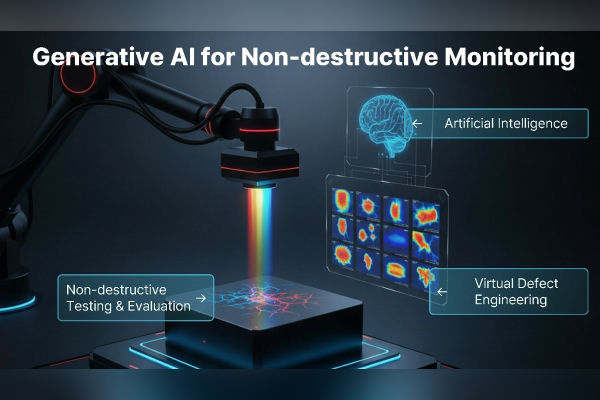
In sectors like semiconductors, energy, automotive, and steel, where even minute fractures or flaws in structures can have a significant impact on performance, system reliability and safety are crucial. Non-destructive testing (NDT) methods have long been used to evaluate the health of materials and structures because these interior defects are invisible to the human eye.
NDT makes it possible to examine internal conditions without causing structural damage. However, it is still quite challenging to accurately and thoroughly uncover internal flaws in practice.
 Notably, geometry, material characteristics, and complicated real-world situations can distort signals detected by physical sensors—such as ultrasonic or electromagnetic waves—imposing intrinsic physical limitations on the precise location and size of flaws.
What if, however, artificial intelligence (AI) is able to “see” things that the human eye cannot?
Inspired by this thought-provoking query, a group of South Korean researchers, under the direction of Sooyoung Lee, an Assistant Professor and Principal Investigator of the Industrial Artificial Intelligence Laboratory in the School of Mechanical Engineering at Chung-Ang University, have created DiffectNet, a novel diffusion-enabled conditional target generation network that could generate high-fidelity and defect-aware ultrasonic images.
Their groundbreaking discoveries were published in Volume 240 of the journal Mechanical Systems and Signal Processing on November 1, 2025, and made accessible online on September 30, 2025.
Even in places that are hazardous or difficult for humans to access, accident prevention will be possible if AI is able to identify and precisely recreate internal flaws in structures. For example, severe mishaps can result from even a little breach in power plants.
Early detection of suspected anomalies is made feasible by AI-based real-time monitoring of internal structures. AI can realistically recreate internal flaws in semiconductor or advanced manufacturing facilities without stopping equipment operation, improving quality control while preserving productivity.
Additionally, the technology may be used to monitor infrastructure in real time, including buildings and bridges, opening the door to a more intelligent and robust urban safety management system.
These examples show how AI is ushering in a new era of intelligent engineering by enabling previously unthinkable technical capabilities.
This research creates new opportunities for real-time defect reconstruction and prediction in highly reliability-critical industries including aerospace, power generation, semiconductor manufacturing, and civil infrastructure by enabling AI to function as the “eyes” of a structure.
Leadership Comments
Prof. Lee remarks: “If the limitations of traditional methods can be overcome through the learning and reasoning capabilities of AI, it becomes possible to elevate the integrity and safety standards of industrial systems to an entirely new level. The proposed technology is not merely an attempt to apply AI to engineering problems, but a fundamental breakthrough. It involves the development of a generative AI technology capable of reconstructing hidden cracks inside structures in real time, thereby overcoming the physical limitations of traditional methods.”
“AI is evolving beyond a mere tool for data analysis and learning—it is becoming an active agent that expands the very boundaries of engineering itself. Moving forward, our laboratory will continue to lead research in developing AI-driven engineering technologies, pioneering an era in which AI redefines the field of engineering,” concludes Prof. Lee.