
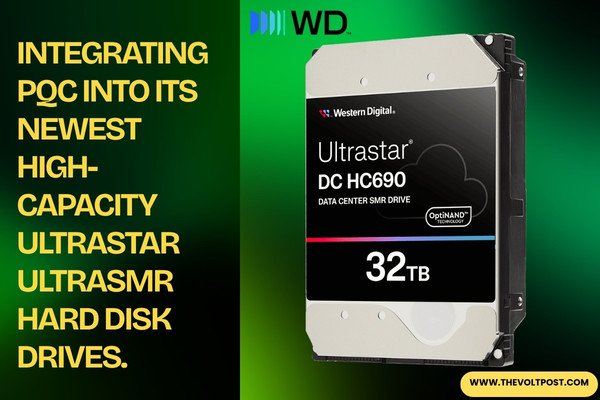
Western Digital Corporation has taken an important step in next-generation infrastructure security by integrating post-quantum cryptography (PQC) into its newest high-capacity Ultrastar UltraSMR hard disk drives.
As AI infrastructure shifts from compute-focused systems to data platforms that continuously store information across inference, training, and interaction, the security and durability of that data are becoming essential, not optional.
These drives are now in qualification with multiple hyperscale customers, signaling early demand for quantum-resilient storage architectures.
AI data systems generate and retain massive volumes of information that can remain valuable for decades. Protecting that data over the long term not just for a few years is now a core infrastructure requirement.
Western Digital’s introduction of the first hard drives to use NIST-approved quantum-resistant algorithms marks a meaningful industry shift, moving PQC from concept to real hardware-based defense.
By strengthening the root of trust, the company is helping guard against threats such as harvest now, decrypt later (HNDL), protecting the data lakes that power today’s AI systems from the future risk posed by quantum computers.
Western Digital is among the first to bring post-quantum cryptography into production storage infrastructure, helping lead the industry’s transition to quantum-ready security with deployed, standards-based protection.
Why post-quantum storage security matters now
As AI workloads generate and preserve data for longer periods, the value of that data grows along with the need to protect it from emerging threats that are evolving faster than many organizations expect.
- Long data lifecycles and extended IT service windows create wider exposure. Enterprise storage systems often stay in service for five years or more, which could overlap with the arrival of cryptographically relevant quantum computers.
- HNDL is already a real concern. Attackers may collect encrypted or signed data today with the goal of decrypting or forging it later, once quantum capabilities become available.
- Firmware-level attacks are another critical risk. As security architectures evolve, device-level trust is becoming increasingly important. A future quantum-enabled attacker could potentially forge digital signatures on firmware updates, making malicious code appear legitimate and compromising drive security.
Western Digital’s PQC approach
Western Digital’s PQC implementation in the new Ultrastar DC HC6100 UltraSMR is designed to protect device trust chains from manufacturing through field service.
This is more than a feature update; it reflects a broader move toward building quantum-resilient security directly into the foundation of data infrastructure.
The focus is on securing device-level trust, including firmware integrity and key management, rather than data-at-rest encryption.
Key elements include:
- Algorithm selection: ML-DSA-87 (NIST FIPS 204) for high-assurance code signing, with dual-signing using RSA-3072 to combine proven and emerging cryptographic standards.
- Infrastructure readiness: PQC-capable public key infrastructure (PKI) and hardware security module (HSM) workflows to support key issuance, rotation, and lifecycle management.
- Operational continuity: Dual-signing and rollback safeguards to help ensure smooth deployment across diverse fleets without disrupting current operations.
As quantum security requirements advance, data protection at the infrastructure layer is becoming a baseline requirement for AI-driven enterprises.
WD is helping define the next baseline for trust in AI infrastructure, where security is embedded at the foundation of the system, not added as an afterthought.
WD expects to expand PQC capabilities across additional enterprise hard drive product lines over time.
 Leadership Comment
“As AI data compounds and becomes more valuable and long-lived, securing it for the future is no longer optional. Quantum computing represents one of the most significant technology transitions of our time, and it is advancing faster than many organizations anticipate. The security architectures that have protected enterprise storage for more than a decade will need to evolve,” said Dr. Xiaodong (Carl) Che, Chief Technology Officer and Senior Vice President at WD.
“Integrating post-quantum cryptography into our Ultrastar enterprise-class drives is part of our commitment to helping customers stay ahead of threats that are already present in the form of HNDL attacks. By aligning with NIST standards and CNSA 2.0 today, we are helping enterprises build a clear, low-friction path to quantum-safe storage infrastructure,” added Dr. Xiaodong (Carl) Che.
To Read The Blog On Post-Quantum Cryptography for Enterprise HDDs, CLICK HERE