



Toray Industries announces that it has successfully tested an inverter (see note 1) at 150°C using a prototype film capacitor (note2) incorporating a proprietary heat-resistant film as the dielectric.
Efforts to decarbonize transportation are accelerating the electrification of automobiles, aircraft, flying cars, and other forms of next-generation mobility.
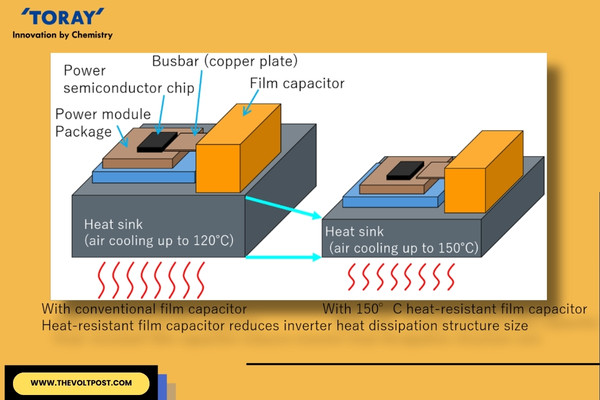
The downside of higher-output drive systems is that the heat resistance of film capacitors that stabilize power within inverters can constrain system design. This is particularly important for flying cars, where smaller, lighter heat dissipation structures are essential to extending flight range, increasing demand for film capacitors that can withstand higher temperatures.
Joint research with Professor Masayoshi Yamamoto of Nagoya University’s Institute of Materials and Systems for Sustainability demonstrated that a capacitor using its 150°C heat-resistant film performed stably in a prototype inverter even under high-temperature conditions.
Thermal simulations (note 3) also demonstrated the potential to halve the size of the heat dissipation structure (note 4) (see graphic below). Toray and the university will develop and evaluate the film with a view to commercialization for 150°C capacitors.
The New Energy and Industrial Technology Development Organization supported this effort through a project to develop highly heat-resistant film for film capacitors for next-generation mobility (note 5).
Toray plans to exhibit its technology at that organization’s booth at the CEATEC 2026 digital innovation exhibition at Makuhari Messe from October 13 to 16.
Toray will keep leveraging its core technologies of synthetic organic and polymer chemistry, biotechnology, and nanotechnology to research and develop groundbreaking materials that can transform the world in keeping with its commitment to delivering new value and contributing to social progress.
Notes
- An inverter converts direct current into alternating current to control motors and other equipment. It is widely used in electric vehicles and industrial equipment.
- A film capacitor uses plastic film as a dielectric. It offers excellent durability and reliability and is widely used in power conversion equipment such as inverters.
- Thermal simulation uses computer models to analyze and predict heat generation and transfer.
- Toray calculated this figure based on the estimated reduction in heat dissipation structure size from using more heat-resistant film capacitors in a power control unit for electric mobility (as of September 30, 2026).
- Selected for fiscal 2023, this New Energy and Industrial Technology Development Organization-funded project is developing dielectric film for 150°C film capacitors that will enable air-cooled power control units for next-generation electric mobility, including flying cars and electric vehicles. Smaller, lighter, more efficient air-cooled units could reduce energy consumption and help conserve energy https://www.nedo.go.jp/english/activities/activities_ZZJP_100197.html
To Know More: CLICK HERE