



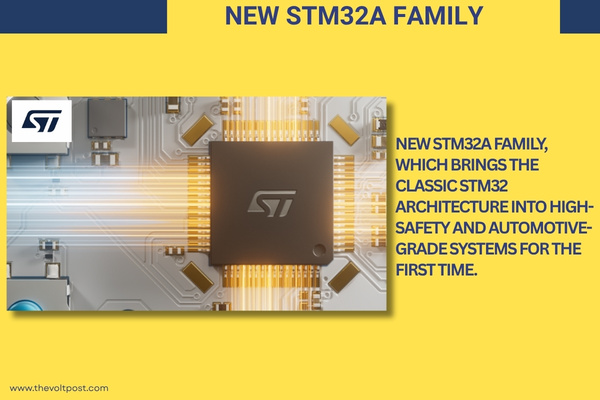
STMicroelectronics is making a major move to unify its flagship STM32 platform across industrial, robotics, and automotive applications. The centerpiece of this strategy is the launch of the new STM32A family, which brings the classic STM32 architecture into high-safety and automotive-grade systems for the first time.
By building on 20-plus years of STM32 development, ST is solving a growing headache for engineering teams – design fragmentation.
As edge intelligence and physical AI take off, industrial and automotive applications are starting to demand the same core feature set – real-time control, robust functional safety, hardware-grade security, and AI capabilities.
A unified platform means developers can build once and carry their proven software IP across multiple market segments without starting from scratch each time.
The Unified STM32 Blueprint
The cross-domain strategy relies on three main pillars to maintain continuity across designs:
- Architectural Consistency: Powered by Arm® Cortex®-M cores, the entire portfolio shares architectural principles, giving engineers a predictable upgrade path between MCU families.
- Shared Ecosystem: Developers retain their familiar workflows through STM32Cube and the broader Arm developer community, keeping software resources and support consistent.
- Scalable Manufacturing: Future STM32 products will leverage shared process technologies—including ST’s 40nm Flash and 18nm FD-SOI with embedded phase-change memory (ePCM), alongside TSMC eNVM tech.
As part of this push, ST is also collaborating closely with Arm to shape the next generation of Cortex-M processors, targeting high-performance MCU foundations specifically tailored for physical AI applications.
Introducing the STM32A Family
Designed for safety-critical environments and automotive qualifications, the STM32A family bridges the gap between general-purpose industrial control and stringent functional safety standards.
The first three MCU lines are currently sampling, with broader rollout scheduled for 2027:
- STM32A4: Tailored for entry-level automotive local control nodes and basic safety modules.
- STM32A5: Designed for mid-range safety-critical tasks across industrial automation, robotics, energy platforms, and vehicle systems.
- STM32A9: Built for high-performance, multi-domain control systems demanding real-time deterministic communication, low latency, and onboard Ethernet.
Leadership Comment
“Embedded innovation should not require developers to start again with every new product. With the unified STM32 platform, we are creating a foundation they can trust across markets and generations. The industry needs less fragmentation and a stronger focus on helping MCU technologies converge around a common foundation, while maximizing software reuse. This is how we intend to make STM32 the reference MCU platform across industries,” said Remi El-Ouazzane, President, Microcontrollers, Digital ICs and RF Products Group, STMicroelectronics.
 “The next major frontier for computing is bringing intelligence into the machines that move, manufacture and operate in the physical world,” said Drew Henry, Executive Vice President, Physical AI, Arm. “Building on more than two decades of collaboration, Arm and STMicroelectronics are advancing Cortex-M together to meet the demands of intelligence at the edge, where the physical world is sensed and controlled, helping unlock the next generation of physical AI systems.”
Hear more from our customers and partners on the benefits of a unified microcontroller platform https://www.st.com/content/st_com/en/campaigns/unified-stm32-mcu-platform-z11.html