


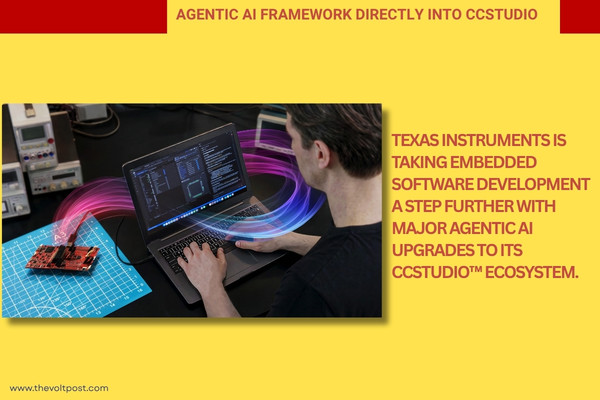
Texas Instruments is taking embedded software development a step further with major agentic AI upgrades to its CCStudio™ ecosystem. While standard generative AI has spent the last couple of years helping engineers draft code, general-purpose LLMs regularly stumble on embedded projects because they lack hardware-specific context. TI is fixing that by integrating an agentic AI framework directly into CCStudio across its MCU, wireless, and radar portfolios.
Rather than just suggesting snippets, TI’s new framework injects exact device parameters, SDKs, pin configurations, and peripheral mapping into AI tools via Model Context Protocol (MCP) servers. By grounding the AI in TI’s actual silicon data, the system virtually eliminates hallucinations and generates production-ready code while keeping latency and token costs down.
Autonomous End-to-End Workflows
Through CCStudio IDE or CCStudio for VS Code, engineers can now use simple natural-language prompts to trigger autonomous workflows.
Industry-standard AI agents can handle the heavy lifting end-to-end:
- Configuring peripherals and writing application code
- Building project files
- Flashing firmware directly onto the target silicon
- Autonomously running debug cycles
Automated Silicon Migration
One of the most practical additions to the ecosystem is TI’s automated device migration skill, designed to compress multi-month code ports into a matter of days or hours. When moving code from a competitor’s chip over to a TI device, specialized subagents divide and execute the migration pipeline automatically:
- Source Analysis: Evaluates the original legacy code and project dependencies.
- Peripheral Mapping: Maps and configures target TI peripherals.
- API & Code Updates: Refactors functions, registers, and API calls to fit TI architecture.
- Build & Debug Iteration: Runs build cycles and automatically iterates through compiler errors until the build succeeds.
This automated hands-off approach lets engineering teams retain their legacy software investments while freeing up resources to focus on system architecture and product-differentiating features.
Supported across TI’s general-purpose, real-time MCU, wireless, and radar System-on-Chip (SoC) lineups, the agentic capabilities are available now. TI is showcasing the updated CCStudio ecosystem live at electronica 2026 in Munich (Nov. 10–13).
Leadership Comment
 “Embedded software development is an incredibly manual and time-consuming process that has been significantly changing over the last few years with agentic AI,” said Amichai Ron, senior vice president, Embedded Processing and DLP® Products at TI. “TI was one of the first semiconductor companies to enable agentic AI workflows in our development ecosystem, and over the last several months, we have been strengthening its capabilities to enable significantly better productivity. Device migration, system configuration, and debugging are all integrated with agentic AI built on TI’s embedded expertise. Our goal is to give developers a more efficient and accurate development experience so they can spend more time innovating.”
To learn more, read the white paper, “Accelerating Embedded Development with Agentic AI in CCStudio™ IDE.”
TI at electronica 2026
At electronica 2026, in Hall C4, Booth No. 159, TI will demonstrate the latest enhancements in its development tools alongside innovations across its analog and embedded processing portfolios.
Visitors can watch live demonstrations of agentic workflows in CCStudio IDE and CCStudio for VS Code, covering end-to-end application development from system configuration to debugging.
For more information about TI at electronica 2026, see ti.com/electronica.
Availability
The CCStudio development ecosystem is available now as a free download on TI.com. The IDE supports multiple agents and models, allowing development teams to get started faster within the AI environment of their choice.