



As spacecraft become increasingly autonomous, software-defined, and incredibly data-heavy, the demand for serious onboard processing is skyrocketing. However, that computing power has to survive the brutal environment of space. To bridge this gap, Microchip Technology has just hit several major milestones with its PIC64-HPSC High-Performance Spaceflight Computing Series, a 64-bit multicore RISC-V platform built specifically for mission-critical aerospace systems.
Passing the Radiation Test
When it comes to space hardware, radiation tolerance is everything. Early characterization of the radiation-hardened variant, the PIC64-HPSC1000-RH, is showing excellent results.
It has demonstrated a Total Ionizing Dose (TID) performance of up to 200 krad(Si) and successfully passed Single Event Latch-up (SEL) testing at 78.2 MeV·cm²/mg.
Crucially, during Single Event Effects (SEE) testing, the system controller held up without a single uncorrected error or external reset. For design engineers, these numbers provide solid proof that the platform is on track to power future missions anywhere from Low Earth Orbit out to Mars.
Silicon in the Hands of Developers
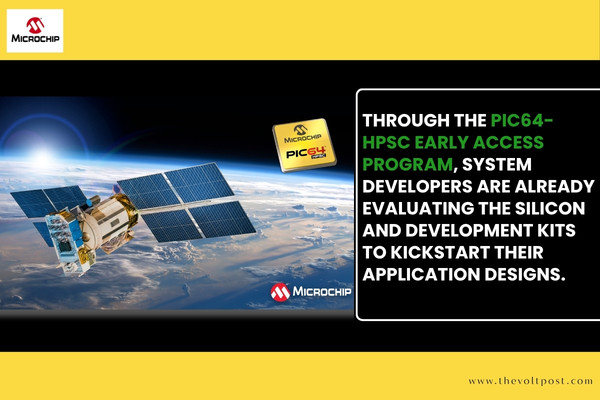
Microchip is not keeping the hardware locked in the lab. Through the PIC64-HPSC Early Access Program, system developers are already evaluating the silicon and development kits to kickstart their application designs.
Backed by Microchip’s direct engineering support, a growing ecosystem of hardware partners is also stepping up, building VPX and VNX+ computing platforms that will make it much easier to integrate these processors into upcoming spacecraft.
Meeting the Need for Onboard Autonomy
Out of the gate, the initial silicon performance is hitting its targets. This lays the groundwork for the kind of heavy-lift computing modern missions demand, think edge AI, advanced Earth observation, secure communications, and high-performance payload processing.
By crunching sensor and mission data locally, spacecraft can drastically cut their reliance on communication bandwidth and make split-second decisions without waiting for a signal from ground control. The need for this capability is urgent; NASA recently ranked advanced onboard computing as its third-highest civil space technology shortfall for FY26.
Rooted in a 2022 contract awarded by NASA and JPL, the PIC64-HPSC High-Performance Spaceflight Computing Series leverages a scalable 64-bit RISC-V architecture to push the aerospace industry toward open, distributed, and heterogeneous computing.
With operational silicon now in customer hands and major radiation milestones already cleared, the platform is rapidly moving from a concept to a core component of next-generation spaceflight.
Leadership Comment
 “Our vision for PIC64-HPSC was to develop a modern, high-performance computing platform capable of enabling the next generation of civil, commercial, scientific and defense space systems,” said Kevin So, vice president of Microchip’s communications business unit. “The combination of operational silicon, radiation-characterization results and customer evaluation activity demonstrates continued execution against that vision and marks an important step in the maturation of the platform.”
Pricing and Availability
PIC64-HPSC evaluation and development kits are available to select customers, providing access to silicon, development platforms, software, tools and Microchip engineering support.
To inquire about availability, contact a Microchip sales representative.