



Allye Energy has introduced the MEV (MAX for EV), the world’s first dedicated EV charger equipped with built-in battery storage made entirely from repurposed electric vehicle packs. Designed to bypass the grid upgrades that typically stall fleet electrification, the MEV charges itself from a depot’s existing electrical supply, even a standard 16A connectionand rapidly discharges that stored energy to deliver up to 400kW to two vehicles simultaneously.
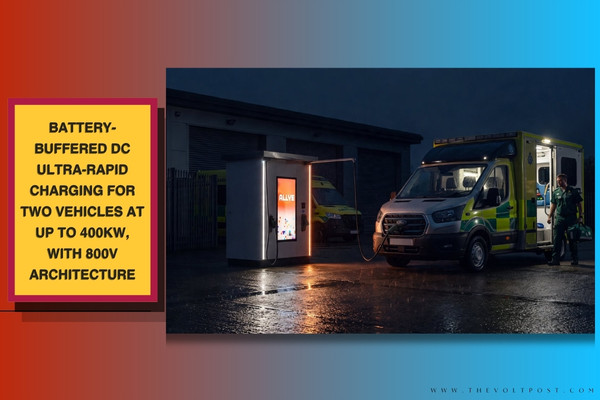
Engineered and manufactured in the UK using batteries from UK-registered vehicles and 95% British-sourced components, the MEV range starts at £70,000. Deliveries are slated for the second quarter of 2027, aligning directly with Round 2 of the UK government’s Depot Charging Scheme.
Breaking the Grid Bottleneck
Grid capacity remains the single largest barrier to commercial fleet electrification. Freight infrastructure body TwentyForty estimates a new depot connection takes 18 to 36 months, while government data shows some businesses waiting up to 15 years.
Depots are rarely short of overall energy, as vehicles sit parked for hours between shifts, but they severely lack the immediate power capacity to deliver fast charging.
Allye has already proven its battery-buffered model within the Depot Charging Scheme. Working with partner Chargepoly, the company equipped J&M Murdoch’s Glasgow refuse depot with a MAX300 unit to buffer an existing 32A (22kW) supply. Installed in a single day, the system averted a £300,000 grid upgrade and now powers a satellite DC fast charger that delivers around 200kWh daily. The new MEV packages this exact approach into a dedicated, fixed unit.
Hardware and Architecture
The launches are in two variants. The MEV200 features 155kWh of storage, while the MEV300 offers 232kWh. By repurposing existing EV battery packs rather than importing new cells, each unit saves an estimated 15 to 24 tonnes of CO2 equivalent.
Allye Energy’s proprietary PackFlex technology gives each battery pack independent management and power control, allowing packs of different sizes, chemistries, and lifecycles to operate seamlessly within the same cabinet.
Built on an 800V architecture, the charger maximizes efficiency for both 400V and 800V vehicles. Furthermore, power and capacity can be upgraded on site with minimal disruption, and the entire plug-and-play unit can be easily relocated if a depot lease expires.
Security and Driver Safety
With cable theft becoming a major cause of hardware downtime, every MEV is equipped with cut detection, forensic marking, and quick-release terminals for rapid replacement. Internally, each battery pack features a pyro fuse to isolate high-voltage circuits, off-gas detection, and standard fire barriers.
Driver safety is equally prioritized. To address personal security concerns at charging stations, the MEV uses a smart “technology handshake” lighting system. The unit remains dark until a user approaches, at which point it illuminates the connectors and surrounding ground with shielded, low-glare lighting.
Integrated cameras also monitor the bays and cables. For charge point operators (CPOs), the system offers optional AI bay monitoring and large 65-inch digital screens that can generate advertising revenue at high-footfall sites.
The Financial Case
While a battery-buffered charger carries a higher upfront cost than a conventional unit, the lifetime operating economics are significantly lower. By drawing a smaller supply, fleets avoid steep utility capacity charges saving roughly £8,900 annually for a 200kVA connection on current South West UK tariffs.
The MEV recharges overnight at off-peak rates and charges vehicles during the day, avoiding peak network tariffs. Utilizing onboard energy management software, it can also trade stored energy in the wholesale market to earn revenue through grid services. Ultimately, the MEV200 is designed to recover its premium over a standard 200kW charger in two to three years, yielding total savings of £50,000 to £110,000 over a decade.
For fleets preferring an operating expense model, Allye offers EV Charging as a Service (EVCaaS) starting at £1,900 a month for the MEV200, covering all capital and maintenance costs.
Proven Field Performance
The MEV is built on the proven power electronics of Allye’s mobile MAX300 system. While the MAX300 is a towable asset used for temporary sites and off-grid power, the MEV is tailored strictly for fixed depot installations.
Allye already has more than 20 MAX systems actively deployed across the UK for clients  like Jaguar Land Rover and Roadchef. At Roadchef’s Killington Lake services, a MAX300 has operated for two years on a highly constrained 315A supply, stabilizing power demands and preventing 12 site-wide power trips in its first year alone—saving an estimated £120,000 without requiring a grid upgrade. Similarly, MAX500 units are currently powering electric excavators at the Lower Thames Crossing, delivering over 126MWh across 900 charging sessions.
To support the 2027 rollout, Allye Energy is actively seeking domestic and international distribution partners, including CPOs, installers, and fleet energy specialists capable of deploying the MEV range.
To Know More: CLICK HERE