



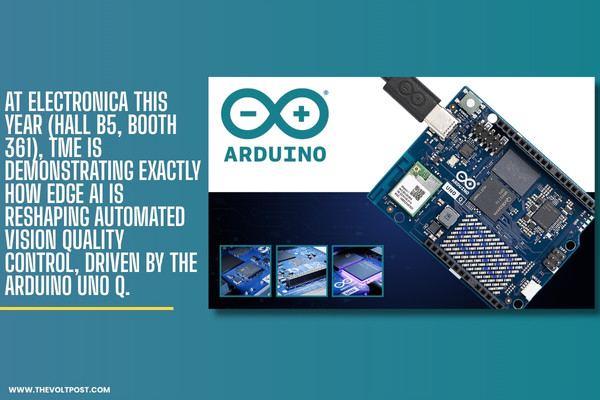
At electronica this year (Hall B5, Booth 361), TME is demonstrating exactly how Edge AI is reshaping automated vision quality control, driven by the Arduino UNO Q. Rather than bouncing video frames to an external server, this compact board handles heavy data processing locally.
By keeping image analysis at the edge, the system drastically cuts latency, frees up factory network bandwidth, and delivers near-instant responses the moment it detects a flaw.
The mechanics are straightforward but powerful. The AI vision system relies on machine learning models trained on vast datasets of both flawless and defective components. Once deployed, it can classify products, catch assembly errors, verify colors, and spot surface damage or illegible prints in real time.
It is not designed to push human operators off the factory floor. Instead, it takes over the repetitive, high-fatigue inspection work with pinpoint consistency, leaving human workers free to handle the final verification of flagged items.
A typical vision inspection station built around the Arduino UNO Q is highly modular. It integrates a compatible camera, dedicated LED lighting, a part presence sensor, and a communication module to feed results directly to operators or broader factory systems like PLCs, SCADA, and MES.
Because the Arduino UNO Q features native Bluetooth and Wi-Fi, dropping it into an existing industrial network is seamless. For engineering teams, this setup offers an ideal, low-risk proof-of-concept before scaling the technology across multiple production lines.
As a major distributor carrying over 1.5 million components from roughly 1,500 manufacturers, TME supplies every piece of hardware required to build out a complete Arduino UNO Q vision station. Both the 2GB and 4GB variants of the platform are currently available through their catalog.
Leadership Comment
“Just a few years ago, automated vision control systems relied heavily on costly smart cameras and elaborate vision systems requiring significant financial outlays and specialised  expertise,” says Pawe? Sióda, Senior Product Manager, TME. “With compact platforms like the Arduino UNO Q, engineers can now rapidly build a demonstrator, test effectiveness through a pilot project and gradually expand their AI vision inspection capabilities in-house.”
Quality control using AI is just one example of the capabilities of the Arduino UNO Q platform.
During electronica visitors are invited to meet the TME team (B5:361) to learn how the platform can also be also used for condition monitoring and vibration monitoring.
Go to the page ‘Discover practical applications of Edge AI with Arduino UNO Q’ for more information.