




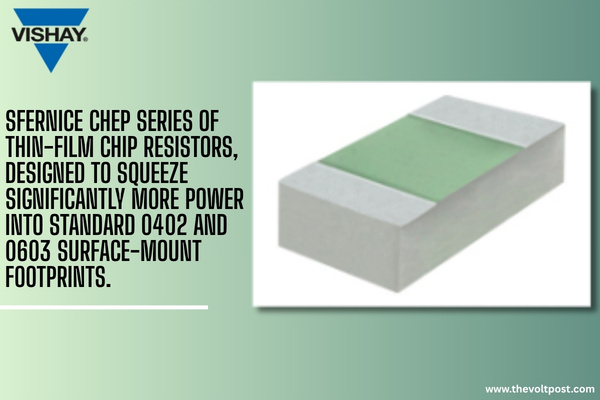
Vishay Intertechnology has introduced its Sfernice CHEP series of thin-film chip resistors, designed to squeeze significantly more power into standard 0402 and 0603 surface-mount footprints without giving up RF performance. Built on an aluminum nitride (AlN) substrate, the devices target telecom, 5G/6G, satellite and aerospace/defense systems where power density and high-frequency behavior matter.
Power density: well above the 1 W norm
Where many competing thin-film resistors in these sizes are rated below 1 W, the CHEP series starts at 1.2 W for 0402 and 1.8 W for 0603.
When mounted according to Vishay’s datasheet guidelines, those numbers jump by 50% to 1.8 W and 2.8 W respectively, letting designers push more power through smaller board areas, often without adding a heatsink.
Frequency performance and mounting options
The resistors are offered with flip-chip or wraparound terminals, and their frequency capability depends on package and mounting style. In 0402, flip-chip mounting supports operation up to 50 GHz, while wraparound (active face-up) goes to 20 GHz; 0603 devices reach up to 40 GHz.
To keep RF behavior clean, the CHEP series is engineered for very low internal reactance, with LC values as low as 1 × 10?²?. That translates to reduced phase shift, more consistent impedance and lower noise in high-frequency signal paths.
Where these resistors are meant to be used
Vishay positions the Sfernice CHEP series of thin-film chip resistors for demanding connectivity and infrastructure designs, LEO satellite terminals, base-station equipment, 5G and future 6G networks, and RF front-end gear such as remote radio units (RRUs) and antennas.
The same characteristics also suit aerospace and defense applications, including drones, satellite payloads, guidance and telemetry systems, data links and phased-array radar.
Electrical specs and environmental compliance
 The resistors cover a resistance range of 20 ? to 120 ?, with tolerances down to ±1% and a temperature coefficient of ±100 ppm/°C (±50 ppm/°C available on request).
They operate from -55 °C to +155 °C and are RoHS-compliant, halogen-free and “Vishay Green.”
Samples and production quantities are available now, with typical lead times around 16 weeks.
To Know More: CLICK HERE