




Ten-Nine Technologies is scaling production of its patented cathode additive TENIX as battery manufacturers increasingly turn toward manganese-rich chemistries in search of lower-cost and more secure alternatives to nickel- and cobalt-heavy batteries.
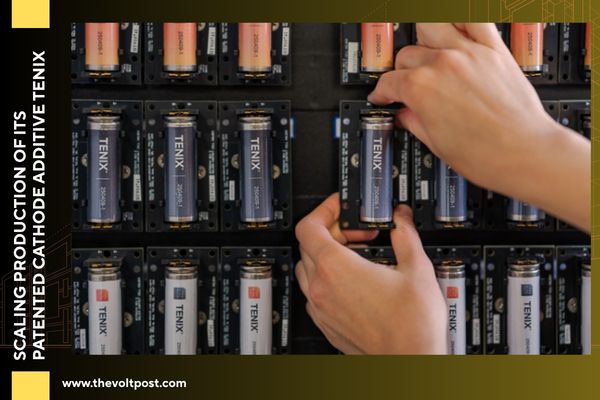
The Tulsa-based company says TENIX addresses one of the longstanding challenges associated with these chemistries: battery degradation. Ten-Nine describes the technology as “anti-aging for batteries,” designed to slow the chemical processes inside a cell that gradually reduce performance with repeated charging and discharging.
The company is currently conducting evaluation trials with battery manufacturers representing more than half of global battery production volume. It is also accepting orders for TENIX for delivery in 2026–27 from its own production facility in Tulsa.
The timing comes as manganese-rich cathodes attract growing attention across the battery industry. Manganese is cheaper and more abundant than nickel and cobalt, with production spread across regions including Africa, South America and Southeast Asia. That broader supply base could also help manufacturers reduce their exposure to the geopolitical and supply-chain risks associated with nickel- and cobalt-dependent chemistries.
But manganese-rich cathodes have historically faced a major drawback: relatively poor cycle life. That is the problem Ten-Nine is targeting with TENIX.
A drop-in additive for existing cathode production
TENIX is blended directly into the cathode material during battery manufacturing. It typically makes up just 0.5–2% of the cathode by weight, roughly 0.5–2 kg for every 100 kg of cathode material.
Importantly, manufacturers do not need to redesign their batteries or install new production equipment to use it. According to Ten-Nine, TENIX can be incorporated into existing cathode production lines as a drop-in additive.
The company says its current production capacity of 100 tons is enough to treat between 50,000 and 200,000 typical EV battery packs, depending on the dosage used.
In third-party testing, TENIX delivered more than 75% additional charge-discharge cycles. Ten-Nine says that could extend a typical EV battery from a 150,000-mile warranty baseline to more than 265,000 miles.
The company estimates that the longer operating life could reduce the cost per kilowatt-hour delivered over a battery’s lifetime by around 40%. Testing also showed a 10% reduction in internal resistance, which can translate into faster charging and less energy lost as heat.
Heat management is another area where Ten-Nine sees potential. The company says TENIX can reduce a battery’s heat output by around 40% over its lifetime — a benefit that could become increasingly important as battery systems are pushed harder in applications such as AI data centers and backup power.
The technology is designed to work across battery types and applications, including electric vehicles, power tools, defense equipment and grid-scale energy storage.
Targeting a potential shift in cathode chemistry
Ten-Nine believes the move toward manganese-rich cathodes could have a significant impact on the global battery supply chain, potentially reshaping the cathode market in much the same way that lithium iron phosphate (LFP) changed battery chemistry and manufacturing economics.
The company’s proposition is straightforward: if manganese-rich cathodes can overcome their cycle-life limitations, they could offer manufacturers a more affordable and geographically diversified alternative to chemistries that rely heavily on nickel and cobalt.
TENIX is intended to address that limitation without requiring manufacturers to overhaul their existing production infrastructure.
Ten-Nine currently holds 67 granted patents covering its core cathode chemistry. The company says there is no direct competitor offering an equivalent cathode additive, noting that technologies such as silicon anodes and solid-state electrolytes address different parts of the battery and solve different technical problems.
From a $100,000 research bet to commercial production
Ten-Nine Technologies was founded in 2014 after Paige received $100,000 from a local angel investor to pursue her battery research independently.
The company’s name comes from its original incorporation as “10-9 LLC.” The reference is to 10??, or the nanoscale at which Ten-Nine works with battery surface chemistry, and 10?, or one billion — representing the number of lives Paige believes improved battery technology could ultimately benefit.
More than a decade later, the initial $100,000 investment has grown into $45 million in funding raised to date.
Ten-Nine is now moving from laboratory development toward commercial-scale manufacturing, with its expanding TENIX production and ongoing trials with major battery manufacturers positioning the company to capitalize on what it sees as the next major shift in battery chemistry.
Leadership Comment
Paige Johnson, Founder and CEO of Ten-Nine Technologies, said:
 “Just like people, batteries age. Products of chemical decomposition build up during use, limiting a battery’s performance and lifetime, and until now that’s just been treated as an unavoidable cost of doing business. I’m a chemist so I wanted to fix that at the source rather than build a whole new battery to work around it. TENIX has a unique surface chemistry that disrupts that aging process, giving batteries more power and significantly longer life. I started this company in the back of a warehouse in Tulsa with $100,000 and four grams of material in a flask. I never imagined we’d end up here, but I always believed that if the chemistry was right, it would matter to a lot of people’s lives. That’s still what gets me up in the morning.”
To Know More: CLICK HERE