



AVILOO has launched the AVILOO Certified EV Battery Report, described as the world’s largest independent study of battery health in used electric vehicles.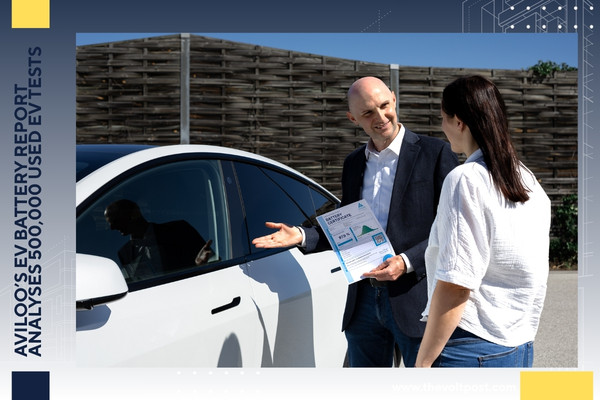
The first edition analyses more than 500,000 independent tests conducted on used EVs between 2022 and 2026. The study covers 20 popular models and draws on AVILOO’s wider diagnostic database, which now includes more than 1 million tests carried out across North and South America, Europe, Australia and Asia.
The company plans to publish the report twice a year.
Its central message for used-EV buyers, sellers, dealers, lenders and insurers is straightforward: battery health should be independently tested rather than assumed from mileage, model averages or the vehicle’s dashboard reading.
According to AVILOO, the overall health of used EV batteries remains strong. However, the data also shows significant differences between models and between individual vehicles of the same model. Those differences can affect a car’s remaining range and its market value.
How the report measures battery health
The AVILOO Certified EV Battery Report is based on data collected through AVILOO’s independent FLASH Test, a three-minute diagnostic carried out through a vehicle’s OBD port.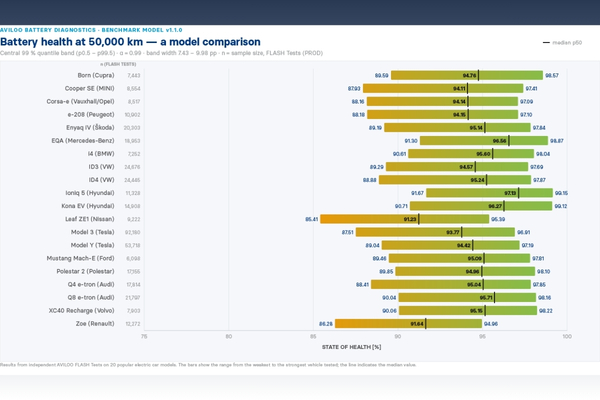
For each model, AVILOO calculates the median State of Health (SoH) at three mileage points: 50,000 km, 100,000 km and 150,000 km. It also provides a range expected to cover 99% of vehicles at each milestone.
SoH represents the percentage of a battery’s original usable capacity that remains. A battery with 95% SoH, for example, retains approximately 95% of its original range per charge.
The report’s charts present the models in alphabetical order. Each bar shows the expected battery-health range at a particular mileage, while the black line represents the median result. The analysis combines vehicles with different battery sizes within each model.
Across the three mileage milestones, AVILOO identified three broad trends:
- Median battery health declines as mileage increases.
- The variation between individual vehicles tends to widen at higher mileages.
- Consistent differences remain between models at each mileage point.
Four models show different degradation patterns
AVILOO’s data highlights how battery performance can vary across popular EVs.
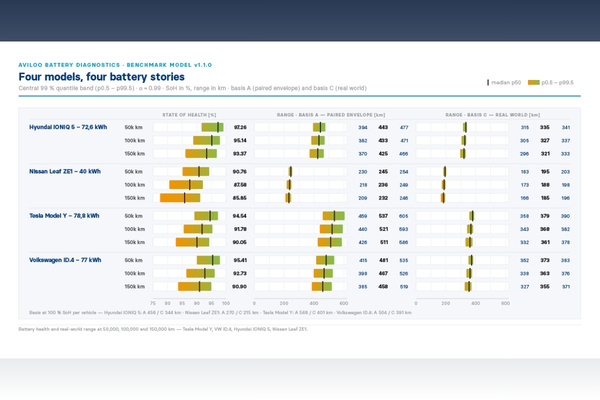
The Tesla Model Y with a 78.8 kWh battery recorded a median SoH of 94.5% at 50,000 km. That figure fell to 90.3% at 150,000 km. In real-world range terms, the median result equates to approximately 379 km per charge at 50,000 km and around 362 km at 150,000 km.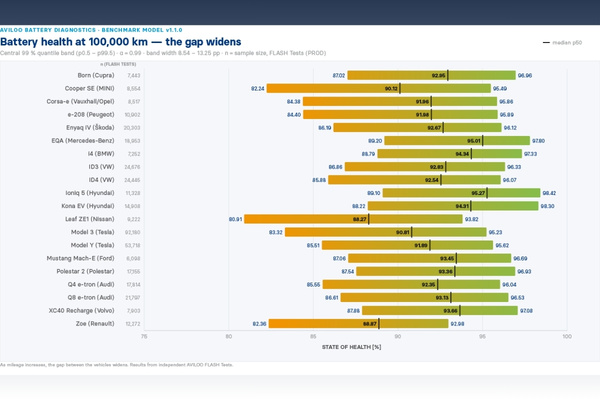
Individual Model Y vehicles showed differences of up to 11 percentage points in SoH across this mileage range. That could translate into approximately 46 km of range per charge, according to AVILOO.
The Model Y has been the world’s best-selling car of any type for three consecutive years*.
The Volkswagen ID.4 with a 77 kWh battery recorded a median SoH of 95.3% at 50,000 km and 90.6% at 150,000 km. The corresponding real-world range was approximately 373 km and 354 km, respectively.
At higher mileages, individual ID.4 vehicles differed by as much as 11–12 percentage points in SoH, equivalent to roughly 45 km of range per charge. The ID.4 was also among Europe’s best-selling EVs in 2025, with more than 40,000 units sold in the first half of the year alone**.
The Hyundai IONIQ 5 with a 72.6 kWh battery recorded the highest median SoH of the four models examined. Its median result declined from 97.2% at 50,000 km to 92.8% at 150,000 km.
That represents an estimated real-world range of approximately 335 km per charge at 50,000 km, falling to around 319 km at 150,000 km. By 150,000 km, the gap between individual vehicles exceeded 12 percentage points in some cases, equivalent to approximately 42 km of range.
The Nissan Leaf ZE1 with a 40 kWh battery recorded the lowest median SoH of the four models. Its median battery health declined from 91.1% at 50,000 km to 86.3% at 150,000 km.
The Leaf also showed the widest variation between individual vehicles, with differences of up to 13.5 percentage points in SoH at 150,000 km. That equates to roughly 29 km of range per charge.
Because of its smaller battery, the Leaf delivered an estimated real-world range of approximately 196 km per charge at 50,000 km, falling to around 185 km at 150,000 km. The model is best suited to shorter, more local journeys, AVILOO said.
The Leaf was the world’s first mass-market EV and has sold more than 650,000 units worldwide***. Its results also illustrate how battery size and charging frequency can influence the real-world performance of a used EV.
Why small SoH differences matter
A difference of 10 percentage points or more in battery health can have a practical impact beyond the figure shown on a report.
It may represent tens of kilometres of lost range per charge, potentially determining whether a vehicle completes a long journey without an additional charging stop. For buyers, dealers, fleet operators and lenders, that difference can also affect how much a used EV is worth.
AVILOO said a model-wide average cannot show where an individual vehicle sits within the expected range. An independent test is therefore needed to assess the condition of a specific battery.
Global data captures climate differences
Mileage is not the only factor affecting battery health. Temperature can influence both battery degradation and charging performance.
Cooler climates, for instance, can reduce charging speeds and produce different wear patterns from those seen in warmer regions.
AVILOO said its global database helps the report reflect a wider range of climates and driving conditions. The tests cover vehicles from North and South America, Europe, Australia and Asia, rather than focusing on a single country or market.
Implications for the used-EV market
Battery condition is becoming increasingly important as the used-EV market expands.
Buyers of used petrol and diesel vehicles have traditionally relied on mileage, service records and inspection histories to assess a car’s condition. For used EVs, the battery is the most expensive component and one of the parts most likely to differ from one vehicle to another.
Marcus Berger, CEO of AVILOO, said:
“The truth in this data is that averages hide a lot. Yes, EV batteries are ageing better than the ‘they wear out fast’ myth suggests – but that’s not the most useful thing this report tells you. What matters is that battery health varies significantly between models, and even more between individual cars of the same model.
“A gap of ten or fifteen percent in state of health is a real difference in range, in what a car is worth, and in what you can rely on it for. You simply can’t know where your car sits in that range without testing it independently.
“That’s why we built the AVILOO FLASH Test, and why we’re now publishing the AVILOO Certified EV Battery Report twice a year – to give the whole market, from individual buyers to fleets and insurers, an honest, independent and genuinely global picture of how these batteries perform.”
AVILOO said the FLASH Test is designed to provide an independent assessment rather than simply reproduce the figure generated by a vehicle’s battery-management system.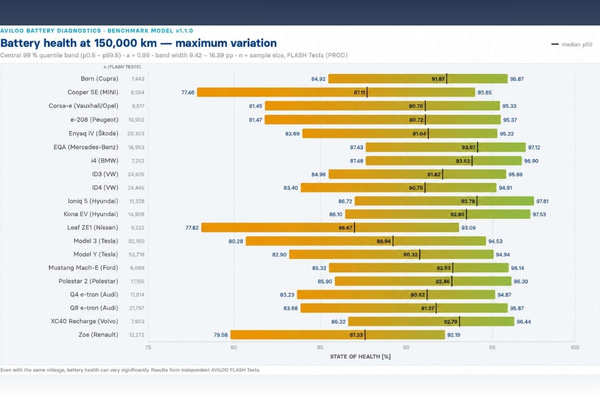
The company calculates SoH using a statistical model trained on hundreds of thousands of comparable used vehicles. The model considers the vehicle’s internal health assessment alongside battery SoH, mileage, age, charging cycles, cell-voltage spread, energy counts and other diagnostic signals.
AVILOO said this approach gives consumers, dealers, fleet operators, remarketing companies, insurers and lenders a consistent way to compare battery health across brands and models.
AVILOO expands battery warranty across Europe
This summer, AVILOO launched its Battery Warranty across Europe, extending the company’s diagnostics into a financially backed guarantee for used-EV buyers.
For each vehicle, AVILOO uses its global diagnostics database to calculate an individual SoH threshold. The battery must remain above that limit for 20,000 km during the one-year warranty period.
If the battery falls below the threshold, customers receive compensation of £2,700 in the UK or $3,600, and €3,000 in most European countries.
The warranty is currently available in the UK, Germany, the Netherlands, Finland, Austria, Belgium, Ireland, Switzerland, France, Sweden, Norway and Denmark.
Automotive companies using AVILOO testing
AVILOO said Mercedes-Benz, Volvo and Porsche Holding have selected it as a preferred independent third-party battery-testing provider for dealerships across Europe. The FLASH Test is being used on both own-brand vehicles and trade-ins.
Leasing companies Ayvens and Arval use AVILOO testing during their end-of-lease remarketing processes. Auction groups BCA and Cox Automotive have also integrated the FLASH Test into their European operations.