





Organic semiconductors are opening the door to a new class of lightweight, flexible electronics, from flexible displays and printable circuits to wearable sensors and devices that harvest ambient energy. At the heart of their performance is doping adding specific molecules to a semiconductor to control how many charge carriers it can support and how efficiently it transports them.
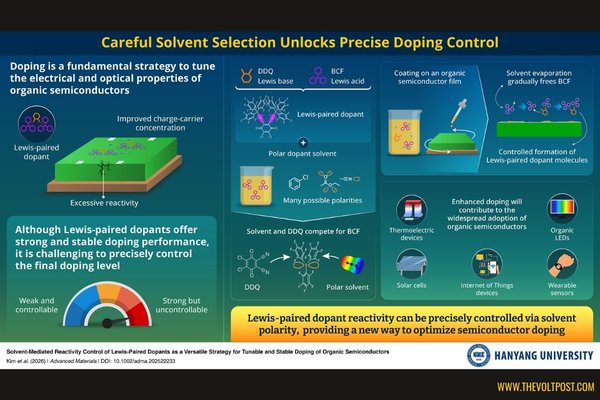
Getting that doping level “just right” has been a longstanding challenge. Researchers have been looking for systems that deliver three things at once: strong doping capability, precise control, and long?term stability.
A recent class of materials called Lewis?paired dopants solves part of the puzzle. These complexes form when a Lewis acid and a Lewis base interact, creating highly stable dopants with exceptional strength. The drawback is their very high reactivity, which makes it difficult to fine?tune the final doping level instead of simply driving it to the maximum.
To address this, a team led by Professor Jaeyoung Jang and Dr. Sang Beom Kim at Hanyang University, Korea, explored whether they could dial back and control the reactivity of Lewis?paired dopants through smart choice of solvent.
Their study, published online in the journal Advanced Materials on March 29, 2026, outlines a practical strategy: using solvent polarity to regulate dopant behavior and achieve strong, controllable, and stable doping in organic semiconductors.
The researchers focused on a Lewis?paired dopant made from two molecules, DDQ and BCF, and tested its behavior in six solvents with different polarities using spectroscopy and computational modeling.
They found that in highly polar solvents, BCF is captured by the solvent molecules, which prevents the dopant pair from forming properly when the solution is applied to the semiconductor. In moderately polar solvents such as ethyl acetate, this capture is temporary. As the solvent evaporates during processing, BCF is gradually released and can then pair with DDQ. This evaporation?driven release allows fine control over the doping level without damaging the semiconductor film or changing the dopant chemistry.
By using ethyl acetate as the processing solvent, the team was able to finely tune doping across several organic semiconductors, including materials that are normally difficult to dope. The doped materials achieved a high thermoelectric power factor and Seebeck coefficient, key metrics for how effectively a material converts heat into electric power. “Our simple solvent?mediated strategy provides a new way to optimize semiconductor doping without designing entirely new dopant molecules,” Prof. Jang notes. He adds that the approach could help enable high?performance, stable organic thermoelectric materials for self?powered wearables and low?power sensing devices.
 Because precise control of charge carriers underpins many organic electronic technologies, these findings have broad engineering implications. Potential applications range from thermoelectric generators and solar cells to organic LEDs, health?monitoring sensors, and Internet?of?Things devices.
“We believe this concept will influence the design of future organic electronic materials and help accelerate the development of next?generation flexible and sustainable electronics,” Prof. Jang concludes.
Reference
| Title of original paper: | Solvent-Mediated Reactivity Control of Lewis-Paired Dopants as a Versatile Strategy for Tunable and Stable Doping of Organic Semiconductors |
| Journal: | Advanced Materials |
| DOI: | 10.1002/adma.202522233 |