



Imagine your car not just driving itself but anticipating your coffee run, tweaking the AC based on your mood, or spotting a failing battery before it strands you all without phoning home to the cloud.
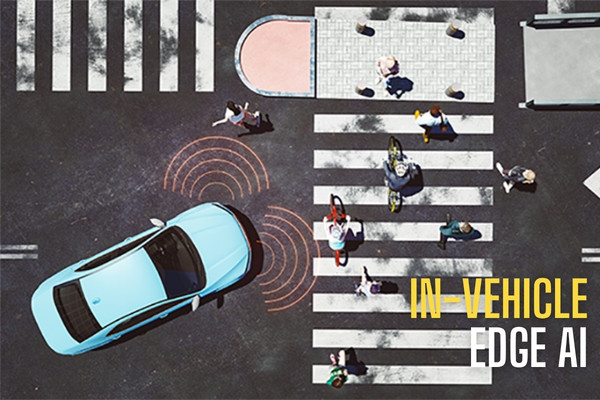
That’s the promise of in-vehicle edge AI, where processing happens right inside the vehicle. As software-defined vehicles (SDVs) take center stage, edge AI is shifting from buzzword to must-have, enabling real-time decisions in spotty connectivity or privacy-sensitive scenarios.
Gone are the days when AI meant shipping gigabytes of data to distant servers. Edge AI mitigates numbers locally using onboard hardware, slashing latency to milliseconds and keeping your data private. In-vehicle edge AI is today known to be a game-changer for everything from advanced driver assistance systems (ADAS) to personalized cockpits.
Why Edge AI Fits Perfectly in Cars
Cars aren’t data centers they’re mobile, power-hungry, and often offline. Cloud AI shines for heavy lifting like model training, but edge handles the gritty, real-time stuff, fusing sensor data from cameras, radar, and LiDAR for instant obstacle detection or optimizing EV range on the fly.
Take adaptive energy management. Edge AI can dynamically adjust power distribution between propulsion, cabin systems, and infotainment based on driving patterns and battery health potentially extending range by 10-15% without driver input.
Predictive diagnostics as AI shifts through vibration, temperature, and integrate data to flag issues early, cutting downtime.
Aptiv’s CES 2026 demos highlighted this “intelligent edge,” where vehicles sense, think, and act autonomously, from robotics-inspired autonomy to personalized user experiences.
Their solutions process data on-device for faster responses, optimizing everything from zonal controllers to full-vehicle orchestration.
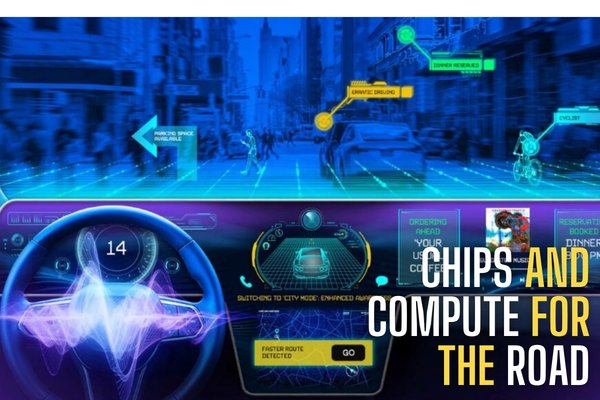
Chips and Compute for the Road
Powering this are specialized AI chips optimized for automotive rigor, high temps, vibration, and functional safety standards like ISO 26262 ASIL-D. NVIDIA’s Jetson Orin NX and Orin Nano lead with 100-275 TOPS (trillion operations per second), handling multi-modal AI for agentic scenarios like proactive navigation or sentry mode.
Texas Instruments is pushing boundaries too, tailoring edge AI for everyday ops like voice assistants and energy optimization at CES 2026, signaling OEMs’ focus on deployable smarts. IDTechEx forecasts the edge AI chip market hitting $80B by 2036, with automotive claiming a big slice alongside smartphones and robots.
Then there’s the automotive AI box, a plug-and-play compute unit for mid-range vehicles. These 30-200 TOPS powerhouses upgrade IVI systems and cockpits, supporting 1-8 billion parameter models for real-time reasoning.
Geely and ThunderSoft’s NVIDIA-based box, for instance, nails agent matrix tasks like welcome interactions and high-precision parking aids (HPA).
SDVs and In-Vehicle Edge AI
Centralized compute platforms like BMW’s Neue Klasse or Tesla’s FSD hardware, pool resources from gigahertz-class SoCs, enabling zonal E/E architectures with TSN Ethernet for deterministic data flow.
This setup supports over-the-air (OTA) updates, pushing new AI models seamlessly. Cerence AI’s xUI platform at CES 2026 demoed agentic AI and LLMs for natural conversations, evolving from voice commands to full contextual understanding.
Microsoft’s mobility push echoes this, blending cloud-edge hybrids for digital engineering, while V2X (C-V2X, 5G) adds cooperative smarts like traffic coordination.
Heat, Safety, and MLOps Hurdles
It’s not all smooth roads. It demands automotive-grade MLOps, toolchains for training, deploying, and updating models under strict safety rules. Legacy E/E architectures bottleneck data sharing, but SDVs’ zonal controllers and service-oriented gateways fix that.
Power and heat another major bottleneck. A 200 TOPS AI box might guzzle 50-100W, straining 12V systems cue 48V architectures and efficient NPU designs. Privacy regs like GDPR push local processing, but debugging edge models without cloud telemetry is tricky.
SAE’s SIAT 2026 paper nails it, SDV infrastructure flexible compute, high-speed nets, and vehicle-wide data access is key to unlocking edge AI beyond ADAS.
What’s Next for In-Vehicle Edge AI
ThunderSoft’s AI box powers Geely cockpits with 200 TOPS for multi-tasking agents. Aptiv’s edge stack spans autonomy to robotics, proving cross-industry scalability.
Looking ahead, IDTechEx sees quasi-zonal SDVs generating $755B in hardware by 2029, with AI features monetized via FaaS at 34% CAGR. Expect generative AI avatars, predictive maintenance, and even emotional sensing by 2030.
TI’s CES focus on practical edge AI hints at broader adoption in non-premium cars. As IDC notes, edge-cloud collababoration, edge for speed/privacy, cloud for reasoning will dominate.
The biggest technical hurdles for in-vehicle edge AI stem from the car’s harsh, constrained environment, where low latency, safety, and efficiency are non-negotiable.
Power and Thermal Limits
Edge devices like AI boxes (30-200 TOPS) can draw 50-100W, straining 12V batteries and generating heat in tight engine bays. Cooling solutions and efficient NPUs are critical, especially for 24/7 ops in EVs.
Compute Constraints
Automotive chips must hit high TOPS (e.g., NVIDIA Orin 200+) on limited memory (<8GB) while meeting ASIL-D safety. Model quantization/pruning trades accuracy for feasibility, but rare edge cases degrade performance.
Legacy E/E Architectures
Traditional distributed ECUs bottleneck data flow; zonal controllers and TSN Ethernet are needed for vehicle-wide sensor fusion, but retrofitting is tough.
MLOps and Updates
OTA model deployment requires automotive-grade pipelines for validation, versioning, and rollback complicated by intermittent connectivity and zero-trust security.
 Sensor and Environment Variability
Fusing noisy data from cameras/radar in rain, fog, or tunnels demands robust models; domain adaptation helps, but real-world testing lags.
Cybersecurity
Local processing exposes sensitive data (e.g., biometrics) to attacks; secure boot, encryption, and anomaly detection add overhead.
In-vehicle edge AI will be the brain making cars proactive partners. From powertrain tweaks to immersive UIs, it’s transforming mobility while dodging cloud pitfalls. With SDVs accelerating, 2026 feels like the tipping point.