


Generational, the UK-based EV battery diagnostics specialist, has just dropped its 2025 Battery Performance Index, the biggest study yet of electric vehicle battery health in the UK. It analyzed over 8,000 passenger cars and light commercial vehicles, finding the average state of health (SoH) holds strong at 95.15% of original capacity.?
The 2025 Battery Performance Index sets fresh benchmarks for what’s normal, above average, or concerning as UK EVs age into 2026. It’s a vital guide for buyers, retailers, fleet managers, insurers, and lenders.
Drawing from 36 brands, vehicles 0-12 years old, and mileage up to 160,000+, here’s the standout data:
- Overall average SoH: 95.15%.
- 8-9-year-olds: Median 85% capacity.
- High-mileage EVs (100k+ miles): Often 88-95% SoH.
- 4-5-year-olds: Median 93.53%.
- OEM warranties (typically 70% over 8 years/100k miles) are rarely at risk.
Percentile Breakdowns by Age
- For 4-5-year-olds: Bottom 25th percentile at 91.64%, median 93.53%, top 75th at 96.49%.
- In the 8-12-year group: 25th at 82%, median 85.04%, 75th at 90%.
- As vehicles age, the performance gap widens highlighting how maintenance makes all the difference between top performers and laggards.?
 Key Insights
Battery degradation isn’t the crisis people once feared. The real issue now is uncertainty about condition, which hits used EV values, performance, and buyer confidence.
Mileage alone doesn’t tell the story anymore, a new fleet EV with 90,000 miles might outshine an older low-mileage one, depending on charging habits and use.?
What It Means for Buyers
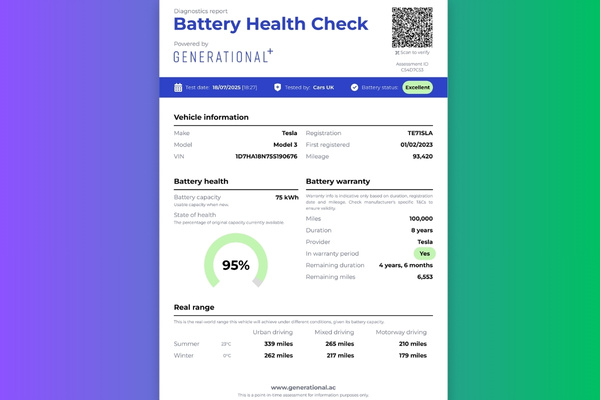
Most EV batteries will outlast the car itself, sailing past warranty minimums. But with performance varying more over time, verified testing is key. Think of it like checking service history or odometer readings battery transparency is non-negotiable.?
 What It Means for Industry
-
Manufacturers: Real-world data proves batteries last, so OEMs can tout longevity and bolster resale values with confidence.
-
Insurers/Warranties: Shift to data-driven pricing based on actual condition, not just age and miles.
-
Fleets: Better decisions on usage, retention, and resale to cut total costs.
-
Policymakers: Mandate condition reporting to ease battery replacement fears and boost EV uptake.?
Bottom line
Battery testing is now essential infrastructure for the growing UK EV market. It cuts uncertainty, lifts residuals, trims finance costs, and speeds deals, building trust for everyone involved.
 Leadership Comments
Oliver Phillpott, CEO of Generational, said: “The Generational Battery Performance Index definitively shows that EV batteries are performing far better than many consumers and industry stakeholders have been led to believe. With an average State of Health of over 95%, and even older vehicles comfortably exceeding warranty thresholds, the underlying fundamentals are extremely strong.
“Transparency in battery condition is the main challenge facing the market today, and essential infrastructure for a healthy used EV sector; as vehicles age, the variance between the best and worst performers widens, and that dispersion defines risk.
“By establishing clear benchmarks for what is typical, above and below average as we look to drive further growth in 2026, we are giving the market the reference points it needs to price risk accurately, strengthen residual values and accelerate adoption.”
Philip Nothard, Chair of the Vehicle Remarketing Association, said: “Potential buyers of used electric cars and vans understandably place a huge emphasis on battery health. They need to trust that this fundamental and expensive vehicle component will meet their needs without any unpleasant surprises. Transparency will prove crucial in building future consumer confidence and dispelling the many misconceptions that have gained currency around EV batteries.”
The full Battery Performance Index can be downloaded here