


The EPC2366 eGaN Transistor can withstand a transient voltage of up to 48 V and a drain-to-source voltage of 40 V.
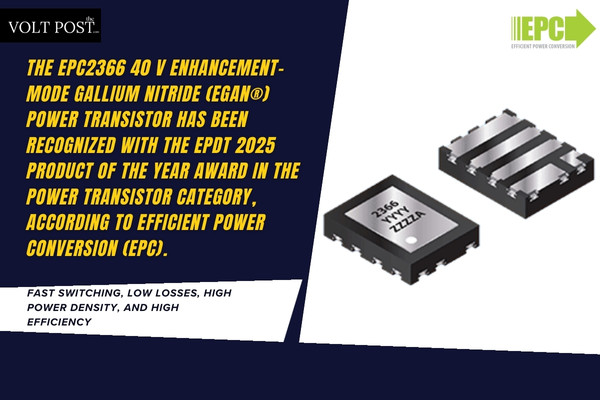
The EPC2366 40 V enhancement-mode gallium nitride (eGaN®) power transistor has been recognized with the EPDT 2025 Product of the Year Award in the Power Transistor category, according to Efficient Power Conversion (EPC). This accolade highlights EPC’s leadership in providing innovative GaN technology that boosts performance and efficiency in data center, robotics, and AI infrastructure applications.
Comprehensive Electrical Performance
For applications requiring fast switching, low losses, high power density, and high efficiency, the EPC2366 is a 40 V enhancement-mode GaN (eGaN®) power transistor. The EPC2366 is an outstanding option for 12 VOUT synchronous rectifier applications, far outperforming any aging power MOSFET transistors of similar voltage.
Its extremely low drain-to-source on-resistance (RDS(on)) of 0.8 m? reduces conduction losses at high current levels. RDS(on) × QG < 12 m? *nC is the device’s tremendous gate charge-based Figure of Merit.
This is a key measure of how well it switches. This low FoM shows that the EPC2366 eGaN Transistor can also reduce switching and conduction losses. Because of this, it is superior to conventional silicon MOSFETs for high-frequency power conversion.
The EPC2366 eGaN Transistor can withstand a transient voltage of up to 48 V and a drain-to-source voltage of 40 V. Additionally, it can manage pulsed currents of roughly 360 A and continuous drain currents of up to 88 A at a gate voltage of 5 V. Similar to silicon MOSFETs, its enhancement-mode operation makes it simple to control the gate while retaining the advantages of GaN technology, including very low output capacitance and no reverse recovery charge.
These features make switching transitions happen faster, cut down on deadtime losses, and make synchronous rectification and half-bridge topologies more efficient.
The device is thermally optimized for high power density thanks to its small 3.3 × 2.6 mm PQFN package, which has a thermal pad on the back that makes it easy for heat to flow to the PCB. The thermal resistance from the junction to the case is usually about 0.6 °C/W, and the thermal resistance from the junction to the board is about 1.8 °C/W.
The junction-to-ambient thermal resistance changes based on the design of the board. It is about 54 °C/W on a JEDEC standard board and as low as 26 °C/W when mounted on EPC’s recommended evaluation layout.
If the PCB is designed and the copper is spread out correctly, these thermal parameters make it possible to get rid of heat effectively, which allows for reliable operation up to a maximum junction temperature of 150 °C.
 Half-bridge evaluation board
Efficient Power Conversion (EPC) made the EPC90167, a 40 V half-bridge evaluation board, to help quickly and accurately test EPC’s EPC2366 enhancement-mode eGaN® power transistors in high-frequency, high-current power conversion applications.
The board has two EPC2366 devices in a small half-bridge configuration and all the other necessary circuitry for immediate use. This makes it a useful reference design for engineers who are working on DC-DC converters, motor drives, or other fast-switching power stages. It is designed and built in such a way that it can take full advantage of GaN technology‘s high switching speed and low loss properties while keeping parasitic inductances and ringing to a minimum.
The board can power a gate drive from 7.5 V to 12 V and works with standard PWM logic input levels. It can work in either single-input or dual-input PWM mode, which makes it flexible enough to work with different types of controllers.
In single-input mode, the onboard logic creates complementary gate signals with a specific amount of deadtime. In dual-input mode, the user can directly control the high-side and low-side switches for more advanced modulation schemes, as long as they make sure that the right amount of deadtime is used.
The EPC90167’s main design goal is to improve thermal performance. The board uses the backside thermal pads of the EPC2366 devices to move heat quickly into the PCB and, if desired, into an external heatsink.
The EPC90167 is easy to use and measure because it has clearly marked test points for important signals like gate drive voltages, switch node waveforms, and supply rails. The guide gives suggested steps for starting up and shutting down the system safely.
These steps include turning on the gate driver before applying the main bus voltage and slowly increasing the operating conditions while keeping an eye on the temperature and waveforms.
Enabling the Future of Efficient Power: Award-Winning Excellence
The EPC2366 is a game-changing eGaN® device optimized for synchronous rectification on the secondary side of 48 V–12 V LLC converters.
Its industry-leading figure of merit enables higher switching frequencies and improved efficiency.
These advantages make it well suited for high-density power applications such as AI data center power supplies.
Key Comments
“Winning the EPDT Product of the Year award recognizes how GaN continues to redefine what’s possible in power electronics,” said Alex Lidow, CEO and co-founder of EPC. “The EPC2366 showcases our ongoing commitment to help engineers design smaller, faster, and more efficient systems that meet the power demands of tomorrow.”
As EPDT’s Editor, Mike Green, commented; “Congratulations to all the team at EPC who have participated in the development, introduction and subsequent promotion of the EPC2366. The company is taking wide bandgap technology into exciting new areas that hadn’t previously been explored, and the differentiation it has achieved with this device, in terms of FoM and power density, will be of clear value to next-generation power system design.”
For additional details, CLICK HERE or view the EPC2366 data sheet and EPC90167 evaluation board quick start guide.