


Researchers utilize superpixels, instead of pixel-level information, to enhance the robustness and accuracy of vision-based structural health monitoring
By removing the need for physical sensors or surface modifications, vision-based structural health monitoring methods provide non-contact, full-field vibration measurement at a lower cost. However, conventional methods rely on pixel-level data, which is noise-sensitive and exhibits instability.

Researchers recently developed an innovative virtual sensor framework that uses superpixels as virtual sensors for vibration measurements rather than pixels. Without the need for physical markers or contact sensors, this approach improves accuracy and robustness even in complex environments.
In various fields such as aerospace, civil engineering, and industry, structural health monitoring (SHM) and condition monitoring are essential processes that guarantee the reliability and security of engineering systems.
These systems are frequently evaluated utilizing vibration-based methods, which identify damage by analyzing changes in a structure’s vibration characteristics. For this, contact-type sensors are usually used in traditional methods.
Despite their effectiveness, these methods have a number of drawbacks, such as low spatial resolution, high costs, difficulties with sensor placement, and measurements that are restricted to the small regions around each sensor.
Vision-based methods have shown promise as non-contact, full-field vibration measurements that are carried out directly from video sequences. These methods are easy to use, inexpensive, and provide high spatial resolutions, making them appropriate for buildings with complex geometry or limited accessibility.
Assessment of the complete structure is also made possible by full-field motion estimation. However, a lot of the vision-based approaches that are now in use have struggled with large structural motions, low-texture surfaces, or lighting changes.
Even though more recent phase-based optical flow methods increase robustness by estimating motion from phase information, they still rely on pixel-level data, which is naturally prone to noise, lighting fluctuations, and distortion in addition to being computationally demanding and challenging to interpret.
To address these challenges, a research team led by Professor Gyuhae Park from the Department of Mechanical Engineering at Chonnam National University in South Korea, has developed a novel superpixel-based virtual sensor framework. “Our approach utilizes superpixels, clusters of neighboring pixels with similar vibrational and structural behavior, as virtual sensors for motion estimation,” explains Prof. Park. “This creates a virtual sensor grid that can adapt to any structure and offers robust and accurate full-field vibration measurement without the need for physical markers or contact sensors. ” The study was made available online on September 30, 2025, and published in Volume 240 of Mechanical Systems and Signal Processing on November 01, 2025.
The proposed approach operates in three stages. In the first stage, pixel-level motion is estimated from video sequences using the phase nonlinearity-weighted optical flow (PNOF) algorithm, developed by the authors in a previous study.
For each pixel, the algorithm extracts local motion from phase information and evaluates the reliability of the estimated displacements in different directions. Unreliable displacement components with high phase nonlinearity are then discarded, and the remaining reliable components are integrated to produce a marker-free full-field displacement map.
In the second stage, the overall confidence of the full displacement at each pixel is calculated, providing a built-in reliability assessment, a first among vision-based vibration measurement methods.
In the third stage, this overall confidence and the full field displacement map are used together to group pixels into superpixels, creating a virtual sensor grid.
Depth information is also incorporated to improve alignment between the sensor grid and structure. Finally, full-field displacement is calculated at the sensor level for damage detection.
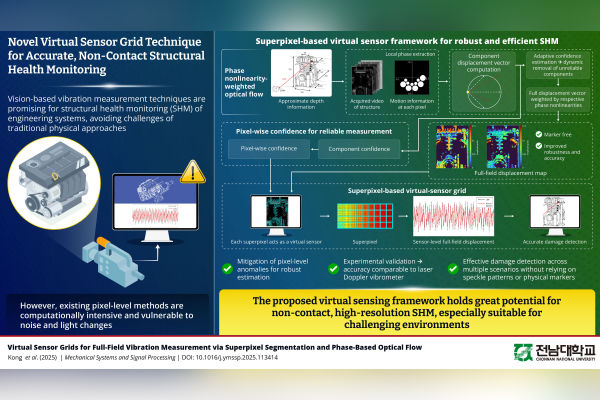
Experimental validation performed on an air compressor system showed that the proposed method achieves accuracy comparable to that of a Laser Doppler vibrometer (LDV) while enabling effective structural damage detection without physical markers or contact sensors. While individual pixels showed some variability, the superpixel-based virtual sensors effectively mitigated these effects.
“Vibration-guided superpixel segmentation enhances both robustness and interpretability of structural diagnostics even in complex environments,” explains Prof. Park. “Our approach makes full-field structural monitoring accessible, low-cost, and deployable using ordinary cameras supporting applications in infrastructure monitoring, aerospace and mechanical equipment diagnostics, smart cities, robotics, and digital twins.”
Overall, this innovative method represents a major advancement for vision-based SHM and may help pave the way for its broader adoption.
Reference
| Title of original paper: | Virtual sensor grids for full-field vibration measurement via
superpixel segmentation and phase-based optical flow |
| Journal: | Mechanical Systems and Signal Processing |
| DOI: | 10.1016/j.ymssp.2025.113414 |
| COI Statement: | The authors declare that they have no known competing financial interests or personal relationships that could have appeared to influence the work reported in this paper.
|
 About The Author
Prof. Gyuhae Park is a Professor of Mechanical Engineering at Chonnam National University, contributing to advanced sensing and structural diagnostics research. His research group focuses on smart systems, noise and vibration, AI-driven structural health monitoring, and non-contact, vision-based sensing technologies.
He has published more than 500 technical works, including over 130 journal articles, more than 400 conference papers, and 10+ book chapters (Google Scholar citations: 20,550; h-index: 59 as of Nov. 2025).
He has served as an Associate Editor for nine top-tier SCI(E) journals and has actively contributed to international conferences as an organizing and scientific committee member.