


Decentralized RF mesh provides a strong foundational layer upon which these operational improvements can be built. It reduces rollout friction, lowers lifecycle costs, and creates a stable substrate for utility data flows. Most importantly, it aligns with the fundamental principle driving India’s energy transition: empowerment at the edge.

India’s power sector is undergoing its most significant structural transformation in decades. With demand rising, renewable energy accelerating, and expectations for reliability increasing across every consumer segment, the country’s distribution utilities are navigating an unprecedented operational challenge.
The push toward smart metering under the Revamped Distribution Sector Scheme (RDSS) is often viewed through the lens of billing efficiency or loss reduction, yet its deeper significance lies in something much more foundational: the creation of a digital grid that can sustain India’s energy ambitions for the next quarter century.
At the centre of this transition lies connectivity: reliable, affordable, scalable connectivity for millions of devices at the grid edge. For a long time, grid digitisation around the world has relied on connectivity models borrowed from telecommunications, assuming that centralised networks, towers, and cellular infrastructure would naturally scale to meet utility needs.
India’s experience is proving that this assumption no longer holds. The sheer density, diversity, and environmental variability across the country make a one-size-fits-all model deeply impractical. Urban high-rises, Himalayan terrains, coastal humidity, legacy infrastructure, and varying load patterns all exist within the same national system. In this environment, the question is not whether the grid should digitise, but how.
Increasingly, decentralized RF mesh is emerging as the answer.
Unlike hierarchical networks that depend on a limited number of high-capacity nodes, RF mesh distributes intelligence across every connected device. Each meter forms part of a self-healing, self-optimising network capable of routing data dynamically according to real-time conditions. In the Indian context, where physical constraints or radio interference can vary street by street, this architectural shift becomes indispensable. Instead of forcing the grid to conform to the network, the network adapts organically to the grid.
This adaptability is not a theoretical advantage; it is a practical necessity in the world’s most complex smart metering terrain. India’s smart metering rollout is operating at a scale unmatched globally, with tens of millions of endpoints planned for installation within a compressed timeline.
The communication layer supporting this rollout must therefore meet five essential criteria: reliability even in dense or obstructed environments; affordability at a national scale; resilience in the face of outages, weather, and interference; true interoperability across vendors; and independence from any single technology stakeholder. Decentralized RF mesh aligns with these demands more directly than any alternative.
A centralised system inherently introduces single points of failure. When a gateway fails, thousands of meters lose connectivity. When a tower faces interference, an entire region suffers. RF mesh, by contrast, eliminates these fragilities by design.
Communication paths multiply as devices join the network, and the failure of any one device becomes inconsequential. For distribution utilities operating in high-loss areas or with dispersed infrastructure, this resilience becomes a strategic asset.
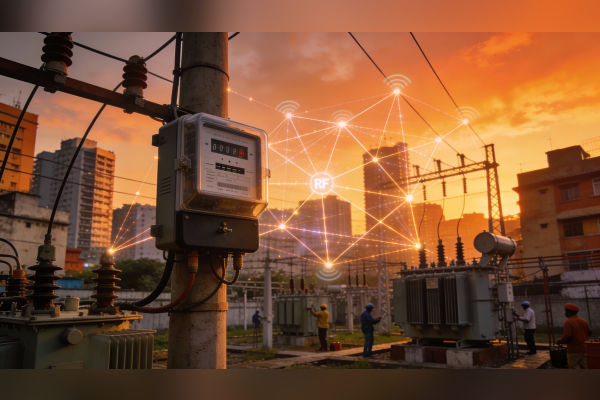 A communication architecture that reflects the physical realities of the grid enables better outage management, more consistent billing cycles, and a clearer view of the network: something utilities have historically struggled to obtain.
India’s adoption of multi-vendor smart metering ecosystems also amplifies the relevance of decentralized mesh. One of the most progressive aspects of RDSS has been the industry’s movement away from monolithic, vertically integrated systems.
The decision to separate meters, NICs, HES platforms, and AMISP responsibilities has opened the door to competition and innovation, while also protecting utilities from lock-in. In such an ecosystem, interoperability becomes the currency of trust. Vendors must ensure their devices communicate seamlessly regardless of brand or model.
Centralized architectures often hinder this openness because they require tighter vertical integration to guarantee reliability. RF mesh, by distributing functionality across nodes, eases the burden on individual components. As long as each meter speaks the same standardised language, the network functions cohesively. For India, this is a policy-aligned approach that supports domestic manufacturing, encourages investment, and spreads risk across multiple suppliers.
This shift towards decentralization is also deeply aligned with the future of energy in India. The grid is no longer a predictable, top-down structure. It is becoming disaggregated, multi-directional, and increasingly dynamic.
Rooftop solar continues to expand, electric mobility is gaining traction, and residential and commercial consumers are adopting smarter appliances and localised storage solutions. All of these innovations introduce variability at the distribution level.
To manage this variability safely and efficiently, utilities need near-real-time visibility at the network edge, visibility that traditional systems were never designed to provide at such a scale.
RF mesh enables each meter to act not only as a node in a communication network but also as a sensor supporting broader grid intelligence. Voltage anomalies, phase imbalances, load fluctuations, and localised outages can all be detected with far greater granularity.
As renewable penetration increases, this granularity becomes indispensable. The integration of distributed energy resources requires accurate, frequent, and resilient data flows to avoid overloading feeders or causing instability.
The story of India’s smart metering transformation is therefore not just about deploying meters faster than any other nation. It is about using this opportunity to build the communication backbone of the modern Indian grid.
The success of RDSS hinges not only on technological choices but on policy clarity, ecosystem collaboration, and the ability to keep pace with a system undergoing simultaneous electrification, decarbonisation, and decentralisation.
The semiconductor and electronics manufacturing ecosystem has a particularly important role to play in this shift. NIC modules, RF chipsets, secure elements, gateways, and edge processors must all be developed with interoperability, scalability, and long-term availability in mind.
This is not a short-term rollout but a multi-decade transformation. A decentralized RF mesh approach is uniquely well-suited to local innovation, as it does not depend on proprietary infrastructure or licensed spectrum. Indian companies can build, test, and innovate directly on open, standards-aligned platforms, contributing to a globally competitive communications ecosystem for utilities.
Of course, no communication system – centralized or decentralized – can solve every problem. Installation quality, workforce training, HES integration, cybersecurity governance, and field validation are equally vital.
But decentralized RF mesh provides a strong foundational layer upon which these operational improvements can be built. It reduces rollout friction, lowers lifecycle costs, and creates a stable substrate for utility data flows. Most importantly, it aligns with the fundamental principle driving India’s energy transition: empowerment at the edge.
As the power system becomes increasingly complex, intelligence must migrate outward, not inward. A grid controlled solely from the centre cannot respond fast enough to local variability. A grid that senses and reacts through millions of interconnected nodes can. Decentralized RF mesh turns this principle into practice.
India’s smart metering boom is frequently described in terms of numbers: how many meters deployed, how many states awarded, how many tenders finalised. But the real achievement lies in the architecture being built underneath. The decision to embrace decentralised communication represents a technological and philosophical shift: one that favours openness over dependency, adaptability over rigidity, and long-term resilience over short-term convenience.
For a country as vast and varied as India, this shift could define not only the success of RDSS but the trajectory of the entire energy system for decades to come. Decentralisation is becoming the structural logic of the modern Indian grid.
And as India continues its rise as both an energy and technology powerhouse, the world is taking notice.
 Not only because of the scale of the rollout, but because India is demonstrating something crucial: when connectivity mirrors the complexity of the grid rather than attempting to simplify it from above, the result is a system that is not only smarter, but stronger and better prepared for the future.
All the opinions in this article are solely those of Sebastien Pellorce, VP, India Business, Wirepas. The Volt Post takes no responsibility for the opinions, figures, and statistics mentioned in the column.