


Particle accelerators at CERN have produced some of the most astounding discoveries about the composition of the cosmos, such as the Higgs boson and antimatter. The pumps that circulate gas mixtures past these particle detectors need to be extremely reliable and maintain the contamination-free of the gases. The particle collider relies on KNF Pumps to meet these strict requirements.
What is the universe made of?
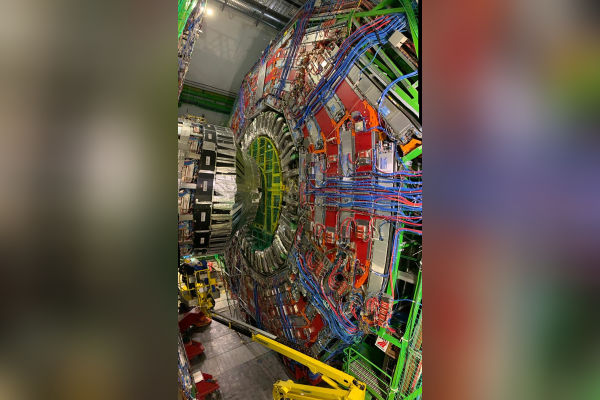
The fundamental structure of the particles that make up everything around us is being probed at the esteemed research facility CERN.
Numerous circular and linear particle colliders are located deep below, partially in Switzerland and partially in France.
These colliders are used for experiments that have led to various ground-breaking discoveries, such as the isolation of antimatter and the discovery of the Higgs boson.
Gaining deeper subatomic insights via particle accelerators
Some of the biggest and most advanced scientific instruments in the world are used in CERN’s research projects.
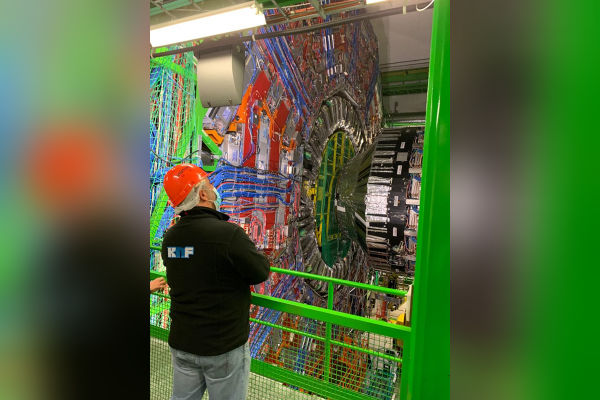
The Large Hadron accelerator (LHC), CERN’s largest particle accelerator, is situated 100 meters below the surface to eliminate environmental effects like radiation.
Particles are driven to nearly the speed of light in this instance before colliding with one another. The phenomena that take place during these collisions are captured by detectors.
Gases to detect collisions
Ionization is the result of charged, high-energy particles colliding with gas. To precisely trace particle tracks, these signals can be amplified using electric fields and then detected electronically. These tests’ findings offer more profound understandings of matter’s structure.
Particle accelerator requires demanding gas mixture
About 30 gas systems are in operation at CERN to provide the appropriate gas mixture to the detectors in the LHC experiments.
The mixture is a sensitive medium in which the signal produced by the multiplication of charges is recorded and examined.
For the particle collider experiments to run effectively and dependably, a proper and stable gas mixture composition is essential.
Great variety of gases used
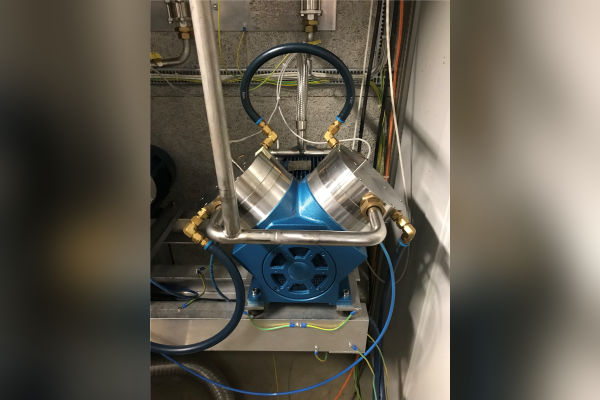
Gas mixtures for these particle detectors are composed of noble gases such as argon, xenon, helium, and other gases such as tetrafluoromethane, tetrafluoroethane, sulfur hexafluoride, isobutane, and carbon dioxide. KNF diaphragm pumps are deployed to circulate the gas mixtures and ensure they are free of contamination.
Drawing from expertise and experience
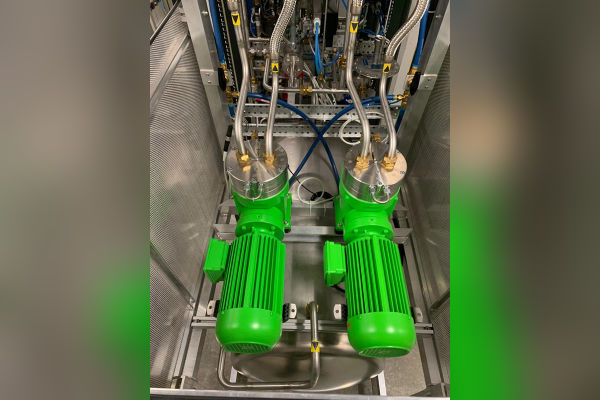
After working with KNF for decades, teams at the experiments highly value the company’s expertise and experience. When new diaphragm pumps were required to purify the specific gas mixtures and circulate them in one of CERN’s four particle detectors, the Compact Muon Solenoid (CMS), two KNF pumps were chosen, and a third installed as a backup.
Collaboratively customized particle collider solutions
Decades of successful collaboration with CERN enabled KNF to understand and deliver customized solutions for these highly specialized applications. Recently, the CERN Gas Team was proactively involved in the customization of the KNF process pumps N 0150 and N 1200.
Cooperation leads to longer service life
Based on the CERN Gas Team’s observations, KNF was able to increase the service life of the diaphragms by modifying the design of the pumps. Evidence of CERN’s continuing confidence in KNF comes from an additional order for 18 KNF pumps with a flow rate of approx. 170 l/min. These pumps were installed at the particle accelerators in 2022.
To Know More: CLICK HERE