


PCB recycling is more vital than ever, with an estimated 53.6 million tons of e-waste generated yearly and set to increase to 74.7 million tons by 2030. The disposal of electronic components and appliances in landfills leads to contamination with heavy metals and toxic organic compounds, which in turn affect groundwater and surrounding ecosystems.

The electronic sector is confronting a problem it helped create. Short product lifespans, fused materials and complex assemblies have turned printed circuit boards (PCBs) into one of the most stubborn forms of waste in the global stream.
It’s estimated that millions of tons of e-waste are generated annually, and most devices are never disassembled in a manner that allows for the recovery of components or materials on a large scale.
Manufacturers are now under pressure from regulators, resource constraints and their own sustainability commitments to change this trajectory.
The shift mirrors the broader trend of moving consumer electronics away from short lifespans toward sustainable design models. The result is a redesign effort that reaches deep into PCB architecture, material science and component engineering.
Turning E-Waste into a Resource
Traditional PCBs were never engineered with reuse in mind. Most boards rely on FR-4 substrate, made from glass-reinforced laminate and epoxy, because it is durable. However, once cured, this material is challenging to separate and recycle.
Boards are layered with copper foils, adhesives and protective coatings that further complicate recycling, making recovery of valuable materials inefficient.
When these boards reach the end of life, the metals within them, including gold, silver, copper and palladium, are often lost. Recovering those materials requires specialized facilities and processes. Even advanced recyclers struggle with boards that mix plastics, metals and hazardous chemicals in ways that resist disassembly.
The result is a significant gap between the theoretical value of e-waste and the amount that can be realistically captured.
Recycling PCBs is more vital than ever, with an estimated 53.6 million tons of e-waste generated yearly and set to increase to 74.7 million tons by 2030. The disposal of electronic components and appliances in landfills leads to contamination with heavy metals and toxic organic compounds, which in turn affect groundwater and surrounding ecosystems.
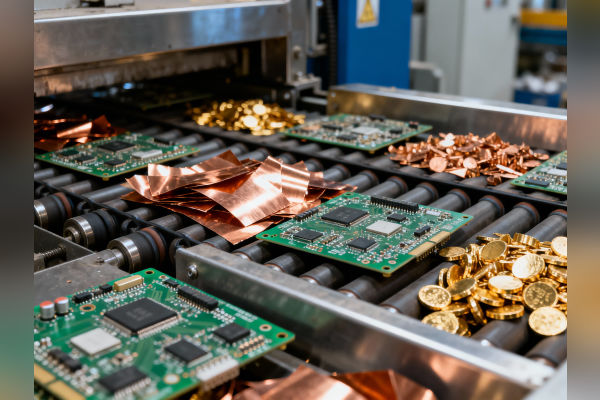
Yet, recycling these boards could be viable, as a single ton of waste electronics could produce precious metals and recapture up to 80% of the production cost, depending on the recycling processes and costs. The following metals can be recycled from e-waste.
| Precious Metal | Recycled Weight per Ton of Waste Electronics |
| Copper | 130 kilograms |
| Silver | 1.38 kilograms |
| Gold | 0.35 kilograms |
| Palladium | 0.21 kilograms |
Innovation in Action and Designing for a Circular Economy
Future-focused companies experiment with new approaches that allow PCBs and their components to reenter the supply chain. These efforts fall into several categories.
Using Sustainable Materials and Substrates
One area gaining traction is the use of biodegradable or recyclable substrates. Researchers have demonstrated that using biopolymers and flax in PCB manufacturing produces a water-soluble material that dissolves after use, making recycling easier and economically viable.
The same study found that these eco-sustainable substrates maintain electrical performance but can break down under controlled conditions, reducing long-term waste accumulation.
While these materials are not yet in mainstream use, they show how the industry may evolve. The goal is to design circuit boards that can be safely processed at the end of their life without relying on thermal or chemically intensive methods.
Designing for Disassembly
Material innovation alone cannot solve the challenges of recyclability. Manufacturers are also adopting new products based on disassembly principles, utilizing construction methods that make boards easier to fragment.
Approaches include:
- Modular layouts: Key components can be removed without damaging the board.
- Reduced use of adhesives: Glues and adhesives complicate mechanical separation.
- Standardized connectors: These could replace hard-soldered joints in certain applications.
Engineering groups are also developing frameworks that help manufacturers evaluate design choices based on end-of-life outcomes. By integrating recyclability into early planning stages, engineers can create a structured way to incorporate environmental goals without compromising electrical performance.
Reusing Components and Extending Life Cycles
Recovering a PCB is only the beginning. The next step is assessing whether any parts can be reused, which introduces a new set of challenges.
Once the components are removed, each must be tested to verify it meets functional and reliability requirements before reentering the supply chain. Testing encompasses several stages, including a visual inspection according to the IPC-A-601E Standard, which ensures the quality meets acceptable standards for reuse.
Physical examination and scans check for cracked or corroded surfaces, in-circuit testing while components remain on the board and parametric or functional testing confirms viability after removal.
These steps ensure salvaged parts can safely perform in new devices. This type of testing is a foundational step for any circular electronics strategy because reused components must match the performance of newly manufactured parts.
 Overcoming Hurdles in the Path to Recyclability
Reimagining PCB and component design requires more than technical creativity. Several structural challenges still limit adoption across the industry.
Understanding Economic Viability and Scale
Initially, recyclable materials, modular assemblies and new production methods introduce added costs at a time when manufacturers are already managing tight margins.
While some companies see long-term value in reclaiming components and materials, others hesitate because global recycling infrastructure is still unevenly distributed.
For component reuse in particular, there is no universal marketplace that guarantees high-volume demand for recovered parts. Building this pipeline requires coordination between manufacturers, repair shops, recyclers and refurbishers.
No manufacturer wants to “scrounge about” for a million components that are suitable for its new phone model, and quality consistency issues are a concern.
Focusing on Automation’s Role in Sorting and Salvaging
A significant barrier is labor. Manual disassembly of PCBs is slow, error-prone and dangerous, making the process unsustainable at scale.
However, automation is starting to meet the need and deliver consistent results, enabling it to win over large-scale producers.
Robotics and AI-assisted vision systems are used in identifying components, desoldering, sorting by type and preparing them for testing. These tools reduce handling errors, support worker safety and improve the reliability of recovered parts.
As automation improves, the economics of component recovery may shift, providing stronger incentives to design boards that can be efficiently disassembled.
Policy, Collaboration and Electronics’ Future
For PCB and e-waste recycling to really make a difference, it will require substantial industry collaboration, political pressure and market opportunities.
Growing Influence of Right-to-Repair Rules
Regulators embrace the shift toward sustainability. Consumers apply pressure on manufacturers to share proprietary designs, diagnostic methods and service parts to allow them to fix their own machines and electronics without turning to the manufacturer.
Several U.S. states have already passed laws in this regard, requiring manufacturers to help consumers keep products functional beyond their expected end-of-life and reduce the purchase of new goods.
Forming Industry-Wide Collaboration
Cooperation across the supply chain could lead to sustainable electronics. When professionals like material scientists, PCB fabricators, device manufacturers, recyclers and policymakers align and form shared goals, real change is possible. No single stakeholder can independently solve the problem of e-waste and recyclability.
With standardized labeling for easier sorting, shared protocols for component testing and the development of a new business model for component reuse, significant steps can be made.
Designing a Professional Watch List
Professionals across electronics, sustainability, IT and smart infrastructure can expect recyclability to influence more design decisions in years to come when a circular market is required and not just encouraged.
Opportunities for future-readiness include:
- New markets for recovered components
- Growth in automation technologies
- Greater emphasis on material traceability
- Potential regulatory incentives
What Comes Next?
Manufacturers are moving toward designs that support repair, recovery and reuse, but the transition is still in its infancy.
New materials, automated disassembly and stronger regulatory frameworks may help accelerate adoption.
As new developments mature, recyclability will likely become a core performance metric, instead of an optional design feature, shaping how future electronics are built and how long they will remain in circulation.
 About the Author: