


A road to sustainable innovation is outlined in the new paper, Sustainable AI for a Greener Tomorrow, which also highlights the increasing environmental effect of AI.
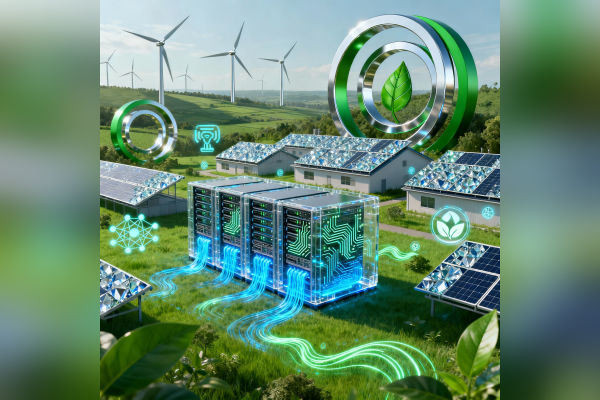
The essential need to incorporate sustainability into every stage of AI development and deployment in order to mitigate the technology’s environmental impact is highlighted in a new white paper from NTT DATA. Implementing innovative and sustainable AI solutions is both a corporate responsibility and a calculated chance to generate long-term value, strengthen the organization, and use fewer vital resources.
A road to sustainable innovation is outlined in the new paper, Sustainable AI for a Greener Tomorrow, which also highlights the increasing environmental effect of AI.
Enormous volumes of electricity are needed to support the technology’s increasing processing demands in order to operate inference pipelines, train massive language models, and maintain always-on services.
By 2028, researchers anticipate that AI workloads will account for almost half of data center power usage. Water use for data center cooling systems, e-waste, and the mining of rare earth minerals for hardware manufacturing are other major environmental effects.
Key Insights
- Expand From Performance to Green Priorities: NTT DATA’s AI experts and sustainability consultants urge the use of holistic sustainability goals, not just conventional AI performance metrics such as accuracy and speed. Efficiency must be prioritized, not as a trade-off, but as a core design principle.
- Quantify Environmental Impact: AI’s energy consumption, carbon emissions and water footprint need standard and verifiable metrics. Industry benchmarks such as the “AI Energy Score” and “Software Carbon Intensity (SCI) for AI” offer ways to embed sustainability into governance, procurement and compliance protocols.
- Lifecycle-Centric Approach: Sustainable AI requires lifecycle thinking, from raw material extraction and hardware production to system deployment and ultimate disposal. Important steps include lengthening hardware lifespans, optimizing cooling systems and applying circular-economy principles.
- Shared Accountability Across the Ecosystem: Responsibility is widely distributed, encompassing hardware manufacturers, data center operators, software developers, cloud providers, policymakers, investors and consumers. Cross-sector cooperation is essential for systemic change.
Barriers and Best Practices
Today, fragmented assessments and inconsistent metrics frequently prevent meaningful benchmarking. Many organizations focus narrowly on energy or emissions without considering water usage, rare material depletion and e-waste. These and other factors must be addressed comprehensively. Even when environmental goals are set, organizations often lack actionable methods to apply sustainability at every stage of the AI lifecycle.
To address these and other concerns, the report, Sustainable AI for a Greener Tomorrow outlines numerous best practices, including:
- Applying green software engineering patterns to reduce resource consumption
- Running AI workloads in locations and at times that align with renewable energy availability
- Leveraging remote GPU Services and on-premises AI
- Reducing e-waste by prioritizing modular and upgradable components, and extending hardware lifespans through refurbishment, reuse and responsible recycling
 Key Comments
“The resource consequences of AI’s rapid growth and adoption are daunting, but the technology also can empower innovative solutions to the environmental problems it creates,” said David Costa, Head of Sustainability Innovation Headquarters, NTT DATA. “AI’s amazing capabilities can help manage energy grids more efficiently, reduce overall emissions, model environmental risks and improve water conservation. It’s vital for organizations to recognize the challenge and build sustainability into AI systems from the start.”
While the road to sustainable AI is complex, an intentional, end-to-end redesign of the AI lifecycle can help fulfill this technology’s positive potential while protecting the environmental systems on which all living things depend.
To help accelerate the transition towards a sustainable future and download the whitepaper, Sustainable AI for a Greener Tomorrow: CLICK HERE