


Pickering Interfaces has revealed a significant new addition to its line of PXI battery simulator modules: models 41-754 (PXI) and 43-754 (PXIe), which come in a small single-slot form factor, are 2- or 4-channel battery simulators with a maximum output of 8 volts and 5 amps per channel. Because the channels are completely isolated from both ground and one another, they can be connected in series to simulate batteries in a stacked architecture.
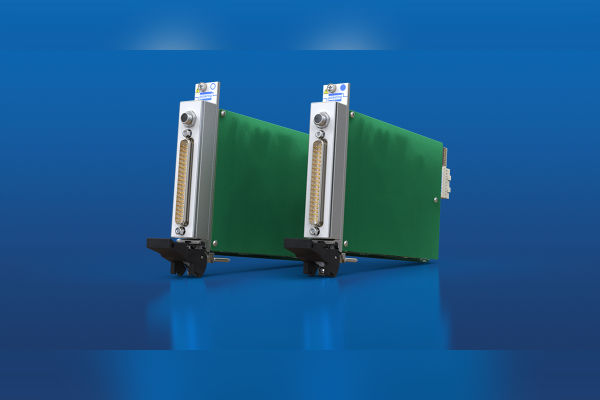
A versatile, scalable, and open design is made possible by the simulator’s smooth integration into modular test systems thanks to its industry-standard PXI form factor. If a higher voltage is required, it is simple to install more modules, which helps to save capital costs and secure system investment for the future.
For sophisticated failure and thermal response testing, this modular approach also facilitates integration with other PXI/PXIe instruments (including third-party modules), such as thermocouple simulators or fault insertion units (FIUs).
The module can be used by battery management system developers to safely test extreme fault conditions including overcharge and short circuits, as well as to simulate problems like cell imbalance, cell aging, and temperature impacts.
The isolation barrier (1000V channel-to-GND and 750V channel-to-channel) allows the module to be employed as a battery stack indicative of those found in contemporary Battery Electric Vehicle (BEV) propulsion systems, and all channels are completely separated from the ground and from one another.
Faster development cycles, reduced total cost of ownership (TCO), and enhanced safety by lowering compliance voltage are all possible with each channel’s ability to simulate up to 16 cells in parallel while still supplying the necessary 300mA balancing current for each cell.
Because of the high voltage and potential for thermal runaway, testing with real batteries in unbalanced or harsh environments can be hazardous. By simulating cells without storing energy, Pickering’s battery simulator removes these safety issues and offers a safer substitute for high-risk test situations.
Engineers can quickly switch between test conditions with Pickering’s battery simulator, in contrast to conventional setups that depend on physically charging and draining batteries. Without having to wait for actual batteries to charge or discharge, this significantly cuts down on test time while guaranteeing reliable, repeatable test results.
The simulator guarantees constant, repeatable settings, which is perfect for accurately comparing test findings across sessions, in contrast to real cells that deteriorate over time.
The 5A battery simulator allows low-compliance voltage open-loop configurations for engineers’ desktops in software development and cell balancing applications. These can be expanded to closed-loop applications in real-time systems.
Together with embedded control systems, hardware-in-the-loop (HIL) testing makes it possible to simulate battery models and test algorithms like state-of-charge, state-of-health, and cell deterioration in real time.
The 5A battery simulator can be used by developers of renewable energy and energy storage systems (ESS) to test grid-scale storage, mimic household storage batteries, and evaluate the system for safety and compliance. Optimizing the load on the battery cells can also extend the life of battery packs, which is especially crucial for older battery packs that have been converted to energy storage.
Aerospace & defense, electrified aircraft, drones, and military vehicles all require highly reliable battery emulation for testing these safety-critical systems. For industrial equipment, electrified forklift trucks, mining vehicles, robotics, and marine propulsion all require testing solutions for BMS integration with high-power industrial batteries.
Drivers are supplied for Windows, Linux, and real-time operating systems, unlike many competitors. All standard products manufactured by Pickering Interfaces include a three-year warranty and guaranteed long-term product support.
 Leadership Comments
“A major upgrade from previous 300mA simulators, our 5A battery simulator family is designed to simplify and accelerate BMS (battery management system) testing,” said Stephen Jenkins, Simulation Product Manager at Pickering. “With up to four fully isolated channels, it enables customers to emulate battery cells or modules in both low- and high-voltage stacks. It combines high current drive and precision readback in a compact platform ideal for demanding applications across EVs (electric vehicles), energy storage, and beyond.”
To Know More About 41-754 (PXI) and 43-754 (PXIe), CLICK HERE
For Pricing and Availability, CLICK HERE