


Google has announced its first commercial partnership in long-duration energy storage (LDES), teaming up with Italian firm Energy Dome to deploy its innovative CO2 Battery technology.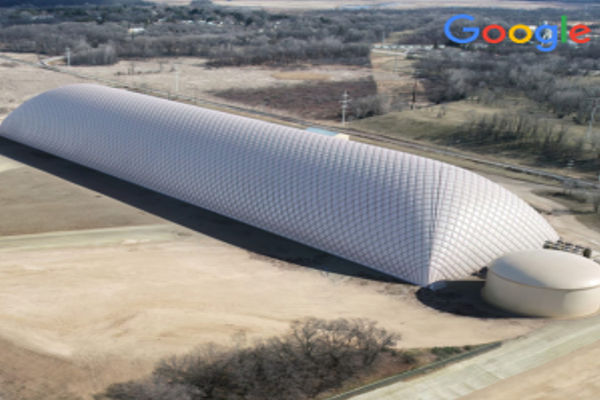
The agreement comes alongside a strategic capital investment in the Milan-based startup, reinforcing Google’s aggressive commitment to running operations on carbon-free energy around the clock by 2030.
A Deal to Accelerate Deployment of its Storage Technology
-
Commercial & investment agreement: Google entered a global commercial partnership with Energy Dome and invested undisclosed capital in the company to accelerate deployment of its storage technology across Europe, the U.S., and the Asia-Pacific region.
-
Clean energy roadmap: This marks Google’s first public contract in LDES and supports its broader goal of powering data centers and facilities with 24/7 carbon-free electricity by 2030.
What Is CO2 Battery?
-
How it works: Energy Dome’s system compresses CO2 into a liquid under pressure when renewable energy is abundant. During discharge, the CO2 expands and is reheated to drive a turbine that generates electricity—able to deliver power for 8 to 24 hours.
-
Supply chain resilience: The technology relies on off-the-shelf steel and water-based components, avoiding reliance on critical minerals such as lithium or copper—an advantage for cost, scalability, and energy security.
Business and Grid Implications
-
Firm, flexible power: Unlike lithium-ion batteries that typically last up to four hours, CO? Battery systems deliver longer durations and add natural grid inertia—crucial for stability as solar and wind displace conventional generators.
-
Modular deployment: Energy Dome’s CO2 Battery is modular and site-independent, enabling rapid replication of projects at scale without major supply bottlenecks.
Energy Dome launched a commercial-scale demonstration plant in Sardinia in 2022, capable of powering 13,000–15,000 homes over a 24-hour cycle.
The startup has contracted projects with Alliant Energy in the U.S., Engie in Italy, and India’s NTPC, including a U.S.-based 20?MW/200MWh installation in Wisconsin. Several additional sites are in active development. 
-
Reducing critical mineral dependence: The CO2 Battery sidesteps strategic challenges linked to global mineral supply chains, aligning with European energy security priorities and policy goals.
-
Competitive edge: For hyperscale energy users like Google, securing long-duration storage lessens dependence on intermittency-prone renewables and smooths data center power operations.
-
Scaling emerging tech: By investing directly, Google supports faster commercialization of LDES and signals confidence to markets and policymakers.
Google’s launch into CO2-based long-duration energy storage via Energy Dome marks a pivotal shift in its clean energy strategy.
By supporting a novel commercial-ready LDES technology, Google aims to accelerate grid decarbonization, meet rising data center power demands, and deliver resilient, firm electricity to its global operations.