

“David MAUCOTEL responded that the latest generation of ST’s ToF sensor—VL53L8CP—can indeed detect sub-millimeter movements, such as chest expansion during breathing, thanks to its enhanced signal-to-noise ratio and embedded Presence AI algorithms.”
When it comes to the future of laptops and intelligent systems, the key to smarter interactions may not lie in cameras, but in something far more elegant—light and distance. Lately global media and technology insiders including The Volt Post were given an exclusive deep dive into the ST’s fifth-generation Human Presence Detection (HPD) solution—a breakthrough blending Time-of-Flight (ToF) sensing with proprietary AI algorithms.
This isn’t just a sensor upgrade. It’s a major step toward how devices understand, respond to, and protect users in an increasingly privacy-conscious world.
The Vision from ST: Privacy, Power Savings, and AI in Harmony
Being the main speaker the session was opened by David MAUCOTEL, Personal Electronics, Industrial & Mass Market Business-Line Director at Imaging Sub-Group, STMicroelectronics.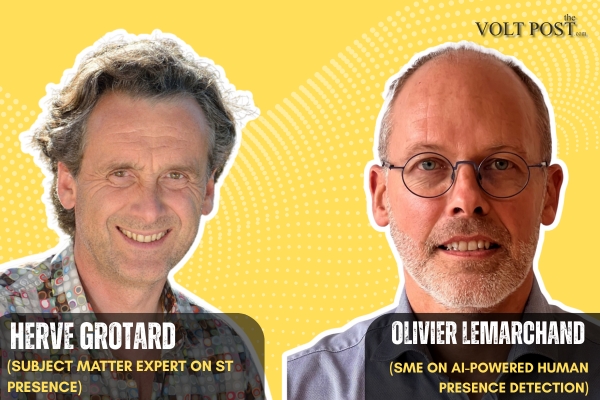
He was assisted by Herve GROTARD (Subject Matter Expert on ST Presence) and Olivier LEMARCHAND (SME on AI-powered Human Presence Detection).
Here offered a sweeping overview of the company’s trajectory in imaging and sensor innovation.
Citing figures from Yole analysts, David Maucotel noted that 3D sensing markets are set to triple in revenue by 2030, fueled by robotics, navigation, and people monitoring use cases. “ST’s value proposition lies in our unique integration of sensor, optics, AI, and system design—all under one roof,” he said.
From smartphones to laptops, and now to smart homes and automobiles, ST’s FlightSense™ and ToF sensor portfolio has been at the core of modern presence detection, offering high-precision data with ultra-low power consumption.
The Volt Post Asks: Can ToF Track Something as Subtle as Breathing?
During the Q&A session, Niloy Banerjee, Group Editor at The Volt Post, asked a forward-looking question that piqued audience interest:
“Is it possible to track micro-movements, like breathing? And how far apart must two persons be in order to distinguish one from the other?”
David MAUCOTEL responded that the latest generation of ST’s ToF sensor—VL53L8CP—can indeed detect sub-millimeter movements, such as chest expansion during breathing, thanks to its enhanced signal-to-noise ratio and embedded Presence AI algorithms.
He elaborated that the solution uses multi-zone sensing (64 zones) to perceive depth and motion. This allows it not only to detect a stationary human, but also to distinguish between individuals based on their distance from the device. With AI trained in-house, the system can identify when a human leaves, returns, or if someone else steps into view—without relying on any image or video feed.
Why ToF is Winning Over Traditional Cameras
Another major theme of the event was privacy. Here Olivier Lemarchand and Hervé Grotard, Business Development Director at ST, emphasized by stating that the HPD solution is not a camera. It emits infrared light and reads back the distance, making it completely blind to identifiable visual features.
That means no facial data, no constant recording, and no privacy concerns.
Moreover, it’s incredibly energy efficient—consuming less than 2 milliwatts and enabling over 20% daily power savings per device. “Imagine if all 50,000 ST employees used this daily,” Grotard said. “We’d save the CO? equivalent of 120 transatlantic flights—every single day.”
Packed with AI—but Built for Tiny Microcontrollers
The fifth-generation HPD isn’t just smart—it’s light.
Four distinct AI models power features like:
- Walk-Away Lock for auto-locking devices when users step away
- Wake-on-Attention for touchless login via posture and head orientation
- Multi-Person Detection, alerting users of potential over-the-shoulder threats
- Hand Gesture and Posture Recognition, allowing intuitive gestures like swipe, tap, or thumbs up
All of this runs not on a heavy GPU, but on a small sensor hub or low-cost STM32 microcontroller, making integration easy and affordable for OEMs.
Opening the Doors to Developers and Industry Expansion
The solution’s AI components—especially its Hand Posture Recognition model—are now publicly available via the ST Edge AI Suite, encouraging developers to build on ST’s work and expand into new applications.
As ST revealed, the HPD platform is already integrated into over 280 laptop models and is being evaluated by top PC OEMs globally.
Future use cases extend far beyond PCs, targeting robotics, smart homes, automotive interiors, and IoT.
A Sensor That Sees Without Watching
STMicroelectronics’ fifth-gen HPD solution isn’t just a technical innovation—it’s a statement on how intelligent systems should respect privacy, enhance usability, and conserve energy.
It doesn’t just detect presence. It understands intent.