



Over 150 member companies worldwide are driving a shift in the automotive industry toward solutions based on the open and interoperable Automotive Serdes Alliance Motion Link (ASA-ML) standard, which will replace proprietary camera communication.
The first ASA-ML camera-development platform of its kind has been delivered by Microchip Technology in collaboration with camera module supplier Nippon Chemi-Con Corporation and video-testing solution provider NetVision Co. Ltd. to streamline and expedite the adoption of ASA-ML for Advanced Driver-Assistance Systems (ADAS).
This platform supports crucial hardware-based link-layer security to comply with new automotive cybersecurity regulations while bringing the standard’s scalable high-speed asymmetric data rates to the Japanese automotive market.
Dozens of ASA-ML members are contributing to the industrialization and acceptance of ASA-ML, including industry leaders such as BMW, Ford, Volvo, GM, Continental, Bosch, Denso, and Microchip, as well as many smaller semiconductor companies.
The entire automotive ecosystem is represented by these and other member companies, which include automakers, Tier 1 suppliers, semiconductor suppliers, cable and connector manufacturers, test tool suppliers, and test houses. OEMs need development tools, emulation platforms, and extensive supply chain assistance when implementing camera solutions based on emerging standards like ASA-ML.
This issue is resolved by Microchip’s VS775S single port ASA-ML serializer/deserializer, which allows Nippon Chemi-Con to develop an ecosystem-ready camera module for the Japanese automotive industry thanks to its standards-compliant, asymmetric, and scalable-bandwidth video support.
By facilitating the effective assessment of video signal quality during the design of camera modules and Engine Control Units (ECUs), NetVision’s camera emulation and development platform also makes use of the Microchip VS775S to streamline development and verification. The platform uses Microchip’s VS775S evaluation board to enable real-time video signal capturing.
In the automotive industry, multi-vendor solutions are now a top priority for supply-chain risk management. Long-term operational resilience and increased sourcing flexibility are priorities for OEMs and Tier 1 suppliers.
This is particularly true for autonomous-level applications at the L2 and L2+ levels, which are incorporating more cameras and sensors into automobiles. The requirement for scalable, architecturally adaptable, interoperable, multi-vendor, and high-bandwidth connectivity solutions that overcome the drawbacks of closed, single-vendor ecosystems in a changing environment is further increased by these trends.
Microchip will be demonstrating this camera/capture card at the Automotive Ethernet Tech Days, Kyoto International Conference Center Annex Hall, Kyoto, Japan, July 3-4.
Leadership Comments
“We were first to market with an ASA-ML chipset through our acquisition of VSI, and now we have collaborated with pioneers like Nippon Chemi-Con and NetVision to deliver the first camera development ecosystem that reduces risk and speeds ASA-ML adoption for Japanese OEMs,” said Kevin So, vice president of Microchip’s communications business unit. “Nippon Chemi-Con’s CDTrans camera module and NetVision’s NV061 development emulation board are both based on our VS775S single-port serializer/deserializer device, further demonstrating the industry’s commitment to a standardized ASA-ML solution for Japanese automotive OEMs as they embrace the rapid growth of camera-based ADAS systems driven by the need for safety and convenience.”
“We are excited to collaborate with an automotive semiconductor market leader like Microchip in offering Japanese OEMs another important first with our new CDTrans ASA-ML-based automotive camera module that is integrated with the VS775S serializer,” said Katsunori Nogami, managing executive officer, chief technology officer with Nippon Chemi-Con. “We recognize the importance and benefit of open standards-based connectivity technologies like ASA-ML that automotive Tier 1 suppliers and OEMs need for interoperable multi-vendor solutions. This collaboration is a key step in accelerating ASA-ML adoption for next-generation ADAS camera systems in Japan’s rapidly evolving SDV landscape. Combined with NetVision’s well recognized camera test and emulation platform, our camera module will enable cross-vendor compatibility, future-proof scalability, and a pathway beyond closed systems.”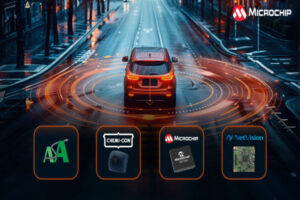
“Partnering with Microchip and Nippon Chemi-Con on this new ASA-ML ecosystem platform will help realize a standardized and scalable electrical/electronic in-vehicle networking architecture for Japan’s SDV era,” said Kenji Kudo, Ph.D., engineering department director at NetVision. “Our development of a VS775S based ASA-ML serializer connection board coupled to our unique camera emulation development platform for ADAS ECUs will help remove a key barrier to adoption for many Japanese OEMs and Tier 1s who have been hampered by proprietary connectivity protocols that limit interoperability and scalability. We look forward to continued collaboration on advancing the ASA-ML ecosystem.”
Pricing and Availability
Engineering samples of the VS775S serializer/deserializer and evaluation kits are available to qualified customers today. For additional information, contact a Microchip sales representative or authorized worldwide distributor or visit Microchip’s website, www.microchip.com/asa.