

NXP Semiconductors has announced a strategic partnership with Rimac Technology to advance the development of centralized vehicle architectures for software-defined electric vehicles (SDVs). Rimac becomes the first company to implement NXP’s latest real-time processor family, the S32E2, into its next-generation electronic control unit (ECU) platform.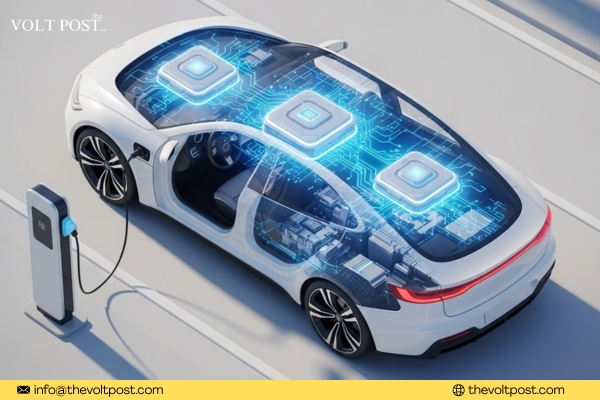
Driving the Shift: From Distributed to Centralized ECUs
Traditionally, electric vehicles rely on over 20 distributed ECUs to manage various functions like powertrain control, vehicle dynamics, charging systems, and body electronics. This collaboration replaces those with just three centralized, high-performance ECUs powered by the S32E2 platform.
The benefits are substantial:
- Reduced complexity in vehicle wiring and architecture
- Significant weight savings
- Lower development and material costs
- Enhanced scalability and serviceability
S32E2 Platform Highlights
The S32E2 processors are tailored for deterministic real-time control, essential for next-gen vehicle functions. Key features include:
- Up to eight Arm Cortex?R52 cores operating at 1 GHz
- Real-time capabilities for simultaneous multi-domain control
- 64 MB of embedded non-volatile memory
- High-resolution analog-to-digital converters
The platform is built to meet ISO 26262 ASIL D standards for functional safety. It supports robust fault containment through core-to-pin isolation and includes a built-in Hardware Security Engine to handle secure boot processes, key management, and runtime data protection.
Software-Defined Vehicle Ecosystem Enablement
With the ability to manage multiple domains from a single ECU, the solution enables modular software development and simplifies the debugging process. Developers can now isolate faults at the task level, reducing system downtime and increasing reliability.
This shift from hardware-centric to software-centric architecture means automakers and Tier 1 suppliers can:
- Create modular and upgradable systems
- Shorten time to market for new features
- Lower total cost of ownership
Rimac’s Vision for the Future
Rimac plans to deploy this centralized ECU platform in its upcoming hypercar models. However, the architecture is scalable and could extend to broader vehicle segments in the future, opening doors for wider adoption across the automotive industry.
Industry Impact
This partnership is an important milestone in the evolution of electric vehicle design, signaling a move toward more efficient, centralized control systems that better support the needs of connected and software-defined vehicles. With the S32E2 processor, NXP and Rimac are poised to lead this transformation by offering solutions that blend performance, security, and functional safety.