

In order to facilitate failure prediction and degradation forecasting using sensing data in a variety of devices, including industrial equipment like motors, ROHM has developed AI-equipped MCUs (AI MCUs) – ML63Q253x-NNNxx / ML63Q255x-NNNNxx. These MCUs are touted as the first in the industry to perform inference and learning on their own without the need for a network connection.
Early failure detection and improved maintenance efficiency have emerged as major problems as the demand for machinery and equipment to operate efficiently grows.
Manufacturers of equipment are looking for solutions that minimize security threats and network latency while enabling real-time operational status monitoring. However, standard AI processing models usually rely on high-performance CPUs and network connectivity, which can be expensive and challenging to deploy.
As a result, ROHM has developed these innovative AI MCUs that allow for standalone AI learning and inference right on the device. By lowering maintenance costs and the possibility of line stoppages, these network-independent solutions promote early anomaly identification prior to equipment breakdown, resulting in a more reliable and effective system operation.
The new devices use ROHM’s unique on-device AI solution, “Solist-AI,” which is implemented using a straightforward 3-layer neural network method. As a result, the MCUs may learn and draw conclusions on their own without requiring network or cloud access.
AI processing models are generally classified into three types: cloud-based, edge, and endpoint AI. Cloud-based AI performs both training and inference in the cloud, while edge AI utilizes a combination of cloud and on-site systems ? such as factory equipment and PLCs ? connected via a network.
Typical endpoint AI conducts training in the cloud and performs inference on local devices, so network connection is still required. Furthermore, these models typically perform inference via software, necessitating the use of GPUs or high-performance CPUs.
Cloud-based, edge, and endpoint AI are the three broad categories into which AI processing models fall. While edge AI uses a combination of cloud and on-site technologies, like factory equipment and PLCs, connected by a network, cloud-based AI conducts both training and inference in the cloud.
A network connection is still necessary because typical endpoint AI trains on the cloud and makes inferences on local devices. Additionally, these models usually use software for inference, which means that high-performance CPUs or GPUs are required.
ROHM’s AI MCUs, on the other hand, may independently perform both learning and inference through on-device learning, even though they are classified as endpoint AI.
This enables flexible adaptability to various installation circumstances and unit-to-unit variances, even within the same equipment model. With ROHM’s proprietary AI accelerator “AxlCORE-ODL,” these MCUs process AI at a rate that is roughly 1,000 times faster than that of ROHM’s traditional software-based MCUs (theoretically, at 12MHz operation).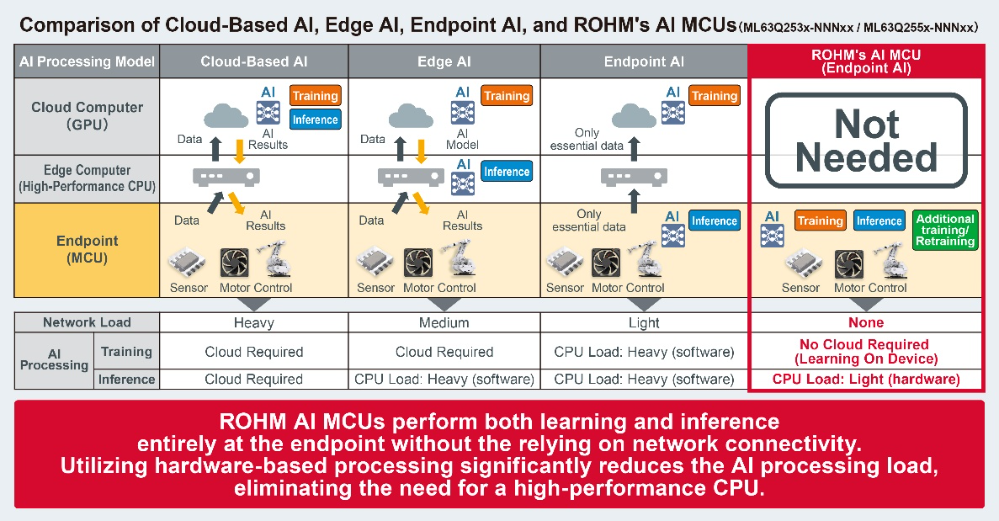
This allows anomalies that “deviate from the norm” to be detected in real time and numerically output. They are also perfect for retrofitting into existing equipment because they allow for high-speed learning (on-site) at the time of installation.
With a low power consumption of about 40mW, these AI MCUs have a 32-bit Arm Cortex-M0+ core, CAN FD controller, 3-phase motor control PWM, and dual A/D converters. They are therefore perfectly suited for predicting faults and detecting anomalies in home appliances, commercial machinery, and residential buildings.
16 devices in various memory sizes, package kinds, pin counts, and packaging parameters will make up the lineup. In February 2025, the TQFP package’s eight versions went into sequential mass production. Online distributors are offering two of these variants with 256KB of Code Flash memory and tape packaging for sale, coupled with an MCU evaluation board.
On its website, ROHM has made available an AI simulation tool called (Solist-AI Sim) that enables users to assess how well learning and inference work before implementing the AI MCU. By providing pre-implementation validation and enhancing inference accuracy, the data produced by this tool can also be used as training data for the real AI MCU.
In order to make adoption easier, ROHM has developed an ecosystem with partner businesses that provides all-inclusive support for model development and integration. In the future, ROHM will keep growing this ecosystem, offering more approachable settings by helping to create training data and suggesting the best ways to deploy it.
Product Lineup
These AI MCUs integrate a 32-bit Arm® Cortex®-M0+ core (Maximum operating frequency: 48MHz) and ROHM’s proprietary AI accelerator AxlCORE-ODL that performs learning and inference using a 3-layer neural network.
On top, leveraging versatile timer functions such as 3-phase motor control PWM along with a wide range of serial interfaces like CAN FD and 12-bit A/D converter enables flexible support for control and data processing in industrial equipment, residential facilities, and home appliances.
AI MCU Development Support Tools
ROHM AI MCUs utilize a standard Arm® core, ensuring compatibility with commercially available tools as well as ROHM’s proprietary integrated development environment. To evaluate learning and inference, an AI operation verification simulator is provided, along with a real-time viewer for assessing AI effectiveness.
Further details on the AI MCU development support system and an overview of each product can be found on ROHM’s dedicated AI MCU development system support page (CLICK HERE),
? Available Products
Arm® Integrated Development Environment: Arm® Keil® MDK
Arm® Debug Adapter: Debugger for connecting a computer to the Arm® core
USB-SPI Conversion Adapter: Adapter for connecting the AI MCU to Solist-AI™ Scope
? Online Sales
MCU Evaluation Board: Board for standalone AI MCU evaluation/software development
Online Sales Information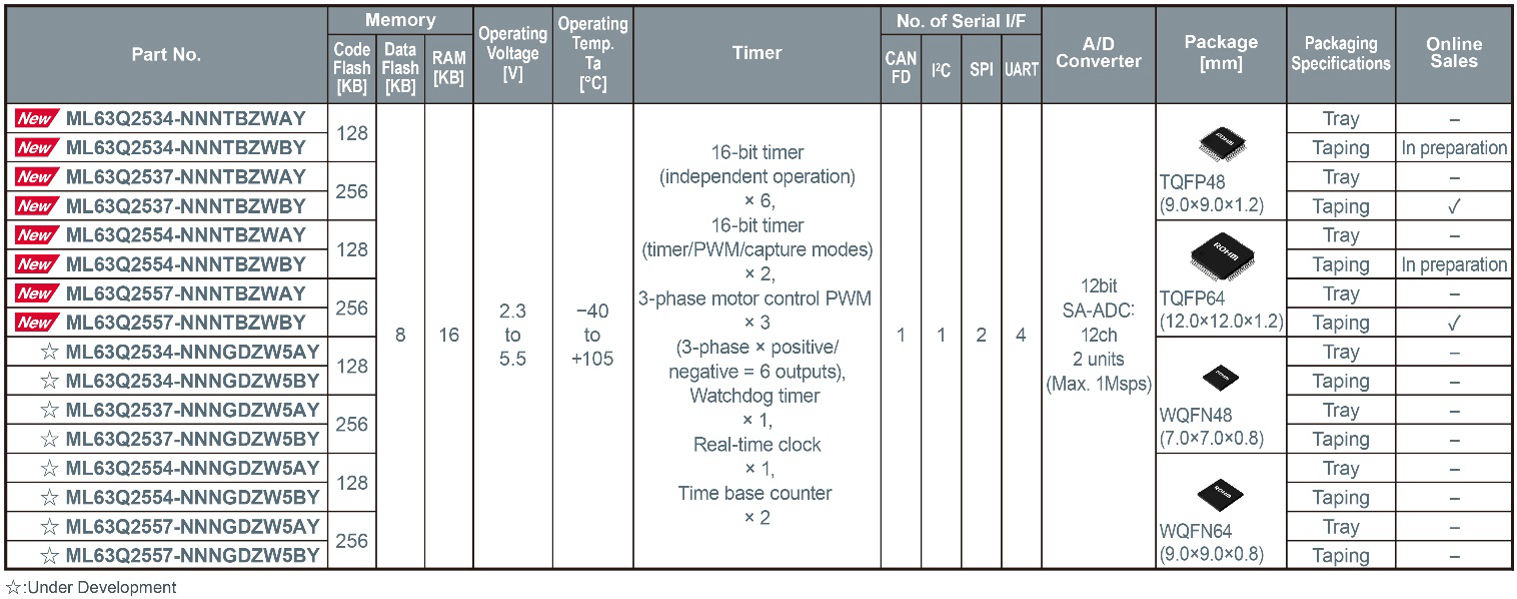
Online Distributors: DigiKey™, Mouser™ and Farnell™
Prices: $20.0/unit (excluding taxes, samples)
Both the AI MCUs and MCU evaluation boards will be offered at online distributors as they become available. (Sales Launch Date: March 2025).
- AI MCU Product Information
Sales Part Nos: ML63Q2537-NNNTBZWBY, ML63Q2557-NNNTBZWBY
- MCU Evaluation Board Information
Sales Part Nos: RB-D63Q2537TB48, RB-D63Q2557TB64
Application Examples
Factory Automation (FA) sensors, motors, batteries, power tools, residential facilities, home appliances, robots. Other uses include devices requiring fault prediction, equipment where operational downtime is unacceptable, and systems that demand improved prediction accuracy.