

The Industrial Technology Research Institute (ITRI) held the Global Semiconductor Supply Chain Partnership Forum in Taipei on May 23 to discuss global supply chain changes and growing geopolitical risks.
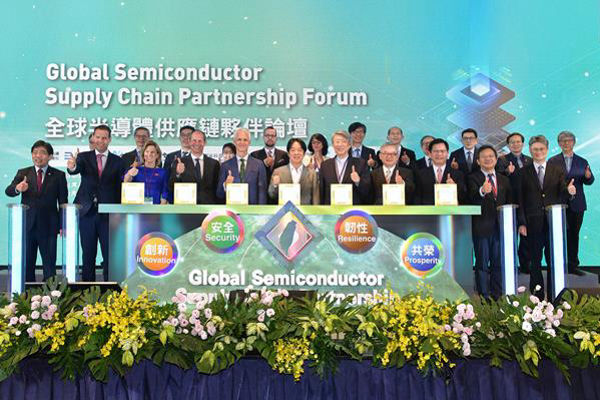
Under the themes of Innovation, Security, Resilience, and Prosperity, the ITRI event examined supply chain security, international cooperation, and technical complementarity in accordance with the government’s initiative on semiconductor supply chain partnerships for global democracies. More than 700 government and business figures attended the event, including officials from Taiwan’s overseas trade offices.
According to President Lai Ching-te, in order to challenge a robust semiconductor supply chain in the face of issues like dumping practices, international democracies must cooperate and play to their individual strengths.
He asserted that Taiwan is prepared to play a significant role in the advancement of technology in the AI era. To stimulate industrial innovation, the government is constructing data centers and supercomputers, enacting laws that encourage it, and providing tax and financial incentives.
Jyh-Huei Kuo, Minister of Economic Affairs, highlighted Taiwan’s critical position in the global semiconductor industry. The Ministry is pushing for investments, value chain co-development, and market research from international supply chain partners.
He added that Taiwan will collaborate with other democracies that share its values in order to create reliable, self-policing market systems that protect reliable supply chains. In order to connect Taiwan’s robust semiconductor workforce with the rest of the world and increase the competitiveness of democratic supply chain partners, the Ministry will continue to promote cross-border talent initiatives.
According to Kazuyuki Katayama, Chief Representative of the Japan-Taiwan Exchange Association, in order to guarantee both commercial success and economic security, a robust semiconductor supply chain necessitates extensive international cooperation, utilizing materials and equipment from Europe and Japan, American design, and Taiwanese manufacturing, efforts to improve the robustness of the semiconductor supply chain were the main topic of the forum.
The first panel highlighted the value of talent, markets, and alliances, advocating for greater investment in Taiwan, closer cooperation with like-minded nations, and the creation of talent networks and derisking procedures.
The second panel discussed initiatives to develop industry-ready people at all educational levels, as well as issues in advanced and mature process technologies. In the midst of supply chain regionalization and restructuring, the third panel discussed the necessity of value-based partnerships and the development of mid- to high-end process technologies.
Leadership Comments
“The EU is working closely with like-minded partners to build robust AI infrastructure and to strengthen resilient and secure semiconductor supply chains,” stressed Lutz Güllner, Head of the European Economic and Trade Office. In this attempt, Taiwan is a crucial and reliable partner. The EU is dedicated to strengthening its ties with Taiwan in light of TSMC’s investment in Germany and the expanding collaboration between Foxconn and European companies in the semiconductor and space sectors.
“Semiconductors are now a core strategic asset in global economic and technological competition, requiring deeply interdependent supply chains,” said ITRI President Edwin Liu. “ITRI will focus on potential niche markets, drive key technology development, and strengthen global partnerships to enhance supply chain transparency, cybersecurity, and adaptability. We will work closely with partners worldwide—from materials and manufacturing to talent development—to explore innovation and “blue ocean” opportunities. Our goal is to build an open, inclusive semiconductor ecosystem where all partners can create value and share in the success.”
“The United States and Taiwan share a long-standing, symbiotic relationship in the high-tech sector with semiconductors at its core,” said Jeremy Cornforth, Deputy Director at American Institute in Taiwan. He emphasized the growing two-way investment, joint efforts to strengthen supply chain resilience and technology security, and a shared commitment to building a strong and innovative global semiconductor ecosystem.”
Ruth Bradley-Jones, Representative at British Office Taipei, said, “Collaboration is at the heart of advancing and securing semiconductor and AI supply chains. The UK will continue to forge partnerships, both in pursuit of advancing semiconductor and AI innovation, and in pursuit of the policy and regulatory frameworks that underpin resilient and diversified global supply chains.”
Matthijs van der Hoorn, Deputy Representative at the Netherlands Office Taipei, noted, “The semiconductor industry is inherently global, and no country can address its challenges alone. As a key player in the global value chain, the Netherlands is committed to working with governments, businesses, and research institutions to jointly build a resilient, reliable, and sustainable chain.”
Akira Amari, Honorary Chair of Japan’s Parliamentary Association for Semiconductor Strategy, stated that the Japan-Taiwan alliance should serve as a starting point for like-minded countries to jointly build a resilient semiconductor supply chain, from design to manufacturing, to mitigate economic security risks and ensure stable global industrial developme