


How do cubes and rack rows get into computer rooms?
Specific customer requirements and other impacts make the journey difficult. But with intelligent infrastructure solutions, data center providers can also make rapid progress in meeting the demanding requirements of AI and 5G.
There is hardly any «one fits all» solution when it comes to data center infrastructures – except perhaps in the case of monolithic hyperscalers. Equipment, applications, re- quirements and other hurdles change almost every day.
The flood of data is increasing. Data centers not only have to constantly exchange, customize, expand and compress the switches, servers and storage. The non-compute infrastructure with operational technology (OT) and wiring is also subject to constant change.
It is true that data centers are familiar with redesigns, migrations, evolutionary pressure, and increases in power and efficiency. But the paths are becoming more complex and steeper. However, there are manageable and efficient solutions for making sustainable progress in a data center. The key: «integrated solutions».
Holistic Approach: Integrated solutions must be understood holistically. The market, customer requirements, and technical aspects must be considered together. It is important to move away from order lists for individual disciplines.
The planned applications, the required computing power, the layout of the computer room, the network topology, the wiring, connectivity, the electrics, cooling and security are all interrelated. With a holistic approach and integrated infrastructure solutions, the tasks can be mastered in a routine manner, e.g., to densify wiring and connectivity or migrate to 400 and 800 Gigabit Ethernet.
Data center providers are constantly having to reorient themselves. Recently, the focus has been on dynamic, disruptive and even more complex developments such as artificial intelligence (AI) and Large Language Models (LLM).
These are to be implemented in enterprise data centers under very tight deadlines and with as short a time to market as possible. Here are a few reasons: They are innovative, increase productivity, create the smart factory, and enable new business models.
And data centers – especially in the industrial sector – are currently confronted with even more new disruptive digital technologies: Self-learning robots and machines (ML), Industrial IoT (IIoT), augmented and virtual re- ality (AR/VR), multi-cloud, hyperconvergence, digital twin, and private 5G wireless networks in the production environment.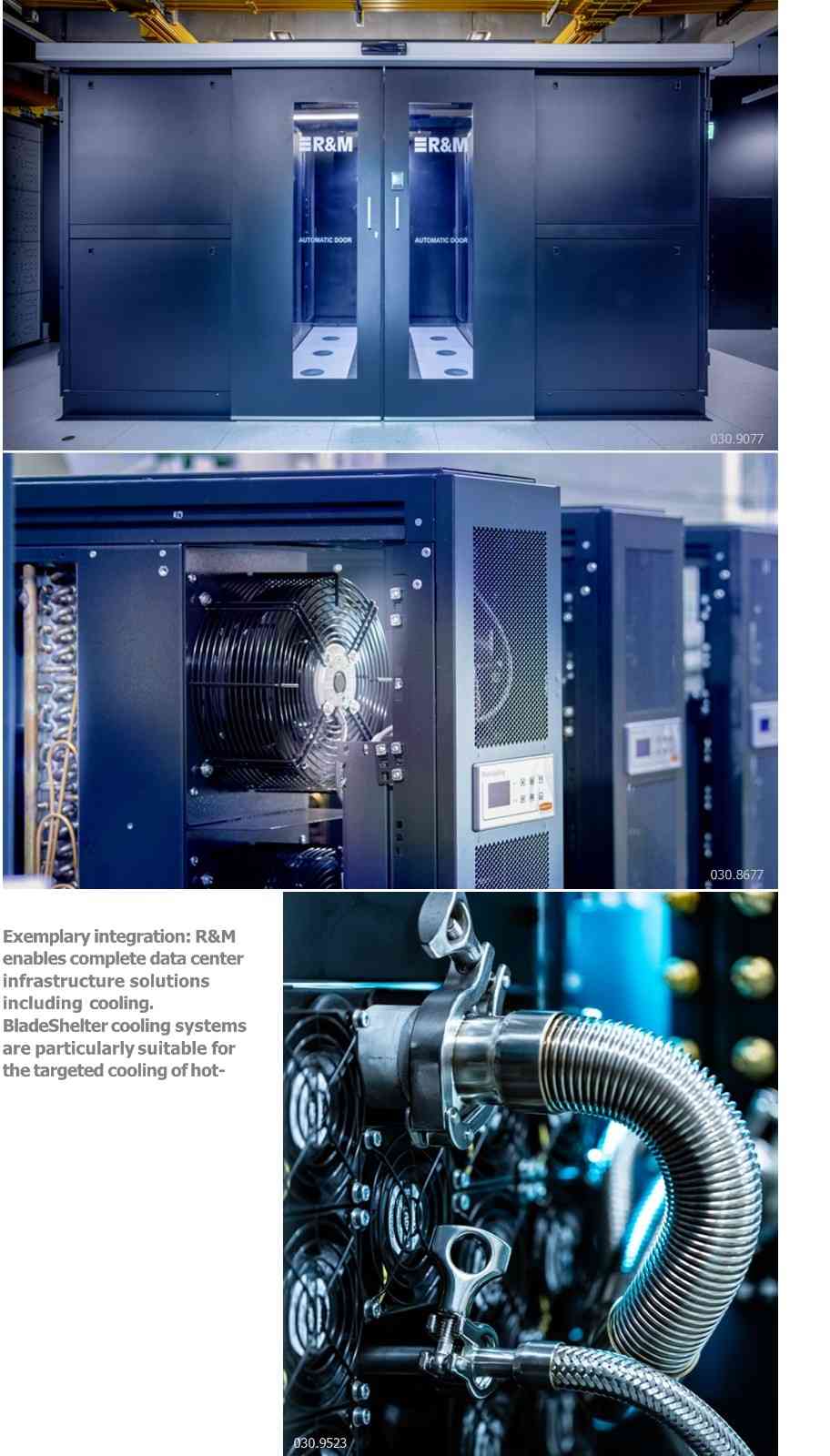
«It remains strategically important that infrastructures and capacities are planned and dimensioned with foresight in spite of the short-term dynamics of AI.»
Critical Requirements
All of these places extraordinary and sometimes critical demands on computing and non-computing infrastructures. These new technologies are not available at the click of a mouse from the cloud like apps, storage, and services.
The required ultra-low latency and data throughput can only be ensured locally and over short distances.
Enterprises may need to spontaneously and creatively upgrade their data centers for new types of high-performance computing. They may have to set up and network an entire AI cluster, a closed AI suite or individual AI racks. A room-in-room concept or new modular micro data centers could be the solution.
It is certainly about upgrades, conversions and greenfield installations in the white space. The deployment of AI-enabled infra- structures impacts the architecture of the data center.
Private 5G is also a new topic for enterprise data centers. 5G wireless networks move huge amounts of data in real time, e.g., in a sprawling factory. This data can only be processed quickly enough locally or at the edge.
Enterprises have to provide computing capacity and connectivity for this. With 5G, they are entering a new field for which their data centers have not yet been configured.
Hot Racks – Wet Cooling
There are other more stringent conditions, such as thermodynamics. In «hot» AI racks, we are dealing with powers of 60, 120 or more kW. High-performance processors for AI applications can only be cooled safely and energy-efficiently with fluids.
This means that data centers have to install special cooling systems or ducts for coolants and heat exchangers. To date, those responsible have focused more on air cooling, air routing and cold/hot aisle enclosures. Now they may need to procure and integrate much more complex infrastructure and cooling systems.
The systems for compute-intensive artificial intelligence or for time-critical AR/VR and 5G data traffic require many parallel optical network connections.
The use of generative AI requires around ten times as many optical fibers as in conventional data centers. Net- work designers may need to intervene in the spine-leaf architecture.
The processor units cannot simply be patched to the nearest distributors. High-performance connectivity must be planned for this. Integrated connectors in VSFF format will play a role in implementing high-density parallel optical cabling. What is certain is that the tried-and-tested principle of structured cabling is the most efficient solution for the basic network structure here too.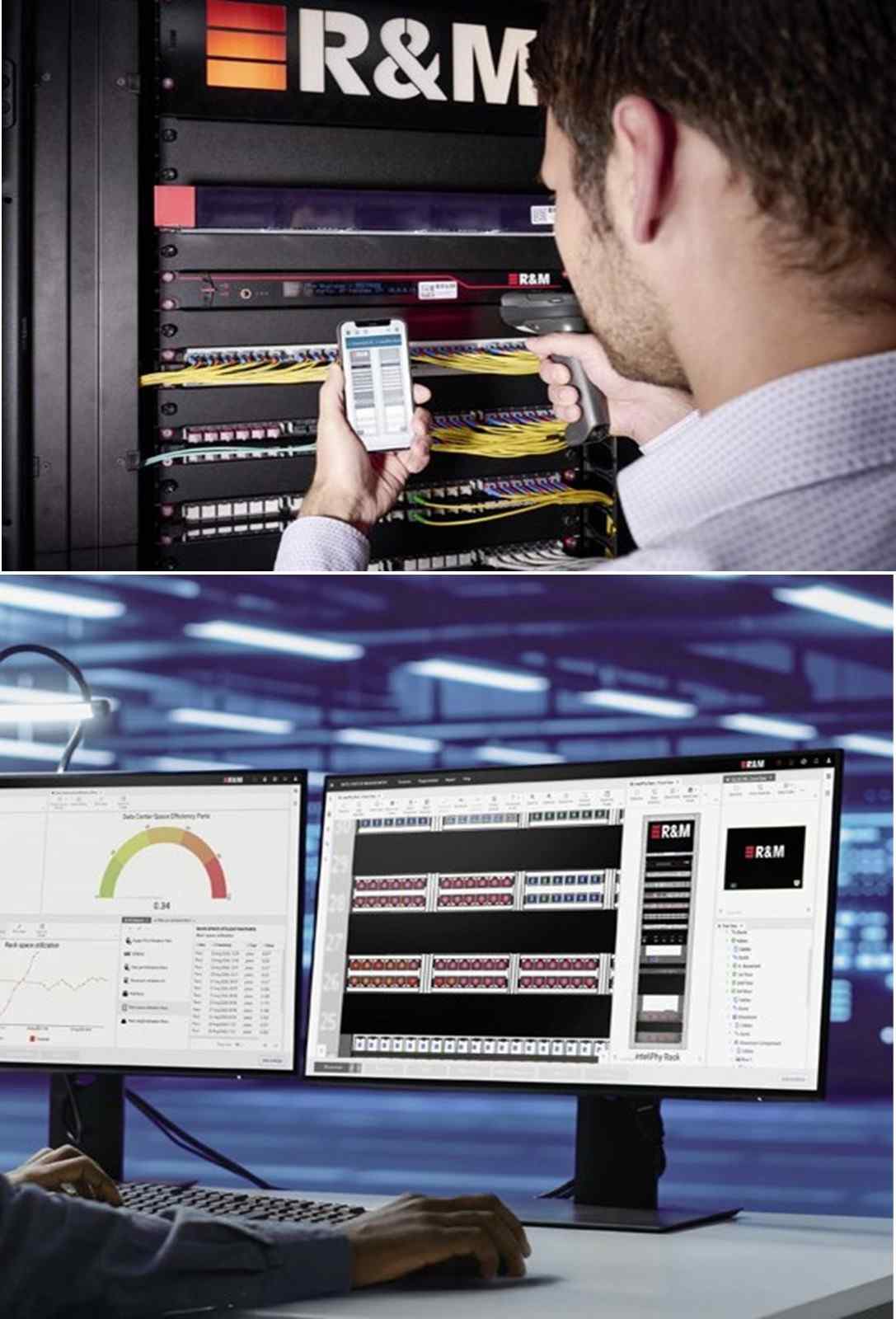
Other Questions Include:
- Can existing electrical and fiber optic infrastructures, racks and cable routings be transformed?
- Will the increased requirements for perimeter, mon- itoring, access control and sensors be met?
- Does the enterprise have skilled personnel to implement the new technologies?
- Does the operator need a new management concept and DCIM system?
More or Less Power Hard to beat in terms of impact: Data centers are coming under pressure in terms of their energy efficiency, and many providers have to act now.
Let’s Look at One Example: In Europe, data centers have been required to measure and report their power usage effectiveness (PUE) since January 1, 2025.
This is what the European Union’s Energy Efficiency Directive (EED) requires. Data centers are to reduce their greenhouse gas emissions by 55% by 2030. This means that they have to constantly monitor and optimize their power consumption.
Do they have the tools on board?
AI is an energy guzzler. Nevertheless, energy consumption should fall or at least no longer increase unchecked. The planning topics of energy efficiency and energy requirements, power distribution, batteries, generators and voltage supply therefore need to be investi-gated in depth.
The arrival of AI computing in industrial companies is only part of the latest wave of digitalization. Similar scenarios exist in clinics that implement edge and AI computing in their data centers in order to revolutionize research and diagnostics.
Retail, municipal utilities, the financial sector and other indus- tries are also relying on AI.
Users of these new, data- intensive technologies will need to build additional and stronger computing power – with a drastic impact on their data centers and their efficiency.
Expertise in Demand
Integrated infrastructure solutions can also help under these new, more complex conditions. The first step is to understand technologies such as AI, AR/VR and 5G as well as their requirements for computing systems. The second step is to look at the specific applications.
The need must be carefully clarified:
- Which and how much computing equipment is used?
- What does this mean for the areas and load capacities, rack design, electrics, connectivity, wiring, cooling and other business adminis-tration technology?
- Is a hermetically sealed cabinet required or does everything fit into an existing rack series?
- Ideally, the provider delivers specifically preconfigured racks reducing the provisioning time by up to 75 %.
Here, too, it will prove advantageous to fall back on experienced project management. The coordination of those involved, trades and systems requires in-depth expertise.
A holistic approach helps to ensure that no component is forgotten, to identify interde-pendencies at an early stage and to integrate systems precisely.
It is important to bring more intelligence into the sophisticated infrastructure. An advanced DCIM system provides real-time insight into every port and temperature sensor, enabling analytics and asset management.
A state-of-the-art DCIM system uses artificial intelligence to analyze and manage facilities. It can allocate power and cooling according to AI capacity utilization. It supports planning in order to optimally position devices, avoid hotspots and optimize operations.
Uncertain Future
It remains strategically important that infrastructures and capacities are planned and dimensioned with foresight in spite of the short-term dynamics of AI. Data center service providers need the certainty that the facilities can be used and expanded in the long term.
At the present stage, however, there is no certainty. What is certain is that the technology will not stand still with AI and 5G. The next evolutionary leap for data centers is already on the horizon: quantum computing.
*All the opinions in this article are of Shajan George | Senior Director – Enterprise Business | R&M India Pvt. Ltd. The Volt Post takes no responsibility for the opinions, figures, and statistics mentioned in the column.*