


Sierra Space has completed successful hypervelocity impact tests at NASA’s White Sands Test Facility in Las Cruces, New Mexico, to improve the structural integrity of its Large Integrated Flexible Environment (LIFE®) habitat.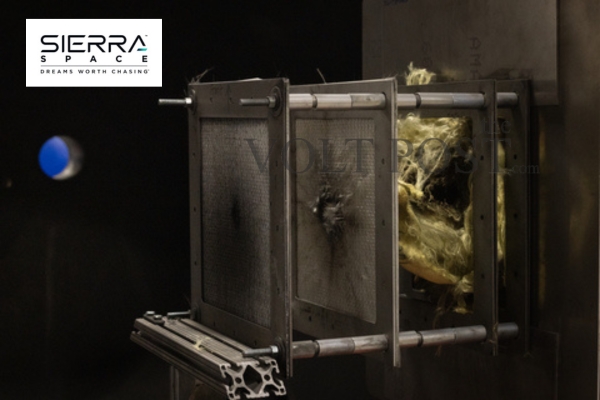
The purpose of this NASA-supported experiment was to improve a shield for the company’s expandable, flexible space station structure, allowing it to survive collisions from hazards in orbit.
The LIFE habitat’s shield, made of novel, high-strength, flexible “softgoods” – a chemically-woven fabric material known as Vectran® – is a lightweight yet durable alternative to typical rigid constructions.
Sierra Space and NASA test teams used a two-stage light gas pistol to simulate strikes from micrometeoroids and orbital debris (MMOD) on LIFE’s outer shield. The testing attempted to identify materials and configurations that improve the habitat’s shielding efficacy while conserving significant bulk, which is crucial for space missions.
The impact testing, which was done under an unfunded Space Act Agreement dubbed Collaborations for Commercial Space Capabilities (CCSC-2), used NASA’s.50 caliber two-stage light gas pistol to simulate MMOD traveling at speeds of roughly seven kilometers per second.
The gun, housed in the Remote Hypervelocity Test Laboratory, employs gunpowder (the first stage) and highly compressed hydrogen (the second stage) to accelerate projectiles at high velocities in order to simulate orbital debris impacts on spacecraft materials and satellite components. Testing is done in a near-vacuum room to imitate space conditions.
Material Selection and Testing Process
The impact trials were conducted in two stages. The first round of shots changed the softgoods materials while leaving the gun parameters constant, mimicking MMOD impacts and directly comparing how each material fared.
After determining the most promising materials, the team altered gun settings to create an equation that described the efficacy and performance of the chosen shield stack.
During the tests, 40 experimental bullets were fired at the materials to verify the configuration choice. After the team had created a robust but mass-efficient shield arrangement, 19 more bullets were fired at the material.
These efforts were crucial in mitigating the potential threats posed by MMOD, which are microscopic, high-speed particles that can inflict considerable damage to spacecraft and habitats in orbit.
Sierra Space team members went to White Sands to see the shots firsthand and work on real-time revisions to the follow-up tests based on the results. This hands-on approach enabled swift, data-driven decisions to improve the shield design.
Collaboration with NASA Drives Innovation
Sierra Space worked closely with NASA throughout the process, leveraging its experience to assess the data and determine the best next steps. This collaboration demonstrates our shared commitment to developing space habitat technologies that can endure the harsh environment of space, including MMOD threats.
Sierra Space remains committed to pioneering space technologies and exploration. The successful testing signifies a significant step in developing the LIFE habitat as a dependable, MMOD-resistant alternative for long-duration space missions. Additional testing will enhance the LIFE home in preparation for its first launch into low-Earth orbit.
Leadership Comments
“Our innovative space station technology drives scientific discovery and fuels a low-Earth orbit economy,” said Shawn Buckley, Vice President, Space Destinations Systems at Sierra Space. “This collaboration with NASA advances our efforts to development a shield that protects against micrometeoroids and space debris, bringing us closer to launching the LIFE habitat into orbit and readying our technology for repeat and long-duration space missions.”
You can view and download video of the test campaign here and photos here.