



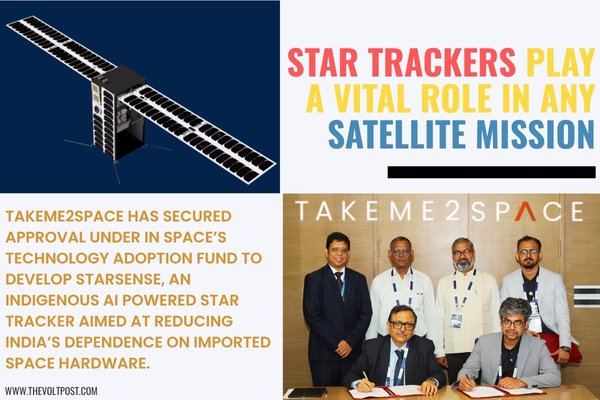
TakeMe2Space has secured approval under IN SPACe’s Technology Adoption Fund to develop StarSense, an indigenous AI powered star tracker aimed at reducing India’s dependence on imported space hardware.
After successfully space qualifying its technology across two orbital missions in 2024, the company is now focusing on one of the few critical subsystems that Indian satellite makers still source from abroad.
Star trackers play a vital role in any satellite mission. They determine a spacecraft’s orientation with extremely high precision, often down to single digit arcseconds, which is essential for advanced imaging and communication systems.
Today, most of these systems are imported from the United States and Europe. StarSense is designed to change that and aligns closely with India’s push for self reliance under the Atmanirbhar Bharat initiative.
The project is structured over a 24 month development cycle that will take it from its current laboratory stage to a fully qualified flight ready system.
The timing is significant. India is expected to launch around 150 satellites over the next three years, and since most missions require two star trackers for redundancy, the immediate domestic demand alone stands at roughly 300 units.
A locally developed alternative could help satellite builders avoid export restrictions, reduce supply chain risks, and speed up mission timelines. It also opens the door for India to position itself as a global supplier of high precision space components.
TakeMe2Space is developing two versions of the system to address different segments of the market. StarSense Lite is designed for CubeSats and academic missions, with a focus on size, weight, power efficiency, and cost.
StarSense Pro targets larger satellites above 50 kilograms that require higher precision and performance.
What differentiates StarSense is its use of artificial intelligence. Instead of relying only on traditional geometric methods, the system uses an embedded AI accelerator to improve accuracy and maintain reliability even in challenging orbital conditions such as cosmic radiation and dense star fields. Additional shielding helps protect the sensor and electronics from the harsh space environment.
Beyond immediate applications, StarSense also supports TakeMe2Space’s broader vision of building a 1 gigawatt Orbital Data Center, a planned constellation of 20,000 high performance compute satellites.
Developing critical subsystems like star trackers in house is a key step toward securing the supply chain needed to support infrastructure at that scale.
 Leadership Comments
“India is on the cusp of a satellite boom, but a critical part of every spacecraft still arrives on a boat or a plane from abroad, often with strings attached. With StarSense, we want every Indian satellite builder, from a college team to a defence programme, to be able to point their spacecraft with world-class accuracy using hardware made here at home. IN-SPACe’s backing through the Technology Adoption Fund is a strong vote of confidence in that mission,” said Ronak Kumar Samantray, Founder and CEO of TakeMe2Space.
“Owning the full hardware stack is not a luxury for what we are trying to build in orbit, it is a necessity. Every sovereign subsystem we develop today brings the vision of a large-scale orbital data centre, built and controlled in India, that much closer,” added Ronak.
To Know More: CLICK HERE