



Silicon Labs is bridging the gap between embedded edge devices and enterprise data architecture through a strategic partnership with Databricks.
As IoT devices pack in more intelligence and custom hardware, the complexity of building them is threatening to bottleneck developers. Silicon Labs is tackling this scaling issue head-on. At its seventh annual Works With Summit, the company rolled out a sweeping set of initiatives designed to streamline how engineers build, deploy, and manage edge intelligence.
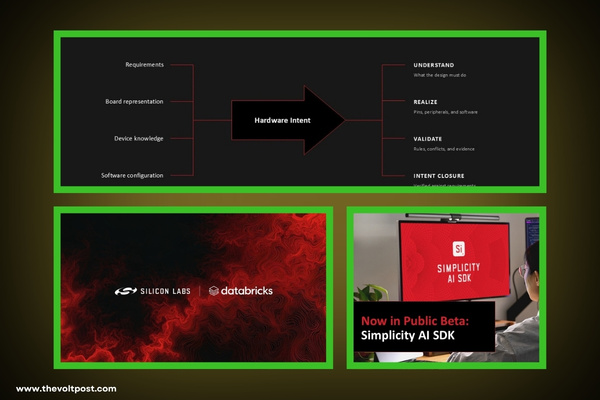
The most immediate shift for developers is the public beta launch of the Simplicity AI SDK. Instead of forcing engineers to adopt a walled-off, proprietary AI tool, Silicon Labs is injecting its specific hardware and software context directly into the AI coding assistants developers are already using, such as GitHub Copilot, Cursor, and Codex.
This AI integration goes a step further with the introduction of Simplicity Design Intelligence. The suite’s inaugural feature, Hardware Intent, acts as a digital safety net for hardware design.
By cross-referencing board schematics, component datasheets, and project requirements, the system can automatically flag pin conflicts and peripheral mismatches before manufacturing. For engineering teams, this means catching fatal design flaws early and drastically reducing avoidable, costly board respins.
On the machine learning front, Silicon Labs is bridging the gap between embedded edge devices and enterprise data architecture through a strategic partnership with Databricks. Moving AI from the cloud to the edge traditionally requires juggling separate technology stacks.
Now, through a new MLOps SDK integration, teams can funnel device fleet data directly into the Databricks platform. Once there, engineers can leverage Databricks’ massive computing resources to train models, and then immediately use the Silicon Labs ML Profiler to verify if those algorithms will actually fit within the CPU and memory constraints of their target hardware.
Finally, Silicon Labs is shifting toward a more collaborative ecosystem by launching a new open-source developer community. Kicking off its beta phase with Bluetooth Low Energy (LE), the initiative leans heavily on GitHub.
Rather than waiting for official platform updates, developers can access sample applications, flag issues, propose fixes, and contribute code directly via pull requests, allowing the broader engineering community to actively extend and refine the Silicon Labs software platform.
Leadership Comment
 “More capable silicon should not create more development complexity,” said Manish Kothari, Senior Vice President of Software at Silicon Labs. “We are giving developers and their AI agents a connected path from hardware and software intent through implementation, community contribution, and the complete AI lifecycle.”
“We’ve been working closely with Silicon Labs as an Alpha customer, evaluating how the Hardware Intent Agent can streamline hardware development across our current and future products while providing feedback on new features as it progresses towards general release,” said Limor Alkelai, Co-CEO, at Risco Group. “We see its potential in enabling quicker and more robust development.”
Availability and Next Steps
The Simplicity AI SDK Beta is publicly available, with official support initially focused on Bluetooth LE and support for GitHub Copilot and Codex. An alpha release of Hardware Intent, the first capability in Simplicity Design Intelligence, is planned for January 2027.
The Silicon Labs open-source community Beta launches with Bluetooth LE, and its sample applications are accessible on GitHub for code review and contributions.
Initial Silicon Labs MLOps tools are available in Databricks today.
To Know More: CLICK HERE