



The TRAVEO CYT4EN MCU flaunts above its class. It effortlessly handles advanced 2.5D graphics, 3D scene rendering, and can drive two separate Full HD displays simultaneously.
Infineon Technologies is making it a lot easier and significantly cheaper for automakers to put high-end digital dashboards into everyday cars and motorcycles.
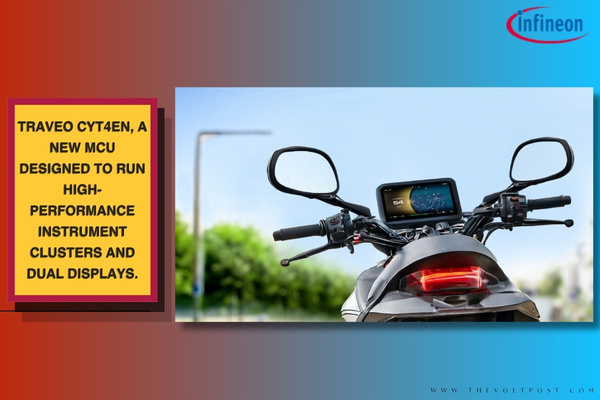
The German semiconductor major has officially unveiled the TRAVEO CYT4EN, a new microcontroller (MCU) designed to run high-performance instrument clusters and dual displays.
Traditionally, pushing this kind of heavy graphical output required a complex, pricey System-on-Chip (SoC). But Infineon has flipped the script. By teaming up with Micron to heavily optimize the chip for external LPDDR4 memory, the new MCU delivers SoC-level graphics without the SoC price tag or system complexity.
Built on Infineon’s proven TRAVEO T2G architecture, the TRAVEO CYT4EN flaunts above its class. It effortlessly handles advanced 2.5D graphics, 3D scene rendering, and can drive two separate Full HD displays simultaneously.
For drivers, the most noticeable upgrade might just be the startup speed. Thanks to on-the-fly rendering and hardware-accelerated decompression, the dashboard springs to life in under 150 milliseconds, bypassing the annoying, multi-second lag common to heavier SoC-based platforms.
Behind the scenes, the engineering and cost benefits for manufacturers are massive. The highly integrated chip drastically reduces a vehicle’s overall bill of materials.
It handles system management and in-vehicle network communications entirely on its own, meaning automakers don’t have to wire in additional microcontrollers. It also streamlines production by allowing for simpler, six-layer PCB layouts, and runs efficiently enough to completely ditch active cooling fans.
On the safety front, the CYT4EN checks all the crucial automotive boxes. It supports ASIL-B functional safety (ISO 26262) and is fully compliant with ISO 21434 cybersecurity standards.
Furthermore, an intelligent independent voltage domain keeps essential communications and basic processing running in low-power modes, ensuring the system stays robust and energy-efficient even when the vehicle is resting.
Ultimately, Infineon’s latest release bridges the gap between budget constraints and premium user experiences, paving the way for next-generation smart cockpits across all tiers of the automotive market.
Leadership Comments
“Cutting-edge cluster and display solutions are playing a central role for the user experience in connected and software-defined vehicles,” said Thomas Boehm, Senior  Vice President Automotive Microcontrollers at Infineon. “With TRAVEO T2G CYT4EN, we are helping our customers bring them to market more quickly, efficiently and cost-effectively. By combining the simplicity, safety, and fast responsiveness of an MCU architecture with the high-bandwidth memory required for modern cockpit graphics, we are enabling a new generation of vehicle displays.”
“Micron’s automotive LPDDR4 memory provides a proven combination of bandwidth, reliability, and functional safety features for cost-optimized cockpit platforms,” said Amanda Henderson, Director of Ecosystem Enablement at Micron. “For vehicle programs where affordability, longevity, and functional safety are key requirements, LPDDR4 remains an effective solution for delivering modern display experiences.”
Availability
The TRAVEO™ T2G CYT4EN is now available.
To Know More: CLICK HERE