NanoXplore and STMicroelectronics Achieve Space Milestone with NG-ULTRA Qualification
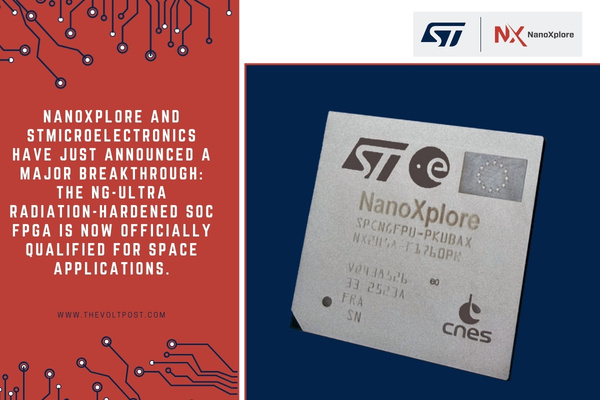
NanoXplore and STMicroelectronics have just announced a major breakthrough: the NG-ULTRA radiation-hardened SoC FPGA is now officially qualified for space applications. Designed specifically for low- and medium-Earth orbit (LEO/MEO) constellations, this chip will power satellite systems for flagship European missions like Galileo, Copernicus, and potentially IRIS².
First Product Certified to New ESCC 9030 Standard
This qualification is a game-changer for Europe’s space ecosystem. NG-ULTRA is the first product to meet ESCC 9030, a brand-new European standard for high-performance microcircuits using flip-chip packaging on organic substrates or plastic.
It delivers the reliability space missions demand while ditching heavier, pricier ceramic packages perfect for deep space but overkill for high-volume constellations.
The “new space” era think satellite swarms, LEO/MEO orbits, and mass deployments is reshaping onboard electronics. Teams need more computing power, lower power draw, and costs that scale with volume. NG-ULTRA s teps up by enabling edge computing in orbit, cutting data transmission bottlenecks to ground stations.
It targets critical functions like onboard computers, data management and routing, real-time image/video processing (compression and encoding), Software Defined Radio (SDR) for flexible comms, and autonomous operations (detection, recognition, supervision).
A Fully European, Secure Supply Chain
This isn’t just about performance it’s about sovereignty. The radiation-hardened SoC FPGA builds a 100% European supply chain for design, manufacturing, assembly, and testing, reducing critical dependencies for long-haul missions.
NanoXplore taps its R&D hubs in Paris, Grenoble, and Montpellier, plus STMicroelectronics’ European sites: Grenoble (R&D/design), Crolles (300mm digital fab), Rennes (space packaging), Grenoble/Agrate (testing/reliability), and backup facilities across the continent.
Cutting-Edge Technical Specs
NG-ULTRA packs a quad-core Arm Cortex-R52 processor with programmable logic into one efficient SoC boosting design flexibility, shrinking board complexity, and optimizing latency, mass, and power.
Built on ST’s 28nm FD-SOI platform (famed for energy efficiency and radiation resistance), it adds advanced hardening to withstand launch shocks, thermal swings, vibrations, and orbital harshness.
Radiation resilience includes:
- TID tolerance: Up to 50 krad (Si) for long-term reliability
- SEL immunity: Tested to 65 MeV·cm²/mg
- SEU immunity: Validated beyond 60 MeV·cm²/mg LET
Performance highlights
537k LUTs + 32 Mb RAM for demanding onboard computing. Its SRAM-based architecture allows unlimited in-orbit reconfiguration, update hardware like software post-launch, adapt to new standards, or tweak for mission phases. This future-proofs satellites for extended life.
An evaluation kit is available too, speeding prototyping, interface validation, risk reduction, and software/logic development before flight production.
 Leadership Comments
“The ESCC 9030 qualification for the NG-ULTRA is a historic step. It proves that Europe now masters the entire production chain for cutting-edge digital components tailored to the requirements of both deep-space and new space constellations. Thanks to the support of the ESA, CNES, and the European Commission (via DG-DEFIS), NanoXplore & STMicroelectronics are securing EU strategic autonomy while making European satellites more competitive than ever.” — Édouard Lepape, CEO, NanoXplore.
“Space applications require robust sovereign supply chain, radiation-hardened and cost-optimized chips. ST is leveraging its expertise in GEO and LEO platforms with proven FD-SOI technology, hardening expertise, manufacturing, advanced packaging and quality assurance assets in Europe to enable NanoXplore’s NG-ULTRA to the New Space market,” said Thomas Goust, Division General Manager of Space Division, RF & Optical Communication sub-group at STMicroelectronics.
To Know More: CLICK HERE