MIKROE has introduced the EnOcean 5 Click, a new wireless connectivity Click board™ designed to streamline communication with EnOcean-based sensors, switches, and actuators. As part of MIKROE’s mission to speed up embedded development, this compact add-on board lets engineers move quickly from proof-of-concept to working prototypes and finished applications.
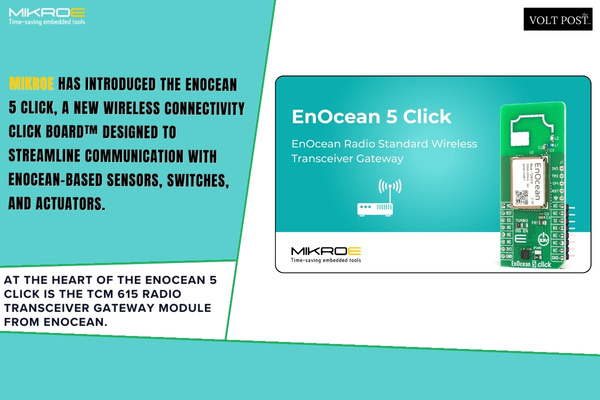
At the heart of the EnOcean 5 Click is the TCM 615 radio transceiver gateway module from EnOcean. This module uses the EnOcean Serial Protocol 3 (ESP3) over a simple UART interface, making it easy to integrate with microcontrollers or processors.
Operating at 868.3?MHz with the EnOcean Radio Protocol 1 (ERP1), it supports both sending and receiving of EnOcean radio telegrams through an integrated 50?? PCB trace antenna. With a sensitivity of -95?dBm and output power of +10?dBm, it delivers strong and reliable wireless performance in a wide range of environments.
The TCM 615 also includes advanced security features defined by the EnOcean Alliance, such as encryption, authentication, decryption, and replay protection, all handled directly on-board. Communication is simple and efficient through a UART ESP3 interface that supports baud rates of 57,600?bps and 460,800?bps.
As one of the latest additions to MIKROE’s lineup of more than  1,900 mikroBUS™ compatible Click boards, the EnOcean 5 Click also includes ClickID™ technology for automatic recognition by the host system making setup virtually plug-and-play.
It’s compatible with any mikroBUS™ enabled host and supported by MIKROE’s mikroSDK open-source libraries, giving developers the flexibility they need for evaluation, customization, and fast deployment.
Leadership Comments
Nebojsa Matic, CEO of MIKROE, said: “This new Click board is ideal for developing energy-efficient dimmers, relays, and shutter controllers that rely on self-powered EnOcean switches. It is part of our 260+ strong family of wireless connectivity Click boards and over 850 projects – with working code – featuring the EnOcean 5 Click can be found on MIKROE’s embedded projects platform, EmbeddedWiki.”