

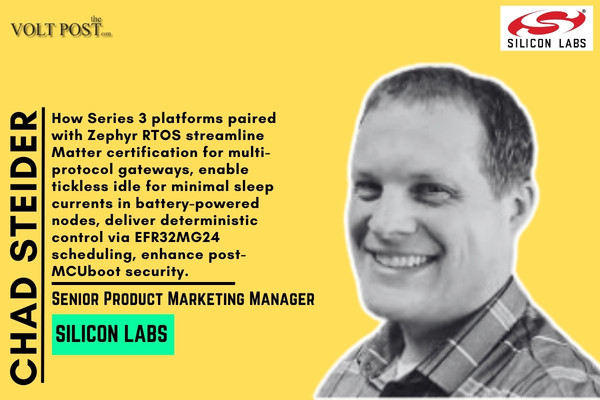
In this Volt Post technical interview, Chad Steider, Senior Product Marketing Manager at Silicon Labs, speaks with Niloy Banerjee, Group Editor of The Volt Post, on how Series 3 platforms paired with Zephyr RTOS streamline Matter certification for multi-protocol gateways, enable tickless idle for minimal sleep currents in battery-powered nodes, deliver deterministic control via EFR32MG24 scheduling, enhance post-MCUboot security.
Chad also highlights on support capabilties as it enables seamless firmware scaling from consumer IoT to industrial applications bolstering India’s thriving edge ecosystem. Edited Volt-Full Excerpts Below.
How does the new Zephyr support on Series 3 make it easier to certify multi-protocol gateways for industrial systems, given developers’ frequent challenges with Matter certification?
Multi-protocol gateways operate at the intersection of multiple standards, software stacks, and certification requirements. This makes them increasingly complex to manage, particularly in industrial environments where reliability and regulatory compliance are essential.
Matter adds another layer of complexity, as the standard continues to evolve and requires ongoing alignment without repeated software rework.
With Series 3 devices and enhanced Zephyr support, developers are provided with a more structured and stable foundation. Zephyr offers an upstream RTOS that aligns well with standards-based ecosystems such as Matter.
On Series 3, this enables cleaner organisation of protocol stacks, more predictable resource management, and a software base that evolves alongside the ecosystem rather than becoming fragmented.
From a certification perspective, this consistency is critical. It allows developers to more easily trace system behaviour, respond to specification updates with less disruption, and maintain compliance throughout the product lifecycle. The result is a more manageable and scalable path toward certification.
What Zephyr power configurations, like tickless idle, are currently operating smoothly on your platforms for battery-powered edge nodes, and what is the practical impact on the sleep current?
For battery-powered edge nodes, power efficiency is not merely a feature; it is a fundamental design requirement. Zephyr incorporates a highly capable power manager, and Silicon Labs’ devices fully leverage this sub-system.
Via the Zephyr power manager, developers can control their devices’ transitions into a number of different energy states (EM1, EM1P, EM2, and EM4), each offering unique power-saving benefits.
Additionally, Zephyr is tick-less. Tick-less operation allows a Zephyr-based system to avoid unnecessary wake-ups when there is no active processing, enabling devices to remain in low-power states for longer periods.
In practical terms, this results in lower sleep currents without requiring developers to invest significant effort in custom power optimisation.
As a result, power behaviour becomes more predictable and repeatable, which is especially important for large-scale deployments where devices are expected to operate reliably for many years on a single battery.
A new, stringent trend of factories needing rock-solid timing is emerging; can you walk through how Zephyr’s scheduler works with the EFR32MG24 for those deterministic control loops?
In factory and industrial environments, timing predictability is often more important than raw computing performance. Control systems must behave consistently under varying workloads, as even small timing variations can have a measurable impact on operations.
Zephyr’s scheduler is designed with this requirement in mind. It provides priority-based scheduling and configurable timing behaviour, supporting deterministic execution. When combined with devices like the MG24, it gives developers an ideal framework for developing real-time systems.
This alignment between hardware and software enables teams to meet real-time requirements without adding unnecessary complexity to the system architecture. For industrial developers, achieving this balance between predictability and simplicity is becoming increasingly important.
With India’s IoT boom, how does this help teams avoid firmware headaches when scaling from consumer devices to industrial products on one software base?
In India, many development teams begin with consumer IoT products and later expand into industrial or infrastructure use cases. In many cases, firmware designed for one category does not scale easily to another, leading to repeated rewrites and fragmented software systems.
By using Zephyr as a common RTOS across platforms, developers can maintain a single software foundation while adapting to different requirements related to reliability, security, and long-term support.
This approach enables teams to reuse core components, build on proven code, and evolve their products over time rather than starting from scratch.
For fast-growing Indian companies and startups, this significantly reduces development effort and makes it more practical to scale products into new markets and use cases.
How is the industry’s transition to more intelligent, software-defined products reflected in Silicon Labs’ CES 2026 announcements?
CES 2026 clearly highlighted how the industry is moving toward software-led innovation. Developers and OEMs now expect platforms to handle increasing system complexity while still simplifying development and shortening time-to-market. Hardware remains essential, but software, tools, and ecosystems are increasingly what define the overall developer experience.
Our announcements reflected this shift through continued investment in open platforms such as Zephyr and in development tools like Simplicity Studio and the Simplicity SDK. These investments are aimed at improving onboarding, enabling software reuse, and supporting long product lifecycles—key requirements as devices become more intelligent and software-driven.
We also see expectations changing around how development itself happens. As software complexity grows, developers want workflows that reduce manual effort, improve productivity, and scale with their ambitions. Our software strategy is designed to support exactly that shift.
Security is beyond MCUboot; what Zephyr features help handle post-quantum threats in the field?
Security requirements evolve throughout a device’s operational life, which can span many years in the field. Zephyr’s modular architecture provides flexibility to update security mechanisms within the constraints of the underlying hardware.
Software updates can address protocol vulnerabilities, rotate certificates, and incorporate security improvements—provided the hardware has sufficient processing power, memory, and cryptographic capabilities to support them.
While emerging standards like post-quantum cryptography show promise, their practical deployment on resource-constrained devices will likely require purpose-built hardware support. Zephyr’s architecture allows teams to integrate these technologies as they mature and as hardware capabilities advance.
When combined with Silicon Labs‘ Secure Vault features—including hardware-accelerated cryptography and secure boot—developers gain significant flexibility for security updates.
However, forward-looking security design still requires careful hardware selection with headroom for future requirements, as fundamental cryptographic capabilities remain bounded by the underlying silicon.
CES brought some compelling Bluetooth demos. How do Zephyr device trees speed up prototyping AI sensors without starting from scratch every time?
Rapid prototyping can become difficult when hardware changes require developers to rewrite large portions of their code. Zephyr addresses this challenge through its device tree approach, which separates hardware description from application logic.
On BG26-based platforms, developers can change sensors, interfaces, or peripherals by updating the device tree instead of reworking the entire application.
This significantly reduces development effort during hardware changes. For AI sensor development, it shortens iteration cycles and allows teams to focus on data processing, inference, and system behaviour rather than repeatedly managing low-level hardware configuration.
What features in Simplicity Studio make cohabitation less of an obstacle for Indian developers who constantly contend with sub-GHz and BLE?
As products increasingly need to support multiple wireless protocols, managing cohabitation can become a major source of complexity.
Simplicity Studio helps address this by offering a unified environment where developers can configure, debug, and validate sub-GHz and BLE applications together.
This integrated approach reduces the need to juggle multiple tools or workflows. For Indian developers, who often build cost-sensitive products targeting multiple markets, this flexibility is particularly valuable.
It allows teams to focus more on application logic and system behaviour rather than toolchain integration.
Large deployments, such as smart cities, require OTA reliability. How does Zephyr’s kernel ensure secure updates and reliable provisioning at scale?
In large-scale deployments, over-the-air (OTA) updates are about far more than pushing new firmware—they are about reliability, recoverability, and trust.
Zephyr RTOS supports structured update mechanisms that enable authenticated updates and predictable rollback in the event of an update failure, ensuring devices remain operational even under adverse conditions.
When paired with Silicon Labs’ secure hardware capabilities, this foundation enables robust provisioning and end-to-end lifecycle management across large device fleets. In smart city deployments—where uptime directly impacts public services and citizen trust—such reliability is not a nice-to-have, but a core requirement.
Silicon Labs in India is a vital engineering hub. Are there collaborations with local universities or design firms to adapt Zephyr for Make in India projects?
India plays an important role in Silicon Labs’ global engineering ecosystem, with local teams increasingly contributing across the full design lifecycle.
We actively engage with developers, ecosystem partners, and academic institutions to build strong capabilities in wireless and RTOS-based development.
Open RTOS platforms such as Zephyr provide Indian teams with access to globally adopted software foundations without the risk of proprietary lock-in. This openness supports collaboration, alignment with international standards, and the ability to build locally while remaining globally competitive.
With 5G, edge and Matter 2.0 on the horizon, where do you see Zephyr evolving to keep software leading the IoT charge?
As IoT systems become more distributed and interconnected, software will increasingly define what devices can do over their lifetime.
Zephyr is evolving to support more advanced networking, stronger security models, and greater scalability while remaining efficient enough for edge devices.
 With developments such as Matter 2.0 and tighter integration with edge and distributed computing, Zephyr’s role as a common, open foundation becomes even more important.