


Intel has signed a non-binding term sheet to acquire AI chip startup SambaNova Systems, marking a major step in its push to strengthen AI hardware capabilities and close the gap with rivals in data center and accelerator markets. The preliminary agreement between Intel–SambaNova could still change or fall through, but it signals Intel’s intent to use acquisitions to accelerate an “AI-first” strategy under CEO Lip-Bu Tan.
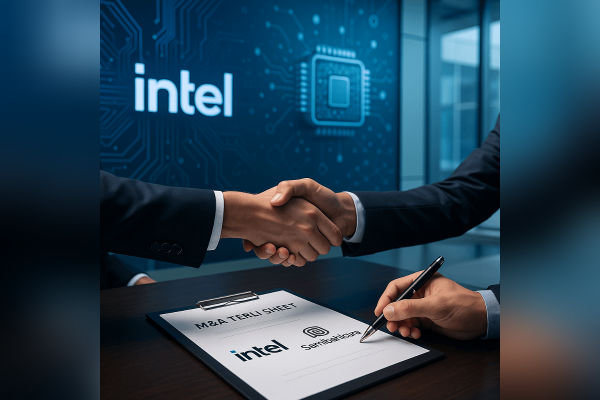
Non-Binding Term Sheet for a Potential Acquisition
Intel-SambaNova have agreed to a non-binding term sheet for a potential acquisition, with detailed financial terms not yet disclosed. The agreement will now move into regulatory reviews, liability checks, and financial due diligence that could take several weeks or months before any transaction is completed.
The deal between Intel–SambaNova is expected to value SambaNova below the roughly 5 billion dollar valuation it reached during the 2021 funding peak, reflecting a reset in private AI chip valuations as Nvidia has tightened its grip on the accelerator market.
A successful acquisition would add another specialized AI processor line to Intel’s portfolio as it races to expand beyond CPUs into high-performance AI accelerators.
Rationale for Intel
SambaNova designs custom AI accelerators and a full-stack platform optimized for inference workloads, enabling enterprises to run large language models and other AI applications more efficiently.
Bringing this technology in-house would give Intel differentiated silicon and software to pair with its own CPUs and foundry capabilities in cloud, enterprise, and government deployments.
Intel has faced pressure for lagging progress in AI GPUs and accelerators, and the company is reshaping its portfolio around AI-centric products while divesting non-core assets.
Together with an earlier multi-billion-dollar U.S. government support package for domestic chip manufacturing, an AI-focused acquisition like SambaNova is seen as part of Intel’s attempt to regain technological and market leadership.
About SambaNova
Founded in 2017 in Palo Alto by Stanford professors Kunle Olukotun and Christopher Ré alongside former Oracle executive Rodrigo Liang, SambaNova has raised more than 1.1 billion dollars to date.
The company focuses on complete AI system chips, systems, and software aimed squarely at high-performance inference and large-scale enterprise deployments.
The AI Chip startup’s valuation surged to about 5 billion dollars after a large 2021 funding round led by SoftBank’s Vision Fund 2, but some institutional investors later marked down their holdings as AI hardware competition intensified.
That reset has made the startup a more accessible target for strategic buyers like Intel that are looking for proven AI architectures rather than building everything internally from scratch.
 Governance Ties And Investor Overlap
Intel CEO Lip-Bu Tan currently serves as chairman or executive chairman at SambaNova, reflecting deep governance and investor ties between the two companies.
Intel Capital is already an investor in SambaNova, and SoftBank—one of SambaNova’s major backers also holds a significant stake in Intel, adding another layer of interconnected interests around any deal.
Earlier reports indicated that Intel had been exploring an acquisition of SambaNova for several months, with discussions always framed as preliminary and subject to change. The newly signed term sheet confirms that those talks have progressed into a structured agreement, even though it remains non-binding at this stage.
Company Comments
Intel has positioned the potential acquisition as a strategic extension of its AI roadmap and data center ambitions, emphasizing that adding specialized accelerators and full-stack AI platforms is critical to meeting customer demand across cloud and enterprise workloads. Company messaging around recent AI moves has highlighted a commitment to “AI-first” product planning, tighter hardware–software integration, and partnerships that help customers deploy large-scale AI more efficiently on Intel-based infrastructure.