

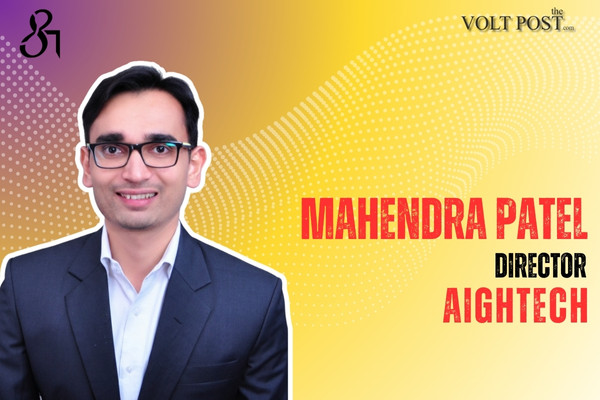
 In this Volt-Full interview, The Volt Post’s Niloy sits down with the vast-experienced Mahendra Patel, Electronics Design Consultant and Director at AIGHTECH defining his new entrepreneurship journey.
During the interview, we explore the inspirations behind AIGHTECH’s founding vision, the company’s mission of technological self-reliance, and Patel’s deep insights into advancing electronics and EV system design in India.
Mahendra Patel shares candid perspectives on balancing performance with reliability, overcoming industry challenges, and driving purposeful, customer-centric innovation while highlighting AIGHTECH’s commitment to shaping the nation’s emerging mobility ecosystem. Edited Volt-Age Excerpts Below:
-
What inspired the founding of AIGHTECH, and how does the company’s mission shape your approach to electronics and EV system design?
Our founding was inspired by a single, critical idea: the urge for technological independence, or Atmanirbharta, in India’s booming EV sector.
Even though EV adoption is rising rapidly (over 2 million EVs sold in 2024), one big question still remains: How much of the technology inside these vehicles is really designed in India? Too often, we depend on foreign partners for core components. That creates a risk, if something fails at scale, we don’t fully control the fix or the supply.
As India aims for 30% EV penetration by 2030, building our own innovation ecosystem isn’t optional, it’s essential.
Our mission is to strengthen that ecosystem by designing reliable, indigenous electronics and EV systems that meet global standards. Every project we take on ties back to this goal: enabling India to own its technology and convert the $200 billion EV opportunity into long-term success, fully aligned with Atmanirbhar Bharat.
-
How do you balance reliability, performance, and practicality when developing new solutions?
In the EV domain, practicality and reliability take precedence over pure performance. The commercial EV market has grown because these vehicles make economic sense. That’s real-world practicality.
But that same market cannot afford downtime. Take an auto-rickshaw driver or a gig worker: a day without the vehicle means a day without income. That’s why one of our core principles, Customer First, drives every design decision. We believe long-term performance naturally follows when reliability and practicality are rock solid.

-
Can you share a recent project or innovation at AIGHTECH that demonstrates your commitment to helping engineering teams scale quickly and efficiently?
The industry has come a long way, especially for two- and three-wheeler EV electronics built for Indian conditions. Our approach focuses on two things: Focused Engagement and Holistic Frameworks.
Electronics design is inherently complex. To combat this, we’re developing dedicated, evolving frameworks for specific types of problems. These help us define scope, explore options, and create implementation plans quickly, saving clients time and preventing costly changes later.
For example, in a recent project to help a team pass an Electromagnetic Compliance (EMC) test for a high-power converter, our approach was:
- Diagnosis: Systematically understand the setup, identify the exact failing frequency bands, and pinpoint the noise sources.
- Optimization-First: Prioritize no-cost solutions and optimize existing components (like small R-C values or magnetics construction) before considering bulky or expensive additions. We emphasize leveraging components like correctly placed Y-capacitors to reduce Common Mode (CM) noise effectively and affordably.
- Cost Reduction: Once we achieve compliance with a good margin, we critically review the design to eliminate overdesigned components, specifically expensive items like certain chokes and shields, maximizing efficiency and cost savings.
Results: This objective, framework based approach allows us to achieve a high success rate. In a recent engagement, 9 out of 12 proposed optimizations worked on the first attempt.
Efficiency requires objectivity. We focus the team’s effort by constantly asking: “Which ideas are truly applicable to the current situation?”. This prevents valuable time from being wasted on solutions based purely on past subjective experience.
Finally, we encourage continuous learning through the military principle of After Action Review (AAR). Once a difficult problem is solved, the team sits down together to objectively reflect on what worked and what didn’t. This single process adds a crucial layer of efficiency, ensuring that the next similar problem is solved even faster and smarter.
-
What emerging trends in electronics design or EV systems excite you most right now?
A lot is changing and many developments are genuinely exciting.
- Edge AI in Vehicles: The evolution of Edge AI is a game-changer. With modern ECUs combining many functions, onboard AI (powered by NPUs) can handle tasks like battery health prediction or smart control without relying on cloud connectivity. It offers better accuracy, lower latency, and higher efficiency.
And importantly, Edge AI doesn’t replace people. It enhances existing algorithms and helps engineers build smarter systems with fewer resources.
- Miniaturization and Optimization: Smaller, more efficient electronics are becoming the norm. With India’s semiconductor ecosystem maturing, custom silicon for specialized needs will quickly become standard. Technologies like GaN and SiC are helping reduce size and weight, especially for high-power converters. OEMs around the world are also exploring various X-in-1 design approaches to integrate multiple functions into a single unit.
- Advanced Battery Systems: The continuous advancement in cell chemistry and battery technology is thrilling. The evolving BMS (Battery Management System) architecture is getting much better at extracting the longest and safest life from the battery pack, enabled by modern hardware design and software tools.
-
How do you collaborate with customers to ensure each solution aligns with their specific needs?
The short answer is: We listen, very carefully.
It’s not just about the client’s technical brief. We look at how their choices affect the end user, the market, and the overall product lifecycle. That’s what helps us offer complete, practical solutions rather than isolated fixes.
Our goal is always to be more than a consultant. We see ourselves as partners in learning. We actively share insights from global semiconductor and electronics design trends so our clients can make informed, forward-looking decisions. That ensures affordability, local availability and long term support are built into the product from day one.
For us, collaboration means building together, not just delivering a report.
-
What advice would you give to engineering teams looking to innovate with purpose in today’s fast-moving technology landscape?
Purpose must be at the core of innovation. Any company with a lasting legacy has one thing in common: unwavering customer centricity, and that’s what inspires us at AIGHTECH.
Instead of chasing fancy features, teams should focus on solving basic, real-world problems for the user and themselves.
CONSIDER THREE PERSPECTIVES:
- Focus on Dignity and Accessibility: In India, we frequently see two-wheelers with side-wheels for mobility. This is a significant, growing market (expected 20% CAGR through 2030) because it offers affordable mobility for people with disabilities and the elderly. Why not design a dedicated vehicle category from the ground up? It can dramatically improve the confidence and dignity of a large population segment.
- Everyday Comfort: Consider our gig workers. Studies show they log exceptionally long hours, often in harsh conditions. When parked in the peak Indian summer, a scooter seat can hit 60°C to over 80°C! A comfortable, ventilated seat is far more valuable to this working class than an optional audio box or a non-essential data device. Innovate where it truly matters to the customer’s daily life.
3. Perhaps the most important point: Invest in your own health and longevity. Instead of looking at “ergonomics” or “mental health” as separate topics, we encourage teams to think in terms of overall long-term well-being. This approach builds greater trust and supports the workforce in a more meaningful, sustainable way. Personal sustainability is what truly helps teams maintain momentum and keep growing their expertise over the decades.
My advice is simple: look around, spot a real challenge, and solve it with empathy and practicality. Innovation starts there.
-
Meeting regulatory compliance and certification requirements are affecting time-to-market. Your comments to it.
Absolutely—it’s one of the most pressing challenges affecting time-to-market today. That’s why we believe the guesswork needs to be removed early. Getting the fundamentals right from day one and thoroughly understanding the problem is half the solution.
Many EV teams are young and ambitious, which is fantastic, but the smartest move is to collaborate with experts early. Asking for help isn’t a weakness; it’s a strategy. This ensures faster regulatory navigation, preserves quality, and helps teams mature quickly—all without risking burnout or costly delays.
Above all, stay objective. Collect relevant data and make fact-based decisions to meet stringent certification deadlines efficiently.
-
How can one handle complex updates, maintenance, and compatibility issues in deployed systems?
The key is strong Impact Analysis and clear Prioritization.
Every update or change adds a new layer of variables to the deployed system. Hence, it makes digital transformation absolutely necessary for effective modern design and change management.
Engineering teams should always evaluate every proposed change based on two primary factors: the impact on the end customer and the long-term reliability of the system.
Our rule for prioritization is simple:
- Highest Priority must be given to points with the highest impact on the end customer, followed closely by issues that could lead to long-term reliability failures and financial risk.
- If the impact to the customer or the system’s long-term reliability is low, those items should be assigned a low priority and scheduled strategically.
This clear, data-driven hierarchy is key to managing complexity, ensuring that time and resources are always focused on maintaining optimal customer experience and system integrity.
 Closing Note
India’s incredible cultural and geographical diversity teaches us to think broadly, stay adaptable, and approach real-world challenges creatively. When this mindset is paired with modern execution methods, it becomes a powerful driver of innovation.
We believe India’s next big leap in EVs and electronics will come through collaboration, not competition. With our blend of hands-on design thinking and strategic foresight, we aim to help engineering teams innovate faster, smarter, and with a clear sense of purpose.