


Globally, quantum scientists are working to enhance quantum computers to increase their reliability and power. The groundbreaking quantum computers sold by the German start-up eleQtron use microwave radiation rather than lasers to control the individual trapped ion qubits, resulting in a simpler architecture and significantly lower cooling and power consumption.
This significant advancement is made possible by Spectrum Instrumentation’s Arbitrary Waveform Generators (AWG), which use cutting-edge Direct Digital Synthesis (DDS) technology to execute quantum operations with up to 20 sine wave carriers per output.
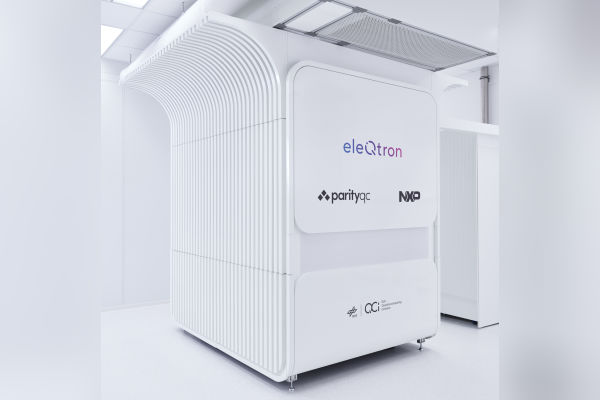
A quantum computer that uses the patented MAGIC (MAgnetic Gradient Induced Coupling) quantum processors was just delivered by eleQtron, a spin-off from the University of Siegen. By controlling and manipulating the qubits with microwave radiation rather than lasers, MAGIC sets itself apart from other quantum processor technologies.
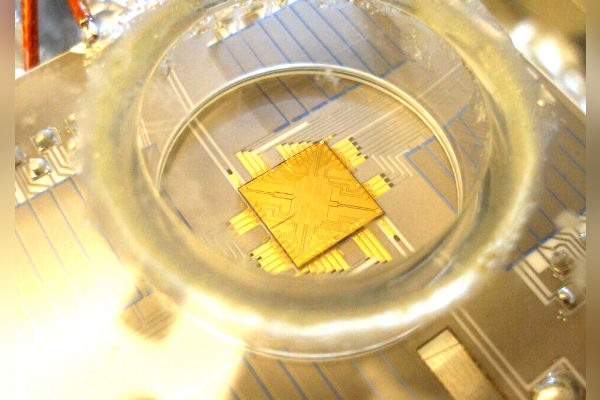
Ytterbium (171Yb+) ions are first produced by laser ablation in a high vacuum. A string of up to 30 ions, each acting as a qubit, can be created using this method in a single register. Using a magnetic field and an oscillating electric field to create a Paul trap (quadrapole ion trap) is essential for putting quantum algorithms into practice.
In order to manage and manipulate the qubits and get them ready to execute quantum gates, several systems use a laser at this point. However, these lasers take a lot of power and must be incredibly accurate at aiming at each ion separately.
In contrast, microwaves use around a fifth of the power and are technically simpler. A single sideband (SSB) mixer is used to combine the output of Spectrum’s DDS card with a high-frequency oscillator source, producing a signal at about 12.64 GHz.
Each ion can be “addressed” by modulating the signal in deltas of 3 to 5 MHz, which provides low crosstalk and integrates well with chip-based ion traps, thanks to the Zeeman effect caused by the magnetic field. The multi-tone signal required to implement individual qubit control and manipulation is produced by the DDS card.
When the eleQtron scientists approached the boundaries of their current AWG hardware, they contacted Spectrum Instrumentation.
To properly regulate each qubit, the generated signals must be adjusted in terms of frequency, pulse length, phase offset, and amplitude. This aids in achieving the target Rabi frequency, which controls how quickly quantum actions occur. However, these specifications put a lot of strain on the Arbitrary Waveform Generator (AWG).
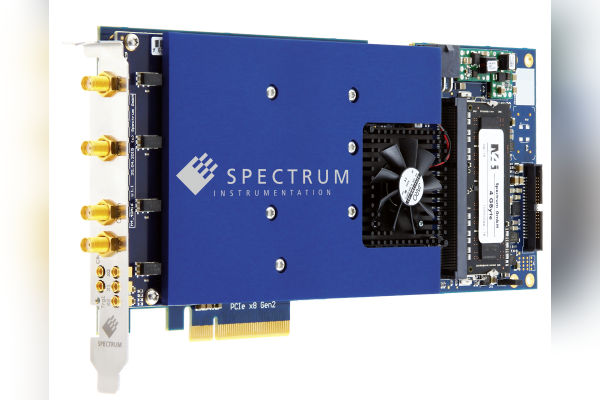
The M4i.66xx-series of 16 bit AWGs, a well-known instrument line in the global community of quantum researchers, was suggested to the eleQtron team. These PCIe cards feature a large onboard memory that can be divided into segments to replay various waveforms, as well as one, two, or four synchronous channels with an output rate of up to 1.25 GS/s.
Up to eight cards can be synced if necessary, and data transmission speeds of 2.8 GB/s are achievable using Spectrum’s optimized drivers. The outputs support up to 20 sine wave cores on a single channel when using the extra DDS firmware.
With only a few keystrokes, each DDS core may be configured for frequency, amplitude, phase, frequency slope, and amplitude slope, resulting in 6.4 ns resolution modifications on the sine wave cores.
In order to construct advanced quantum circuits, it is necessary to have flexibility in the design of quantum processors and to address more qubits. The DDS solution was essential to the eleQtron team’s concept. They also noted Spectrum’s exceptional support, ranging from the high caliber of the documentation to the design engineers’ prompt action.
To Know More: CLICK HERE