


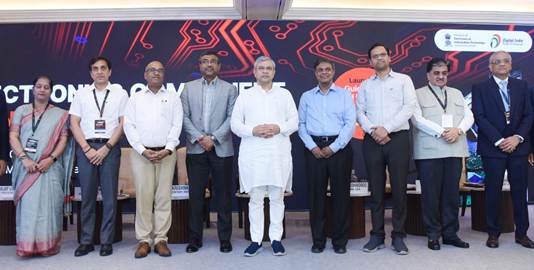
In a landmark move to strengthen India’s position as a global electronics manufacturing hub, the Ministry of Electronics and Information Technology (MeitY) officially launched the Electronics Components Manufacturing Scheme (ECMS).
The scheme, along with its operational guidelines and dedicated portal, was unveiled by Union Minister Ashwini Vaishnaw. The initiative is part of India’s broader strategy to deepen the electronic components supply chain and build design capabilities domestically.
The launch event, held at MeitY Bhawan in New Delhi, witnessed participation from more than 200 dignitaries, including senior government officials, global and domestic industry leaders, financial institutions, and members of the diplomatic community.
Objectives of ECMS
Aiming for Self-Reliance in Electronics Manufacturing
The primary goal of the ECMS is to bolster India’s electronic component manufacturing ecosystem. By doing so, India aims to reduce dependency on imports, enhance its value chain, and support the “Make in India” and “Atmanirbhar Bharat” (self-reliant India) initiatives.
Key Objectives Include:
- Establishing a resilient domestic electronic components supply chain
- Encouraging innovation and design capabilities
- Generating high-quality employment
- Positioning India as a preferred global destination for electronics manufacturing
Hybrid Incentives Model
For the first time, the Government of India has introduced a hybrid incentive model in electronics manufacturing:
- Capital Support: To set up or expand electronic component manufacturing units.
- Revenue-Linked Support: Financial incentives linked directly to the actual revenue generated by manufacturers.
- Employment Incentives: Benefits linked to the number of high-skill jobs created.
Key Features of ECMS
Comprehensive Supply Chain Coverage
Unlike earlier schemes that narrowly focused on final assembly or limited sub-assemblies, ECMS addresses the entire electronics manufacturing ecosystem — from raw material processing to end-product assembly.
This approach aims to fill critical gaps in:
- Active and passive components
- Semiconductor packaging materials
- Printed circuit boards (PCBs)
- Connectors, sensors, and advanced materials
Design-Driven Approach
Recognizing that innovation begins with design, ECMS emphasizes the development of strong design teams within India. Companies investing in local R&D and design will enjoy additional benefits under the scheme.
Ministerial Remarks
Ashwini Vaishnaw: “India Has Arrived in Electronics Manufacturing”
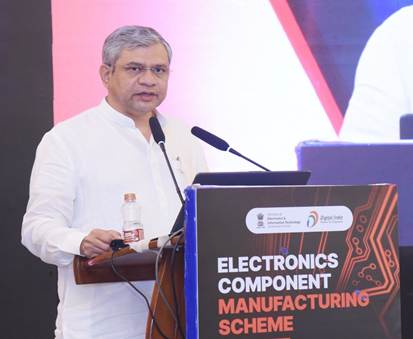
Speaking at the launch, Union Minister Ashwini Vaishnaw emphasized India’s meteoric rise in the global electronics sector:
“In just a few years, India’s electronics production has multiplied five times, and exports have grown six times. Our ambition should not just be manufacturing; it should be manufacturing at Six Sigma quality and developing indigenous design capabilities.”
He also highlighted progress in areas such as mobile phones, servers, laptops, and IT hardware, crediting both industry efforts and proactive government policies.
Vaishnaw further urged the industry to think long-term: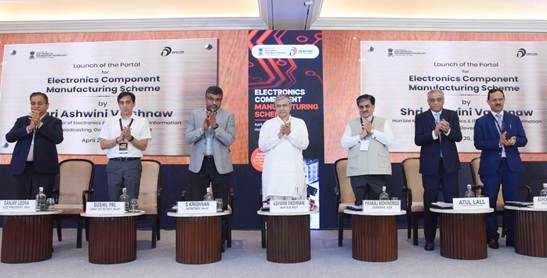
“Let’s prepare ourselves for 10- and 20-year horizons. We must move with the confidence that Indian companies can lead globally in electronics, semiconductors, and AI.”
S. Krishnan: “Collaborative Effort Is the Key”
S. Krishnan, Secretary, MeitY, underscored the collaborative spirit needed to make ECMS a success:
“ECMS is designed to make India a global powerhouse in electronics manufacturing. MeitY will work closely with industry players, startups, academia, and state governments to ensure seamless execution.”
Krishnan stressed that the scheme would not only support large companies but also nurture a vibrant ecosystem of MSMEs and startups.
Launch of the ECMS Portal
To facilitate seamless applications, tracking, and transparency, MeitY simultaneously launched a dedicated ECMS portal. The portal will serve as a one-stop platform where eligible companies can:
- Register for the scheme
- Submit required documentation
- Track application status
- Avail grievance redressal services
This digital-first approach aligns with the broader push towards Digital India and ease of doing business reforms.
India’s Expanding Electronics Footprint
Tremendous Growth in Mobile Manufacturing
India is now the second-largest mobile phone manufacturer globally. Between 2014 and 2024:
-
Mobile phone production surged from ?18,900 crore to over ?3.5 lakh crore.
-
Mobile phone exports crossed ?1.2 lakh crore in FY24, a sixfold jump from FY17.
IT Hardware and Server Manufacturing
With the success of the Production Linked Incentive (PLI) Scheme for IT Hardware, global giants like Dell, HP, Lenovo, and Acer have expanded their manufacturing operations in India.
The government’s focus is now shifting from final assembly to manufacturing components like motherboards, batteries, memory modules, and chassis.
The Role of Sarvam AI and Indigenous Design Push
In another major announcement, Sarvam AI was selected to develop India’s first indigenous foundational AI model. The government will collaborate with Indian startups and academic institutions to promote AI models “built for India, by India.”
Sarvam AI’s initiative reflects India’s ambition not just to be a consumer of next-gen technologies but also an original developer and global competitor.
This move parallels ECMS’s vision of building design capabilities in electronics, further enhancing India’s technological sovereignty.
Global Industry Reactions
Industry bodies and global corporations hailed the ECMS initiative as a transformational step:
Rajeev Chandrasekhar, Minister of State for Electronics and IT, commented:
“This is the decade of India. With ECMS, we are laying down the building blocks for a strong, resilient, and innovation-driven electronics manufacturing ecosystem.”
Sanjay Gupta, Chairman of India Electronics and Semiconductor Association (IESA), said:
“By incentivizing core component manufacturing and design, India is now serious about building deep-tech capabilities that will define global electronics for decades to come.”
Executives from Samsung, Micron, and Tata Electronics present at the event also expressed keen interest in exploring component manufacturing opportunities under ECMS.
Future Outlook: What’s Next for ECMS?
Aggressive Targets for 2030
The Indian government aims to achieve:
- $300 billion electronics production by 2026
- $120 billion electronics exports
- 50% localization in key component segments such as PCBs, sensors, and semiconductor packaging
Strengthening Skill Development
Parallel to manufacturing incentives, the government plans to roll out specialized skilling programs in collaboration with IITs, NITs, and private institutions. A strong skilled workforce will be critical to meeting ECMS’s ambitious goals.
The launch of the Electronics Components Manufacturing Scheme (ECMS) marks a pivotal chapter in India’s journey towards becoming a global electronics manufacturing and design powerhouse. By incentivizing both production and innovation, ECMS is set to transform the electronics landscape, create lakhs of jobs, reduce import dependence, and enhance India’s strategic autonomy in critical technologies.
With strong political will, industry enthusiasm, and a future-ready policy framework, India is poised to lead the next wave of global electronics innovation.