



South Korean fabless startup BOS Semiconductors has completed the tape-out of its first automotive AI accelerator chip, a key milestone as it prepares to enter the fast-growing market for AI-enabled vehicles.
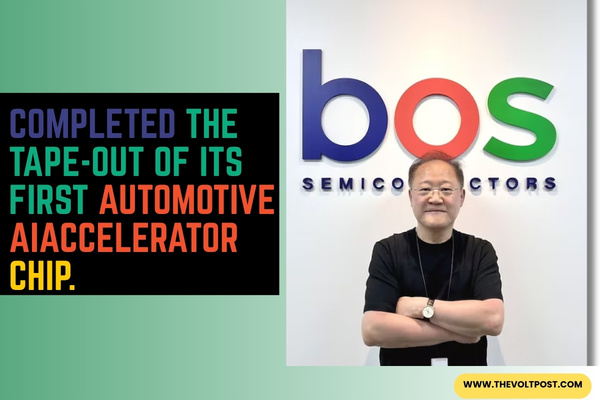
The company is led by Park Jae-hong, a former Samsung Electronics executive who previously held senior roles in the tech giant’s system chip division.
Park has built a team with deep experience in high-performance, safety-critical silicon, betting that automakers will need more specialized compute as cars become increasingly software-defined.
From design to first silicon
The tape-out, finished in early August 2026, means BOS has locked in the chip design and sent it to a foundry for initial manufacturing runs.
In semiconductor development, this step is followed by several months of prototyping, validation, and qualification before any volume production can begin.
Over the coming quarters, BOS will work with its manufacturing partner to produce first silicon and start lab testing.
The startup must also run extensive automotive-grade qualification, including temperature cycling, vibration tests, and functional safety assessments under standards such as ISO 26262.
If those steps go smoothly, the company could begin sampling chips to potential customers by late 2026 or early 2027, in line with typical industry timelines for similar programs.
Early adopters are expected to be Korean and other Asian automakers and suppliers already familiar with Park’s track record from his Samsung days.
Why automotive AI?
Car makers and tier-one suppliers are racing to pack more compute power inside vehicles as software-defined architectures become the norm.
Modern EVs and premium models already depend on powerful onboard computers to process data from cameras, radars, and lidars in real time.
BOS was founded to focus exclusively on AI processors for next-generation automobiles, covering everything from advanced driver-assistance systems to fully autonomous driving stacks.
Its accelerator is designed specifically for automotive workloads, where reliability, power efficiency, and compliance with safety standards matter as much as raw performance.
While the company has not disclosed detailed specifications, its positioning points to a focus on inference-heavy tasks such as object detection, path planning, and in-cabin AI features.
A crowded but expanding field
 BOS is entering a segment that already includes well-funded players such as Nvidia, Mobileye, Qualcomm, and a growing list of Chinese and European specialists.
Even so, demand for automotive AI compute is expanding quickly enough that multiple vendors can coexist, especially if they differentiate on power efficiency, cost, or integration with specific software stacks.
For South Korea, which has strong auto and display industries but lags in domestic AI chip designers, BOS represents a strategic bet on moving up the value chain.
Success would give Korean car makers a local source of advanced AI silicon and reduce reliance on foreign suppliers for critical components.
Concept to Real Hardware Development
The tape-out announcement signals that BOS Semiconductors is moving from a concept and hiring phase into real hardware development.
The next 12 to 18 months will be decisive, as the company proves its chip works in real vehicles and wins design-ins with major automakers.
If BOS Semiconductors can execute on validation and customer adoption, Park’s team could become one of the few homegrown success stories in automotive AI chips, and a test case for whether South Korea can build a competitive fabless AI semiconductor ecosystem around its existing strengths in manufacturing and mobility.
Source: BigGo Finance report on BOS Semiconductors’ automotive AI accelerator tape-out.