


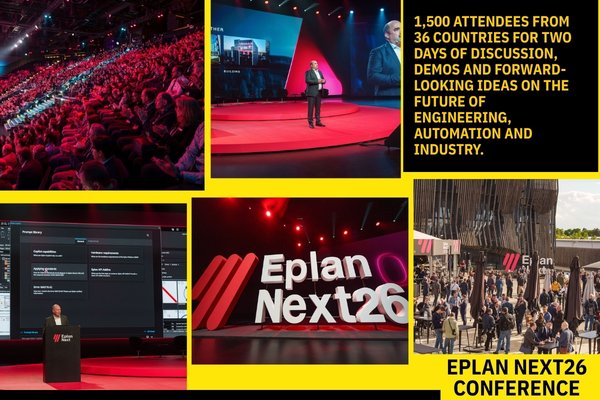
Eplan’s first Eplan Next26 conference in Munich brought together around 1,500 attendees from 36 countries for two days of discussion, demos and forward-looking ideas on the future of engineering, automation and industry. The event also marked the debut of Eplan Copilot and Eplan Smart Sourcing, while attendees got an early look at the upcoming Eplan Platform 2027.
The Eplan Next26 centered on a key question?
How will electrical engineering change in the years ahead, and what role will automation and artificial intelligence play in that transformation?
Those themes were explored through keynote sessions, panel discussions and expert presentations from Eplan, its partners, users and industry leaders.
Looking at the factory of tomorrow
Attendees heard directly from companies already shaping the future of industrial production. Leaders from DMG MORI, Eaton and Siemens shared how they are preparing for the next stage of automation and which tools they are already using to stay competitive.
Siemens Digital Industries COO for Automation Business and CTO Rainer Brehm spoke about the shift from rule-based automation to goal-based automation, describing it as the next major step forward. He pointed to end-to-end, AI-based Advanced Machine Engineering, which Siemens is developing with Eplan, as one example of that direction.
DMG MORI Group President and CEO Dr.-Ing. Masahiko Mori introduced the company’s “Machining Transformation” initiative and highlighted its collaboration with Eplan on digital twin development for control cabinet design.
Eaton Operations Director Power Distribution Systems China Andy Lee also shared insights from a highly automated control cabinet manufacturing facility in Changzhou, where the Eplan Platform supports electrical engineering and humanoid robots inspect the wiring.
A closer look at future tools
The Future Lab gave visitors a hands-on look at emerging technologies and practical applications for tomorrow’s engineering workflows. One highlight was an auto panel design tool that can generate a basic mounting panel layout directly from an initial bill of materials, helping teams quickly estimate costs and select the right enclosure during the bidding stage.
Another standout was a software-supported production workstation designed to help even less-experienced staff build control cabinets to a high and consistent quality standard.
The lab also covered Siemens Teamcenter integration and advanced machine engineering, showing how mechanical engineering, product data management and electrical control technology can work more closely together.
A preview of what’s next
Eplan used the event to preview the new Eplan Platform 2027, which has been shaped by around 500 customer requirements. The platform is being developed to speed up electrical engineering across three stages: preplanning, electrical engineering and control cabinet engineering.
The company also introduced Eplan Smart Sourcing, a new automated procurement solution that made its German debut at the event.
One of its key advantages is that engineers can already see during the design phase where the required parts are available and how quickly they can be sourced. During Master Classes, participants explored the latest software features along with topics such as control cabinet design, efficient machine cabling and digital product structuring.
Standardisation and collaboration
The Partner Plaza featured more than twenty companies, including ABB, Phoenix Contact, Rittal, Rockwell Automation, Siemens and Weidmüller, all presenting technologies aimed at making engineering simpler and more automated within the Eplan ecosystem.
A major theme throughout the exhibition was data consistency, which speakers said is essential for building a complete digital twin in engineering.
Several experts also pointed to the growing importance of the Asset Administration Shell as a standardised way to exchange data. The broader message was clear: the future of engineering will depend not just on better tools, but on better connection and collaboration across systems and teams.
A strong beginning
By the end of the event, Sebastian Seitz described the conference as a strong starting point and said the discussions made one thing clear that cooperation will be essential in solving the challenges ahead. He added that the technologies already exist, and the real task now is to integrate them consistently into everyday processes. Eplan is already looking ahead to continuing that conversation at Eplan Next27.
 Leadership Comments
Eplan CEO Sebastian Seitz set the tone in his opening address: “We are giving you a taste of what’s to come. Here at Eplan Next, we need to discuss one of the greatest challenges facing our shared industry, namely the digitisation of our entire value creation process.”
When presenting the new AI, which takes a different approach than many other industrial AI applications – in part due to its protecting of intellectual property – Seitz said: “Today we are launching out Eplan Copilot in the cloud environment.” He emphasised the importance of data security, the AI’s robust architecture, and the long-term goal of making workflows truly autonomous. “We need to contribute a great deal of knowledge and build the right skill sets into the AI, not just to automate processes, but also to autonomously control them. Our goal is to develop this technology so that it evolves from a copilot to a pilot.”
To Know More: CLICK HERE