



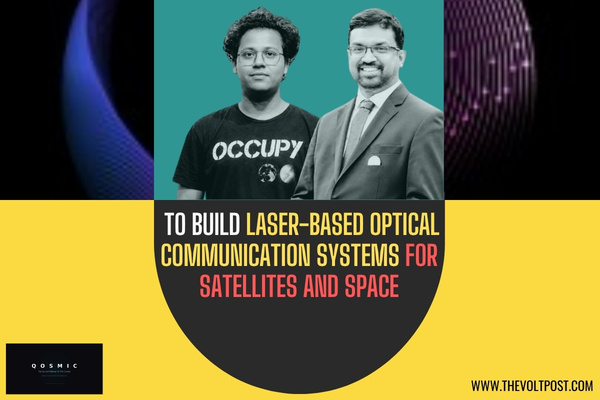
Bengaluru-based spacetech startup QOSMIC has raised $3.3 million in seed funding as it works to build laser-based optical communication systems for satellites and space infrastructure. The round was led by Accel and Prosus, with participation from South Park Commons, ARTPARK and angel investor Manish Jain.
Space’s next data layer
QOSMIC is focused on one of the biggest challenges in the growing space economy, moving far larger volumes of space data between satellites and Earth.
The company says conventional radio frequency links are reaching limits because of spectrum congestion, transmission windows and bandwidth constraints.
Its solution is an optical communication stack that uses lasers instead of RF to enable much faster data transfer.
According to the company, this could become a key part of the connectivity layer that supports orbital data centers, satellite networks and future space applications.
Fresh Boost to Scale Manufacturing
The fresh capital will help QOSMIC scale manufacturing, strengthen integration and testing, and expand its engineering team across optics, electronics and mechanical systems.
The startup, founded in 2025, says it has already advanced to TRL6 and successfully demonstrated its communication chain over a 10 km terrestrial link.
The company also plans to deploy optical ground stations and satellite communication terminals as it moves toward in orbit testing and commercial rollout.
That positions QOSMIC in a fast emerging segment of spacetech where hardware, photonics and advanced electronics are converging to solve a real infrastructure problem.
Industry significance
For the broader deeptech and electronics ecosystem, QOSMIC’s raise is another sign that space is becoming a serious engineering market, not just a launch market.
The shift from RF to optical links could open demand for precision  optics, high reliability electronics, thermal systems and advanced interconnects.
It also reflects rising investor confidence in startups building core infrastructure for the orbital economy, especially in India’s growing spacetech landscape. As satellites generate more data, the companies that solve transmission bottlenecks may become just as important as those building the satellites themselves.
References
Sources used for this article include Business Standard, Voice Lapaas, and related coverage from Indian Startup Times and Economic Times.