





IBM has signed a definitive agreement to acquire HRL Laboratories, a long-standing research and development institution jointly owned by Boeing and General Motors. While ownership will change, both Boeing and GM are expected to continue collaborating with IBM on quantum computing and advanced technology initiatives after the deal closes.
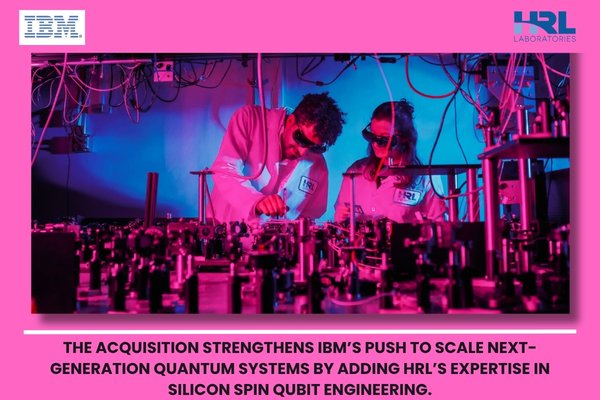
The acquisition strengthens IBM’s push to scale next-generation quantum systems by adding HRL’s expertise in silicon spin qubit engineering.
This complements IBM’s existing focus on superconducting qubits, with both approaches sharing a foundation in advanced silicon fabrication, an advantage seen as critical for scaling quantum technologies.
HRL’s capabilities extend beyond qubit design. The company has built a strong portfolio in quantum sensing, advanced materials, cryogenics, and high-performance electronics. These technologies are expected to support IBM’s broader quantum roadmap, particularly in areas such as ultra-precise sensing for life sciences, navigation, defense, and scientific research.
The deal also brings HRL’s work in novel quantum materials into IBM’s ecosystem, which could help unlock more efficient semiconductors and improve the sensitivity and scalability of quantum systems.
In addition, HRL’s decades of R&D across communications, advanced manufacturing, and electronics, serving both commercial and U.S. government customers will complement IBM’s efforts in next-generation computing and mission-critical technologies.
IBM continues to advance its quantum roadmap, centered on superconducting architectures and breakthroughs in error correction and algorithm efficiency. The company is targeting the launch of its IBM Quantum Starling system by 2029, which it says will be 20,000 times more powerful than current machines and capable of executing 100 million quantum operations. A follow-up system, Blue Jay, is planned for the mid-2030s with a projected capacity of 1 billion operations.
Looking further ahead, HRL’s silicon-based spin qubit expertise could provide IBM with additional pathways to scale quantum systems beyond the next decade.
The acquisition also aligns with IBM’s recent manufacturing push. In May 2026, the company announced plans to establish Anderon, a standalone quantum wafer foundry supported by the U.S. Department of Commerce. The facility is intended to enable scalable and flexible production for multiple quantum computing approaches. IBM expects HRL to play a role in advancing spin qubit manufacturing within this ecosystem, potentially accelerating development cycles across quantum platforms.
Financial terms of the deal have not been disclosed. The transaction remains subject to regulatory approvals and customary closing conditions, with completion expected by the end of the third quarter of 2026.
Leadership Comments
 “The HRL team will help IBM push even farther forward toward the frontiers of quantum innovation,” said Jay Gambetta, IBM’s Director of Research and IBM Fellow. “This talented group of researchers brings a broad portfolio of technologies that will strengthen IBM’s long-term plans to deliver useful quantum computing to the world, bringing together advances across quantum computing, quantum sensing, and quantum networking to enable the applications of the future.”
“Joining IBM is the natural next chapter for what we have built at HRL, where our team has dedicated years to exploring paths to how future quantum computers could be built at scales that today seem impossible,” said Rob Vasquez, President and Chief Executive Officer at HRL Laboratories. “We now look forward to leveraging IBM’s industry leadership and working alongside their world-class talent on fundamental infrastructure to take this vision forward. Additionally, our cutting-edge physical and information science innovations will combine with their advanced research capabilities to deliver an unmatched suite of technology solutions for our commercial and government customers.”
To Know More: CLICK HERE