



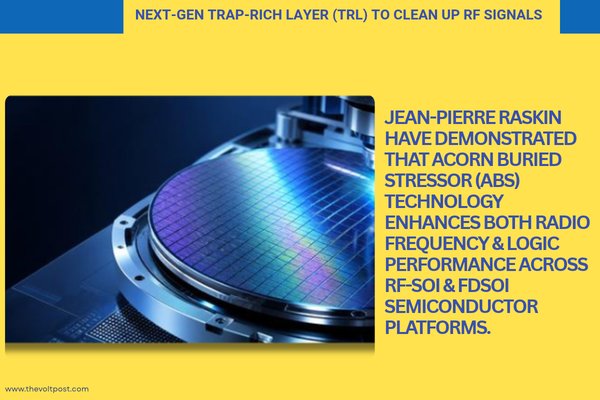
Acorn Technologies and Université catholique de Louvain professor Jean-Pierre Raskin have demonstrated that Acorn Buried Stressor (ABS) technology enhances both radio frequency and logic performance across RF-SOI and FDSOI semiconductor platforms.
The research confirms that an ultra-thin buried silicon-germanium layer serves a dual purpose inside silicon-on-insulator wafers.
Originally created to introduce beneficial silicon strain that accelerates FDSOI logic devices, the layer also operates as a next-generation trap-rich layer (TRL) to clean up RF signals. Professor Raskin originally pioneered the trap-rich substrate innovation that commercial RF-SOI wafers rely on today.
Conventional RF-SOI substrates depend on thick polysilicon trap-rich layers to stop parasitic surface conduction near the silicon and buried oxide boundary.
Without that barrier, wireless signals suffer from coupling loss, harmonic distortion, and weaker passive component behavior. By replacing conventional layers with an ultra-thin silicon-germanium structure, Acorn delivers comparable RF isolation alongside higher transistor drive current at a potentially lower manufacturing cost.
Characterization and modeling from the joint study highlight several gains for wireless, mmWave, 5G Advanced, and upcoming 6G chip designs:
- Simulated RF nFET peak transition frequency () climbed from 362 GHz to 442 GHz, while peak maximum oscillation frequency () rose from 385 GHz to 431 GHz.
- Estimated electron mobility in FDSOI devices increased by up to 50 percent, lifting both digital and RF figures of merit.
- Earlier physical measurements on advanced FDSOI devices incorporating ABS recorded a 10 percent jump in saturation current and a 17 percent boost in transconductance.
- Substrate testing verified lower harmonic distortion matching commercial trap-rich RF-SOI benchmarks.
- Structural analysis using Raman spectroscopy, TEM, PED, and XRD confirmed that built-in stress within the silicon-germanium layer survives high-temperature fabrication steps, including rapid thermal annealing at 1050°C.
As chipmakers look past simple geometric shrinking to squeeze greater power efficiency and RF integration out of each wafer, Acorn is actively exploring commercialization paths for ABS with foundry, wafer, and SOI ecosystem partners.
Leadership Comments
“These results show that ABS is far more than a logic-performance technology,” said Tom Horgan, CEO of Acorn. “ABS provides a potential path to extend FDSOI scaling by offering strain engineering in transistors while introducing a FDSOI-compatible trap-rich layer for improved RF-FDSOI circuit performance. ABS also offers the potential for a lower- cost, high-performance RF-SOI substrate that avoids the significant costs associated with a conventional polysilicon-based trap-rich layer. For foundries, wafer suppliers and SOI ecosystem partners, this creates a significant opportunity to advance RF and logic integration on SOI platforms.”
“Acorn’s buried stressor technology is significant because it combines two important materials-engineering mechanisms in SOI structures,” said Professor Raskin of UCLouvain. “What is especially surprising and innovative is how effectively an ultra-thin silicon-germanium layer can function as a trap-rich layer, while also preserving the strain-engineering benefit for FDSOI. This combination has strong potential for future RF-FDSOI and RF-SOI technology development.”
To Know More: CLICK HERE